
Cyclone Dust Collector for Cement & Bulk Material Handling
Centrifugal Pre-Separation for Coarse, Abrasive and High-Dust-Loading Applications
What Is a Cyclone Dust Collector?
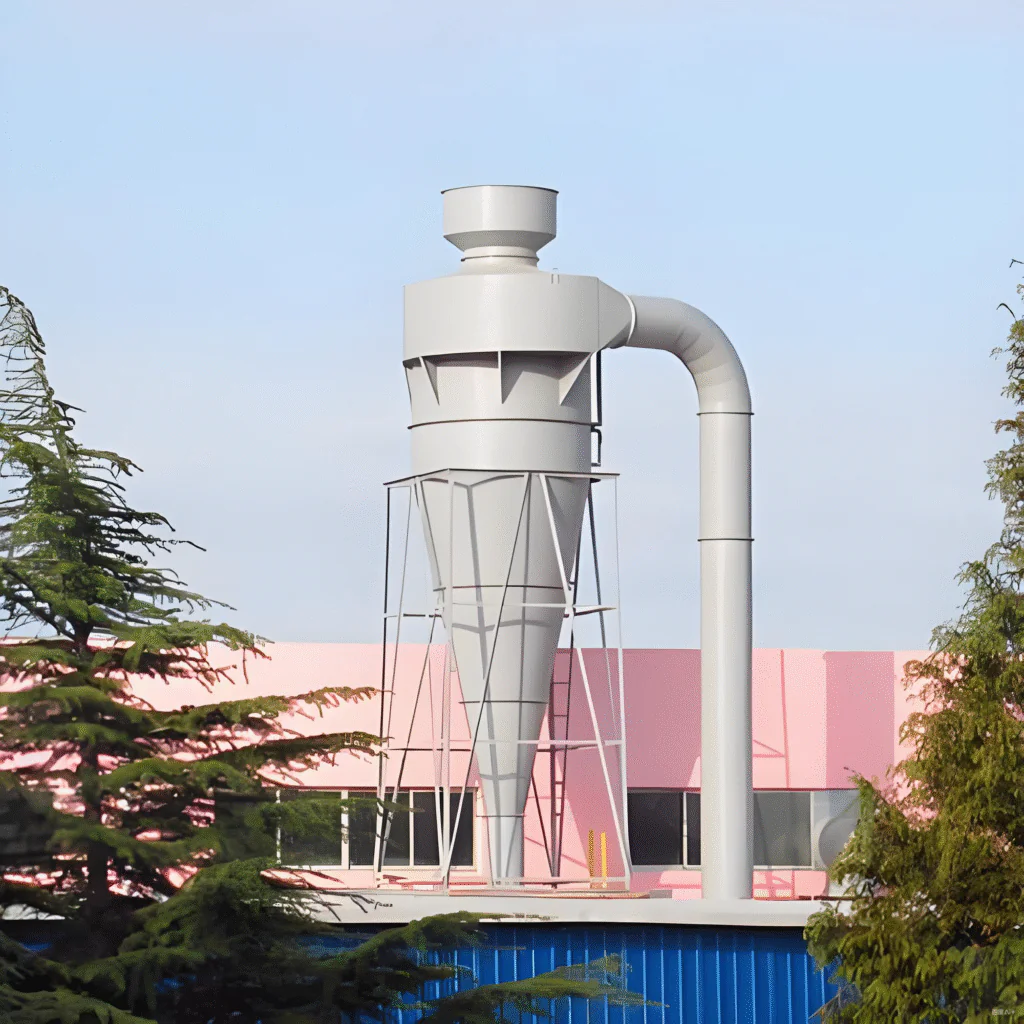
A cyclone dust collector is a mechanical dust separation device that uses centrifugal and inertial forces to remove particulate matter from a dust-laden gas stream without filter bags or filter cartridges.
Dust-laden air enters the cyclone tangentially and forms a rotating vortex. Particles with sufficient size and density move toward the outer wall, lose momentum and fall into the lower hopper, while the remaining gas exits through the central outlet.
In cement plants and bulk material handling systems, cyclone separators are commonly used for coarse or abrasive dust separation, product recovery, or as a pre-cleaning stage before downstream bag filters or other filtration equipment. In many applications, the cyclone is integrated into a complete dust collection system.
The actual collection efficiency depends on particle size and density, airflow, inlet velocity, cyclone geometry, pressure drop and operating conditions.
Key Features
✅ No Filter Media Required
Uses centrifugal and inertial forces instead of filter bags or cartridges.
✅ Suitable for Coarse and Abrasive Dust
Suitable where larger or abrasive particles need to be separated from the gas stream.
✅ Handles High Dust Loading
Can reduce particulate loading before downstream filtration equipment.
✅ Simple Mechanical Structure
Contains no internal moving separation elements, simplifying routine maintenance.
✅ Wear-Resistant Construction Options
Carbon steel, stainless steel or wear-resistant lining can be selected according to operating conditions.
✅ Suitable for Pre-Separation
Can be installed before bag filters or other final filtration equipment.
How Does a Cyclone Dust Collector Work?
A cyclone dust collector separates particles by creating a high-velocity rotating airflow inside the cylindrical and conical body.
Typical operation includes:
✅ Dust-laden gas enters the cyclone tangentially.
✅ The gas stream forms a downward rotating outer vortex.
✅ Centrifugal and inertial forces move heavier particles toward the cyclone wall.
✅ Separated particles move downward into the hopper.
✅ The gas reverses direction and exits through the central outlet tube.
✅ Collected dust is discharged through the lower outlet or a suitable dust-handling device.
Cyclone performance is strongly influenced by particle size and density, gas velocity, cyclone geometry, pressure drop, internal condition and air leakage at the dust outlet. In general, larger or denser particles are easier to separate than very fine particles. For more technical background, see the U.S. EPA cyclone control technology guidance.
Main Components of a Cyclone Dust Collector
✅ Tangential Inlet
Introduces dust-laden gas and creates the rotating airflow.
✅ Cylindrical Body
Forms the main upper separation chamber.
✅ Conical Section
Guides separated particles downward toward the dust outlet.
✅ Vortex Finder / Outlet Tube
Allows the remaining gas stream to exit through the upper central outlet.
✅ Dust Hopper or Outlet
Collects separated particles before downstream discharge.
✅ Support Structure and Connections
Includes supports, flanges, inspection points and optional wear-protection components.
Cyclone Dust Collector or Bag Filter?
A cyclone dust collector and a bag filter perform different separation functions. A cyclone dust collector uses centrifugal and inertial forces and is mainly suited to coarse, dense or abrasive particles, particularly where pre-separation is required. A bag filter uses fabric filtration and is generally selected for finer particulate removal and final dust filtration.
In many cement and bulk material handling systems, both can be used together:
Dust source → Cyclone pre-separator → Bag filter → Fan / clean-air outlet
The cyclone reduces coarse-particle loading, while the bag filter provides the finer filtration stage. For centralized fine-dust filtration, see our Bag Filter for Cement Plant Dust Collection.
Typical Applications
Cyclone dust collectors are commonly considered where the dust stream contains a meaningful proportion of coarse, dense or abrasive particles.
Typical applications include:
✅ Cement raw material and clinker dust pre-separation
✅ Limestone and mineral powder processing
✅ Crushing and screening dust recovery
✅ Mill or process exhaust pre-cleaning
✅ High-dust-loading conveying and transfer systems
✅ Product recovery from suitable powder processes
✅ Pre-separation before bag filters or other final filtration equipment
Cyclone selection should be based on the actual particle-size distribution, dust density, airflow and process temperature rather than material name alone.
Cyclone Dust Collector Design & Selection Factors
Cyclone performance depends on the complete operating condition. Before selection, confirm:
✅ Required airflow or gas volume
✅ Particle-size distribution
✅ Dust bulk and particle density
✅ Inlet dust concentration
✅ Gas temperature
✅ Moisture and stickiness
✅ Dust abrasiveness
✅ Allowable pressure drop
✅ Required separation objective
✅ Upstream and downstream equipment
✅ Dust discharge arrangement
✅ Available installation space
For applications requiring capture points, ducting, fans and final filtration equipment, see our industrial dust control system solutions.
Is a Cyclone Suitable for Fine Dust?
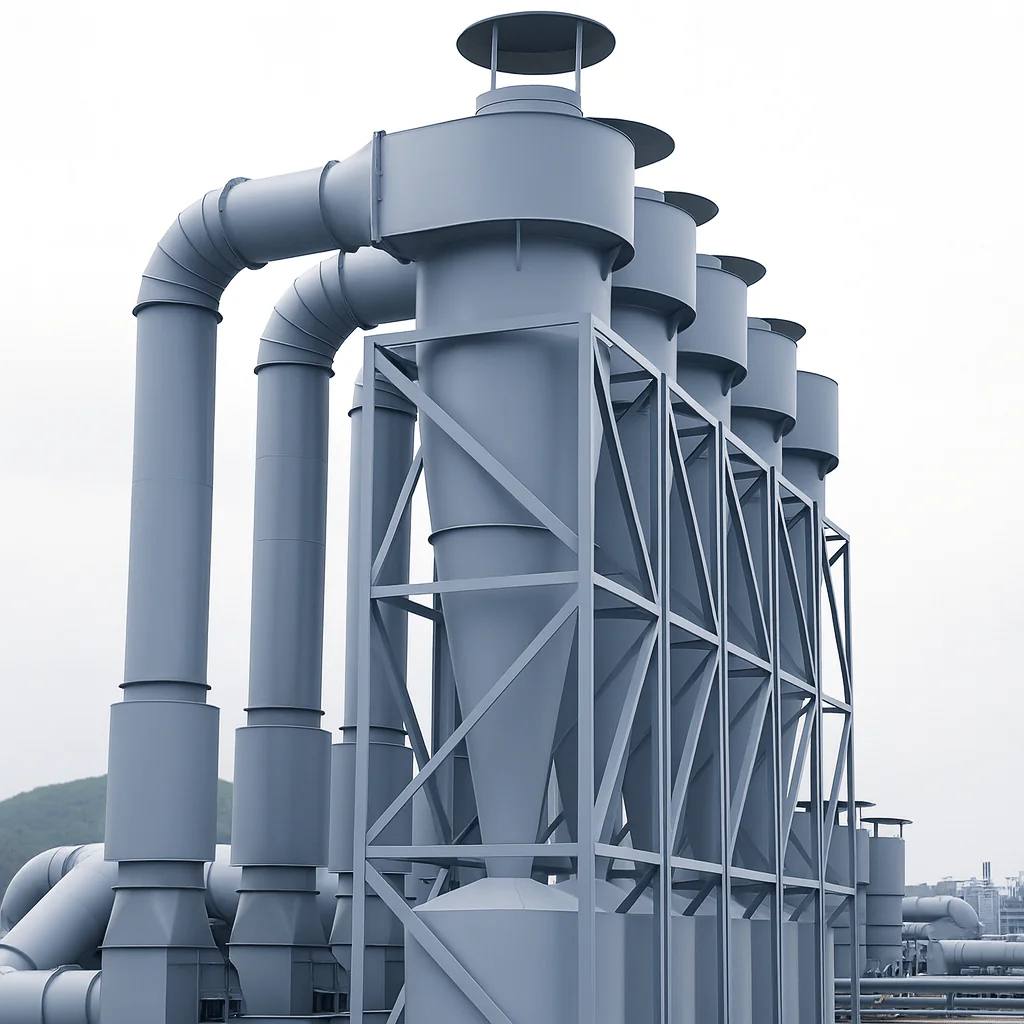
Cyclone dust collectors can remove a portion of fine particulate, but collection efficiency generally decreases as particle size becomes smaller.
Where very fine dust or low outlet particulate concentration is required, a cyclone is usually used as a pre-separator rather than the only final filtration device.
Depending on the operating conditions, a bag filter, pulse jet dust collector, or cartridge dust collector may be required for final fine-dust filtration.
Inspection and Maintenance
Cyclone dust collectors require relatively limited routine maintenance because they contain no filter media or internal moving separation elements.
Periodic inspection should include:
✅ Wall erosion in abrasive applications
✅ Dust buildup or plugging
✅ Air leakage at the hopper or outlet
✅ Wear around the inlet and cone
✅ Flange and duct leakage
✅ Hopper discharge condition
✅ Abnormal pressure-drop changes
For abrasive materials, wear-resistant liners may be considered in high-wear areas.
Cyclone Dust Collector FAQs
What is a cyclone dust collector?
A cyclone dust collector is a mechanical separator that uses centrifugal and inertial forces to remove particles from a dust-laden gas stream without filter bags or cartridges.
What particle sizes can a cyclone dust collector remove?
Performance depends on cyclone design and operating conditions, but cyclones generally collect larger particles more efficiently than very fine particles. Particle-size distribution should be confirmed during selection.
Can a cyclone dust collector replace a bag filter?
Not in every application. Cyclones are often used for coarse-particle removal or pre-separation, while bag filters provide finer filtration where lower outlet dust concentration is required.
Can a cyclone handle abrasive dust?
Yes, cyclones are commonly considered for abrasive particulate applications, provided the body material, wall thickness and wear protection are selected for the expected operating conditions.
Can a cyclone be used at high temperature?
Cyclone separators do not rely on fabric filter media, so they can be suitable for elevated-temperature gas streams when the construction material, expansion allowance and connected equipment are designed for the actual temperature.
What information is required to select a cyclone dust collector?
Provide airflow, particle-size distribution, dust density, inlet concentration, gas temperature, moisture, abrasiveness, allowable pressure drop, required separation objective and downstream equipment.
Request a Customized Cyclone Dust Collector
Send LVRUI your dust or material data, required airflow, particle size information, gas temperature, abrasiveness, upstream and downstream equipment, and available installation space. We will recommend a suitable cyclone size, inlet arrangement, construction material, and system configuration.
✅ Stand-alone or pre-separator configuration
✅ Carbon steel, stainless steel or wear-resistant construction
✅ Customized inlet, outlet and hopper dimensions
✅ Technical drawings and system integration support