
Lump Breaker for Cement Silo and Dry Bulk Powder Handling
Low-Speed Single- or Twin-Shaft Deagglomeration Before Conveyors, Valves and Loading Systems
What Is a Lump Breaker?
A lump breaker is a low-speed size-reduction machine used to break compacted or agglomerated dry bulk material before it enters downstream conveying, feeding, valve or loading equipment.
It is typically installed beneath a silo or hopper, or at a material transfer point where oversized lumps may block the outlet, restrict powder flow or overload downstream equipment. The machine reduces the lumps to a more manageable size so that the material can continue through the handling system.
LVRUI supplies single- and twin-shaft lump breakers for cement, fly ash, lime powder, gypsum powder, mineral powder and other compatible dry bulk materials. A lump breaker is intended to restore material flow and limit blockage; it is not a fine grinding mill and should not be treated as the only solution for severe bridging inside an entire silo.
Key Features
✅ Low-Speed Lump Breaking
Breaks friable agglomerates without operating as an aggressive fine crusher.
✅ Single- or Twin-Shaft Design
The shaft arrangement is selected according to lump size, material condition, required capacity and available space.
✅ Individually Replaceable Wear Blades
Each breaking blade can be removed and replaced separately without replacing the complete shaft assembly.
✅ Flexible Installation Configuration
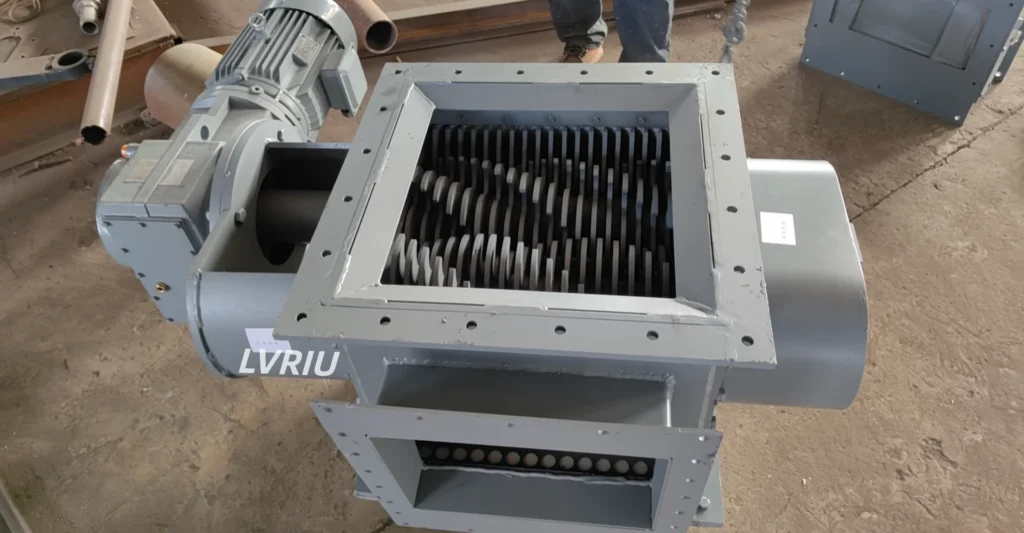
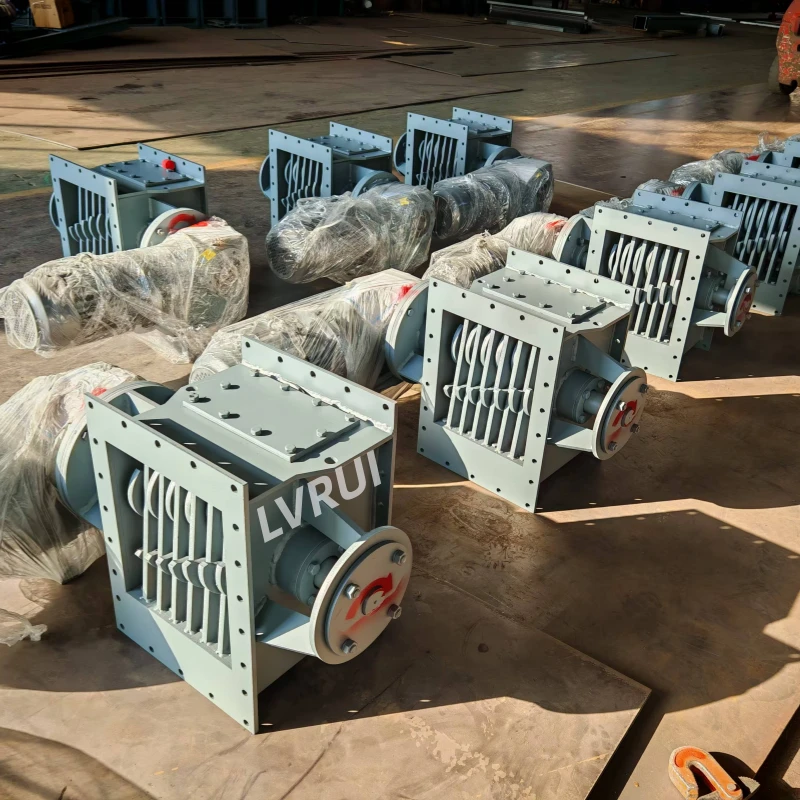
Available for horizontal or vertical installation, with top inlet–bottom outlet, top inlet–side outlet, or horizontal inlet-and-outlet arrangements.
✅ Customized Equipment Interfaces
Inlet, outlet, flange and supporting dimensions are matched with the upstream and downstream equipment.
✅ Local or Interlocked Control
The motor can operate through local control or be interlocked with the complete material-handling system.
How Does a Lump Breaker Work?
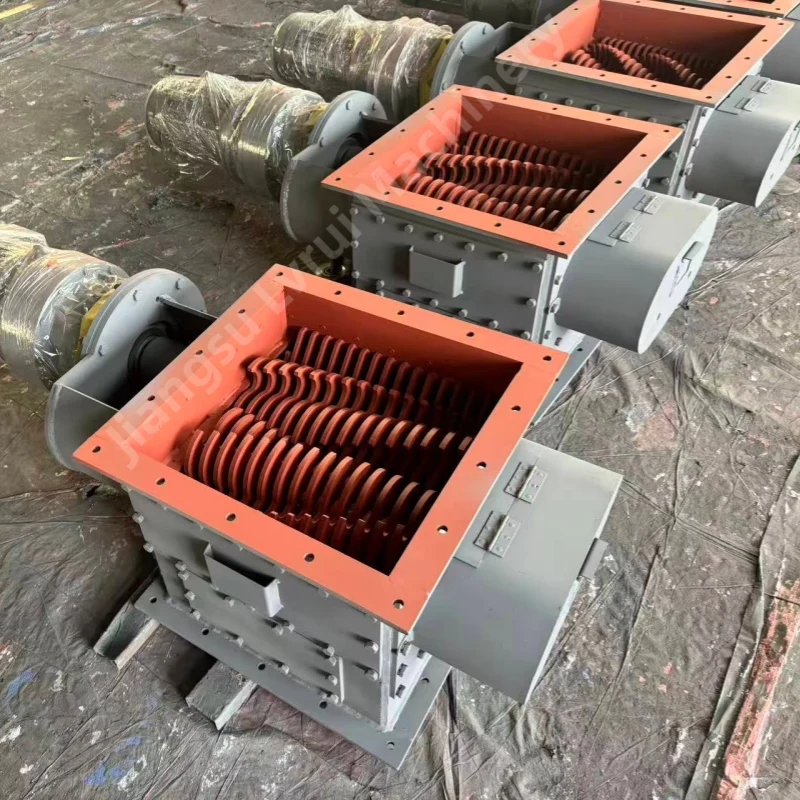
A lump breaker uses one or two low-speed rotating shafts fitted with breaking blades. As agglomerated material enters the housing, the blades pull, shear and compress the lumps before the reduced material passes into the downstream equipment. The breaking result depends on the material hardness, moisture, lump size, shaft configuration, blade clearance and rotor speed. A lump breaker is used to reduce agglomerates and restore material flow rather than guarantee a fixed discharge particle size.
For cement powder applications, the typical clearance between breaking blades is approximately 5–6 mm. Most loosely agglomerated cement lumps are relatively easy to break, while lumps hardened by prolonged storage may require greater breaking force. Blade arrangement can be adjusted according to the required lump reduction and processing capacity. A denser blade arrangement generally reduces throughput.
Suitable Materials and Applications
Before opening the inspection cover or replacing blades, isolate the power supply and follow the applicable site lockout/tagout procedure. For general reference, see the OSHA control of hazardous energy requirements.
LVRUI lump breakers are used for cement powder, fly ash, lime powder, gypsum powder, limestone powder, mineral powder, slag powder, dry mortar materials and other compatible dry bulk solids that may form agglomerates during storage or discharge.
Typical installation positions include:
✅ Beneath cement silos and storage hoppers
✅ Before flow control gates, screw conveyors or air slide conveyors
✅ Before rotary valves, feeders or bulk loading systems
✅ At dry powder transfer points
The equipment helps reduce the risk of hardened lumps obstructing downstream equipment. Wet, sticky, fibrous, very hard or highly abrasive materials require separate evaluation.
A lump breaker can process material that reaches its inlet, but it is not the only solution for severe bridging or dead zones inside a silo.
Typical Construction and Configuration
| Item | Typical Configuration |
|---|---|
| Equipment Type | Low-speed lump breaker |
| Shaft Arrangement | Single shaft or twin shaft |
| Installation Orientation | Horizontal or vertical |
| Material-Flow Arrangement | Top inlet–bottom outlet, top inlet–side outlet, or horizontal inlet and outlet |
| Drive Type | Electric motor with gearbox |
| Breaking Components | Individually replaceable wear blades |
| Blade Material | Wear-resistant steel or material selected for the application |
| Housing Material | Fabricated carbon steel or project-specific material |
| Inlet and Outlet | Customized according to project interfaces |
| Control Mode | Local control or system interlock |
| Inspection Access | Removable or bolted inspection cover |
| Power Supply | According to destination-site requirements |
The final shaft arrangement, motor power, blade quantity, housing orientation and flange dimensions are confirmed according to the material data and approved production drawing.
Reference Model Specifications
| Model | Capacity | Max Feed Size | Output Size | Motor Power |
|---|---|---|---|---|
| LRB400 | Up to 100 t/h | ≤300 mm | ≤20 mm | 4–5.5 kW |
| LRB500 | Up to 200 t/h | ≤400 mm | ≤20 mm | 5.5–7.5 kW |
| LRB600 | Up to 300 t/h | ≤500 mm | ≤20 mm | 7.5–15 kW |
Based on practical experience with cement powder lumps, the typical discharge lump size is ≤20 mm under suitable operating conditions. Actual results depend on lump hardness, blade configuration, feed rate, and material characteristics. Some larger fragments may pass through, so this value should not be treated as a guaranteed maximum particle size. Closer blade spacing generally improves lump reduction but may reduce throughput.
Single-Shaft vs Twin-Shaft Lump Breaker
| Comparison | Single-Shaft Design | Twin-Shaft Design |
|---|---|---|
| Shaft Arrangement | One rotating shaft | Two coordinated rotating shafts |
| Typical Duty | Lighter agglomerates or lower-capacity duties | Larger lumps or higher-capacity duties |
| Breaking Action | Material breaks against blades or fixed elements | Material is pulled and broken between two shafts |
| Structure | Simpler and more compact | Stronger material intake |
| Blade Maintenance | Individual blades replaceable | Individual blades replaceable |
A twin-shaft lump breaker is not automatically better for every application. Selection should be based on the actual lump condition, required capacity, installation space and material-flow arrangement.
Lump Breaker vs Crusher
| Comparison | Lump Breaker | Crusher |
|---|---|---|
| Main Purpose | Break agglomerates and restore material flow | Provide stronger particle-size reduction |
| Typical Feed | Friable or compacted lumps | Harder or larger solid materials |
| Operating Style | Usually low-speed breaking | Stronger impact, compression or crushing action |
| Typical Position | Before conveyors, valves, feeders or loading systems | Dedicated crushing stage |
Choose a lump breaker when the main problem is material agglomeration, silo outlet blockage or oversized lumps entering downstream equipment. Choose a crusher when the process requires stronger or more controlled particle-size reduction.
How to Select a Lump Breaker
Please provide:
✅ Material name, bulk density and moisture
✅ Material temperature
✅ Maximum lump size and approximate hardness
✅ Required discharge capacity
✅ Required or acceptable discharge size
✅ Silo or hopper outlet dimensions
✅ Required installation orientation and inlet/outlet arrangement
✅ Available installation and maintenance space
✅ Power supply and control requirements
✅ Site layout or equipment arrangement drawing
The shaft arrangement, motor power, blade profile, blade quantity and housing configuration must be selected according to the actual operating conditions rather than model number alone.
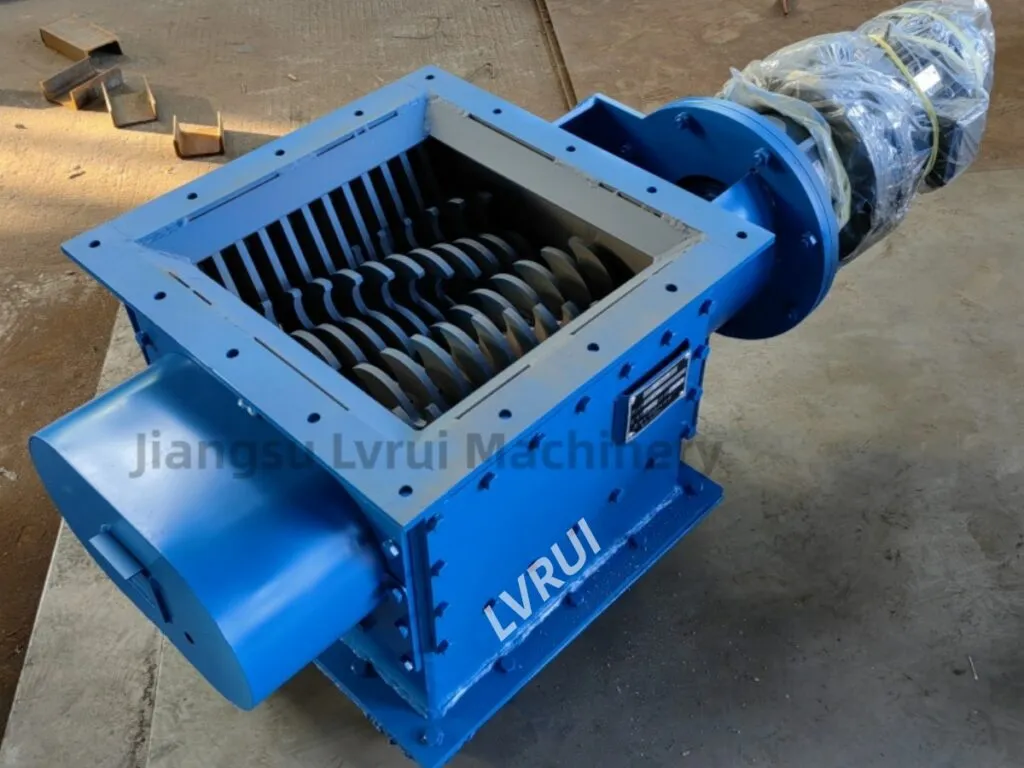
Real Project Reference: LVRUI supplied a cement silo bottom lump breaker for West China Cement in Tongchuan, Shaanxi, China. The equipment was designed to break agglomerated cement before downstream discharge. View the West China Cement Lump Breaker Project →
For site preparation, alignment, control sequence and commissioning checks, see our lump breaker installation guide.
Manufacturing and Inspection
LVRUI manufactures each lump breaker according to the confirmed material data, interface dimensions and approved production drawing.
Before shipment, the main checks include:
✅ Housing, flange, inlet and outlet dimensions
✅ Shaft, bearings and replaceable blade installation
✅ Blade clearance, rotor movement and rotation direction
✅ Motor, gearbox and inspection-cover arrangement
✅ Surface coating, marking and packing
The equipment may be test-operated without load before shipment. Final performance should be verified with the actual material after installation.
LVRUI provides technical drawings, installation instructions and remote technical guidance.
Lump Breaker FAQs
What is a lump breaker used for?
A lump breaker reduces compacted or agglomerated dry bulk material before it enters downstream conveyors, valves, feeders or loading equipment.
Can a lump breaker be installed horizontally or vertically?
Yes. LVRUI lump breakers can be configured for horizontal or vertical installation. Available material-flow arrangements include top inlet with bottom outlet, top inlet with side outlet, and horizontal inlet with horizontal outlet.
Can the breaking blades be replaced individually?
Yes. Each blade is an independently replaceable wear part. Worn or damaged blades can be changed without replacing the complete shaft assembly.
Can a lump breaker solve silo bridging?
It can break lumps that reach the silo outlet or lump breaker inlet, but it cannot completely solve severe bridging or dead material zones inside the entire silo. Other flow-aid equipment may also need to be evaluated.
What is the difference between a lump breaker and a crusher?
A lump breaker mainly breaks friable agglomerates and restores material flow. A crusher is generally selected when stronger particle-size reduction is required.
What information is required for a quotation?
Please provide the material, bulk density, moisture, maximum lump size, required capacity, inlet and outlet dimensions, installation orientation, downstream equipment, power supply and site drawing.
Request a Customized Lump Breaker
Send LVRUI your material data, maximum lump size, required capacity, silo outlet dimensions and equipment arrangement drawing. We will recommend a suitable shaft configuration, blade design, drive and interface dimensions.
✅ Single- or twin-shaft configuration
✅ Horizontal or vertical installation
✅ Customized inlet and outlet arrangements
✅ Individually replaceable wear blades