
90 Degree Bag Transfer Conveyor for Cement Packing Lines
Motorized Pivoting Belt Unit for Right-Angle Transfer Between Belt Conveyors
What Is a 90 Degree Bag Transfer Conveyor?
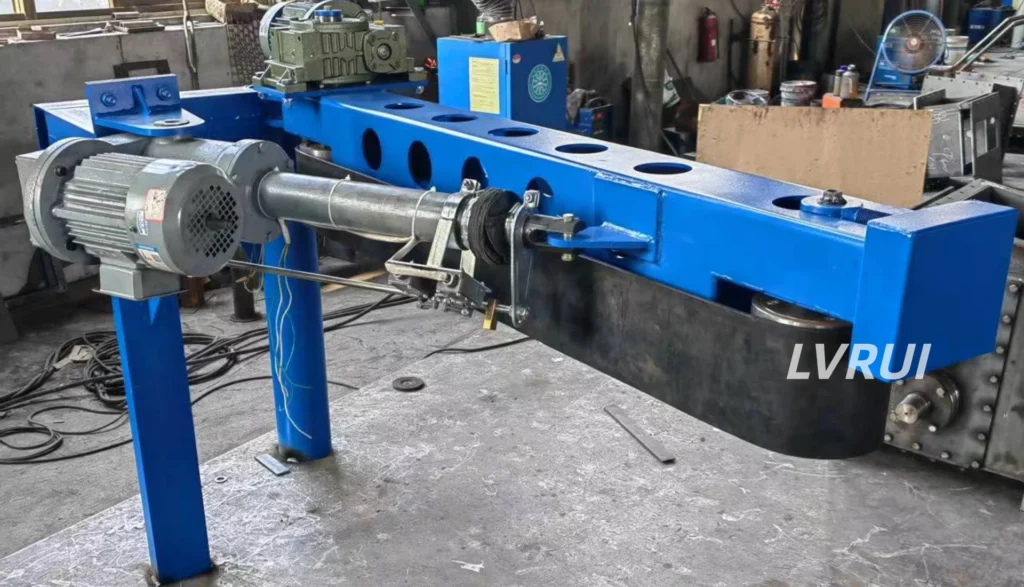
A 90 degree bag transfer conveyor is an auxiliary bag-handling device installed between two belt conveyors arranged at right angles. It uses an independently driven belt mounted on a pivoting frame to transfer flat filled bags from the incoming conveyor to the outgoing conveyor.
The pivoting frame is moved by an electric linear actuator or pneumatic cylinder. The equipment changes the conveying direction by 90 degrees without flipping, laying down or pushing the bag sideways.
Key Features
✅ 90-Degree Direction Change
Transfers filled bags between upstream and downstream belt conveyors arranged at right angles.
✅ Powered Transfer Belt
The turning unit has its own motor-driven belt to support and transfer the bag during the operating cycle.
✅ Electric or Pneumatic Pivoting
The movable belt frame can be actuated by an electric linear actuator or pneumatic cylinder.
✅ Flat Bag Transfer
The equipment redirects bags that are already lying flat without functioning as a bag laydown or bag-flipping machine.
✅ Packing-Line Interlock
Sensors, limit switches and control signals can coordinate the transfer unit with the upstream and downstream conveyors.
✅ Customized Interface Dimensions
Belt width, inlet height, outlet height, turning direction and supporting structure are confirmed according to the actual conveyor layout.
How Does a 90 Degree Bag Transfer Conveyor Work?
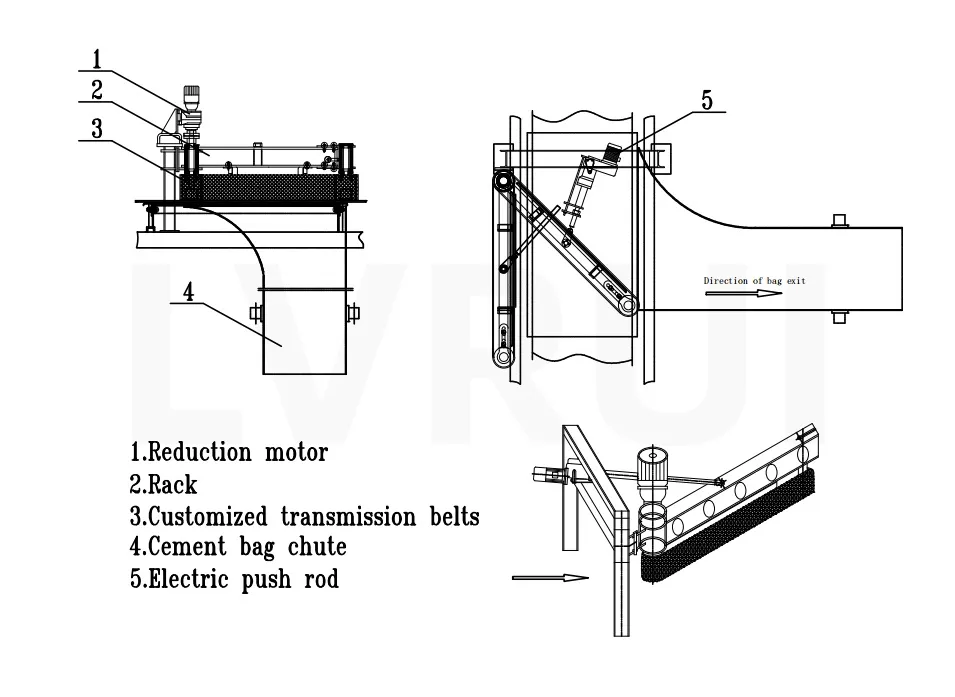
The turning mechanism is installed at the junction of two belt conveyors arranged at right angles. Throughout the turning process, the filled bag remains flat and is continuously supported by the conveyor belt.
Before the bag enters the turning area, an electric linear actuator or pneumatic cylinder moves the motor-driven turning belt into its operating position. As the bag moves forward, the running turning belt contacts the side of the bag and guides it toward the perpendicular downstream conveyor.
The coordinated movement of the main conveyor and the turning belt changes the conveying direction of the bag by 90 degrees. The bag is not lifted, flipped or changed from an upright to a flat position.
Main Components
| Component | Function |
|---|---|
| Geared Motor | Drives the transfer belt |
| Powered Transfer Belt | Receives and transfers the filled bag |
| Pivoting Frame and Support | Moves and supports the belt mechanism |
| Electric Linear Actuator or Pneumatic Cylinder | Changes the position of the pivoting frame |
| Bag Guide and Transfer Interface | Guides the bag between the connected conveyors |
| Sensors and Control Interface | Confirms position and coordinates the transfer cycle |
Suitable Bags and Applications
Suitable Bags
✅ Cement valve bags
✅ Dry mortar and gypsum powder bags
✅ Lime and mineral powder bags
✅ Paper or woven polypropylene bags
✅ Other compatible filled industrial bags
For dust generated during downstream truck loading, conveyor discharge or manual bag stacking, see our guide to mobile dust collection for bagged cement.
Typical Applications
✅ Transfer between cement packing and palletizing conveyors
✅ Direction change before bag counting or accumulation
✅ Connection between conveyors in limited workshop space
✅ Existing bag-conveyor line modifications
✅ Dry mortar and mineral powder bagging systems
The inlet height, outlet height, conveyor speed and bag spacing must be coordinated with the complete conveying line.
Where cement dust is generated at fixed packing or bag-transfer points, the line can be connected to a suitable dust collection system.
90 Degree Bag Transfer Conveyor vs Other Bag-Handling Equipment
| Equipment | Main Function | Bag Condition | Operating Method |
|---|---|---|---|
| 90 Degree Bag Transfer Conveyor | Changes the conveying route by 90 degrees | Bag remains flat | Powered pivoting belt |
| Bag Turner Conveyor | Lays down or corrects the orientation of an upright bag | Bag position or orientation changes | Turning arm, guide or special conveyor |
| Bag Kicker Conveyor | Pushes a bag sideways onto another conveyor | Usually remains flat | Pneumatic or mechanical pushing arm |
| Powered Curve Conveyor | Carries bags through a fixed curved route | Bag follows the curved belt | Fixed curved conveyor structure |
Select a 90 degree bag transfer conveyor when a powered movable belt is required to transfer flat bags between two conveyors arranged at right angles.
Typical Technical Configuration
| Parameter | Typical Configuration |
|---|---|
| Belt Drive | Independent geared motor |
| Pivoting Actuator | Electric linear actuator or pneumatic cylinder |
| Transfer Belt Width | Customized according to filled bag dimensions |
| Equipment Height | Matched with connected conveyors |
| Frame Material | Fabricated carbon steel |
| Bag Guide | Fixed or adjustable |
| Control Mode | Local control or conveyor-line interlock with optional PLC signals |
| Position Detection | Limit switches or sensors |
| Turning Direction | Confirmed according to the site layout |
| Power Supply | According to destination-site requirements |
Actual operating frequency depends on bag spacing, actuator cycle, belt speed and packing-line capacity.
How to Select a 90 Degree Bag Transfer Conveyor
Please provide:
✅ Filled bag dimensions, weight
✅ Upstream and downstream conveyor widths
✅ Incoming and outgoing conveying directions
✅ Preferred electric actuator or pneumatic cylinder
✅ Power supply, compressed air and control-interface requirements
Manufacturing and Pre-Shipment Inspection
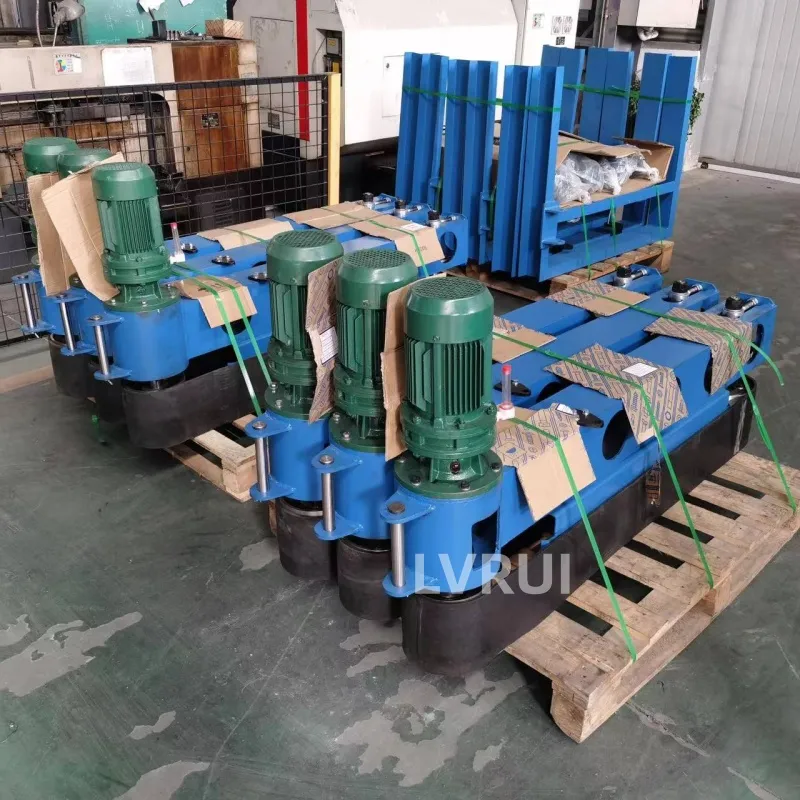
LVRUI manufactures each unit according to the confirmed bag data, conveyor interfaces and approved production drawing.
Before shipment, the main checks include:
✅ Frame and interface dimensions
✅ Transfer-belt direction and tracking
✅ Motor installation and rotation direction
✅ Pivoting movement and actuator stroke
✅ Limit switches and control-signal response
The equipment may be test-operated without load before shipment. Final transfer performance should be verified after installation using the actual filled bags and complete conveyor line.
LVRUI provides technical drawings, installation instructions and remote technical guidance.
Guards, sensors and emergency-stop arrangements should be designed according to the final installation layout and applicable local safety requirements. For general reference, see OSHA’s machine-guarding requirements.
90 Degree Bag Transfer Conveyor FAQs
What is a 90 degree bag transfer conveyor used for?
It is used to transfer flat filled bags between two belt conveyors arranged at right angles. It is commonly installed in cement packing and palletizing lines where the conveyor route must change direction.
Does the equipment flip or lay down the cement bag?
No. The filled bag is already lying flat before entering the transfer unit. The mechanism changes the conveying route but does not function as a bag flipper or bag laydown conveyor.
What drives the turning mechanism?
The transfer belt is driven by a geared motor. The pivoting frame can be moved by an electric linear actuator or pneumatic cylinder.
How is it different from a bag kicker conveyor?
A bag kicker normally pushes the bag sideways using an arm or plate. A 90 degree bag transfer conveyor receives the bag on a powered belt and moves the entire belt mechanism toward the outgoing conveyor.
What bag sizes can the conveyor handle?
The structure is customized according to the actual filled bag length, width, thickness, weight and surface material. LVRUI does not select the model from nominal bag weight alone.
What information is required for a quotation?
Please provide the filled bag dimensions, bag weight, required bags per minute, conveyor widths, inlet and outlet heights, turning direction, actuator preference, power supply and site layout.
Need Help Selecting a 90 Degree Bag Transfer Conveyor
Send LVRUI your bag dimensions, bag weight, required conveying capacity, conveyor height and packing-line layout.LVRUI will confirm the belt width, transfer mechanism, actuator type and connection dimensions according to your existing conveyor line.
✅ Electric actuator or pneumatic cylinder options
✅ Customized belt width and conveyor height
✅ 90° bag transfer matched to the existing conveying direction
✅ Connection dimensions configured for upstream and downstream conveyors