
Clamshell Gate for Bulk Material Discharge
Synchronized Dual-Blade Gate for Silos, Hoppers and Loading Bins
What Is a Clamshell Gate?
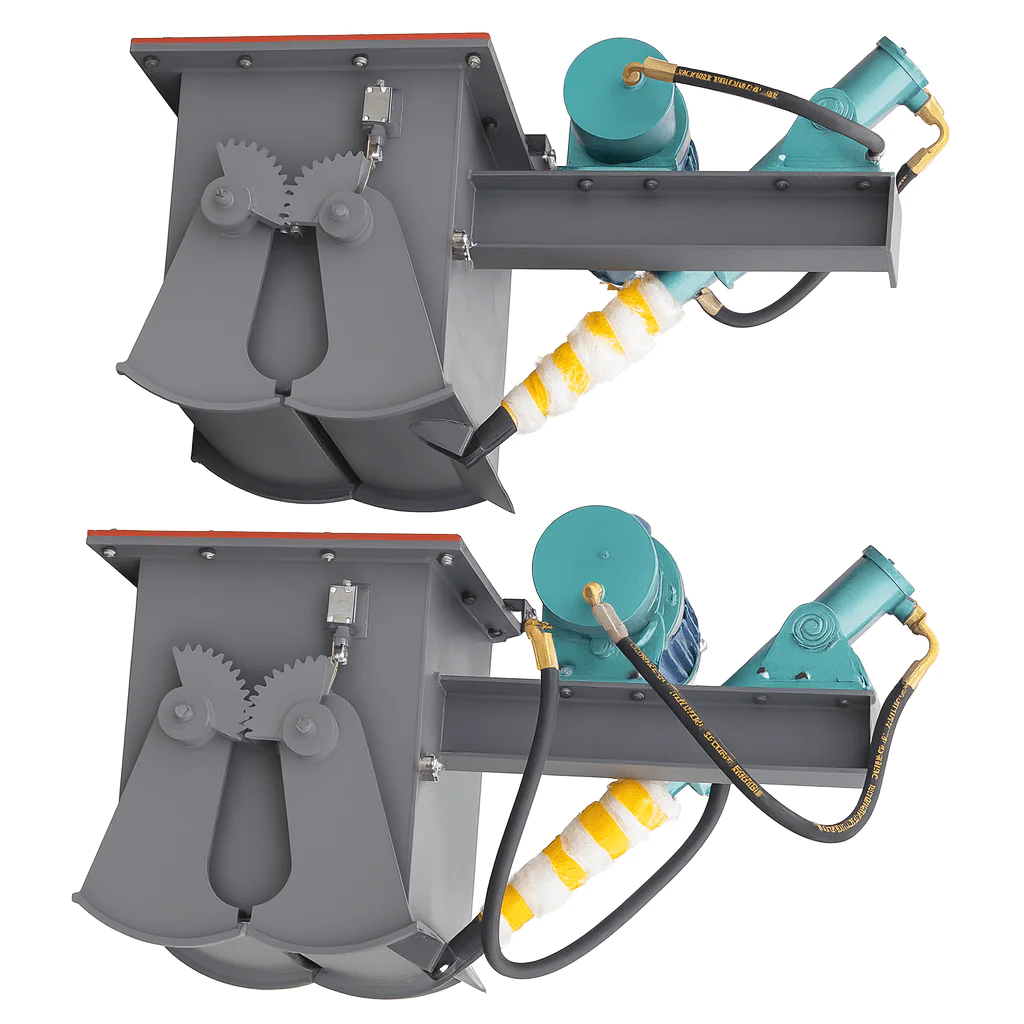
The LVRUI clamshell gate is a heavy-duty bulk material discharge gate with two opposing curved blades synchronized by external gears. Also called a clamshell gate valve or dual-blade clamshell gate, it is installed beneath silos, hoppers, bunkers and loading bins to control the gravity discharge of clinker, aggregate, limestone, coke, ore and other granular or moderately lumpy bulk solids. The gate can be operated by an electro-hydraulic actuator or pneumatic cylinders according to the gate size, material load, operating frequency and available plant utilities.
Key Features
✅ Synchronized dual blades
External gears keep both curved blades moving together for a balanced central opening.
✅ Flexible drive and control
Electro-hydraulic or pneumatic operation is available, with optional partial positioning for coarse flow adjustment.
✅ Clear discharge passage
The blades move away from the main flow path when fully opened, reducing obstruction to coarse materials.
✅ Heavy-duty construction
Wear-resistant blades and liners are available for clinker, aggregate, coke, ore and other abrasive bulk solids.
✅ Customized design
Opening dimensions, flanges, actuator stroke and installation direction are manufactured according to the approved drawing.
How Does an Electro-Hydraulic Clamshell Gate Work?
A clamshell gate uses two curved blades mounted on opposite shafts and synchronized by external gears. An electro-hydraulic actuator or pneumatic cylinder drives the linkage, causing both blades to open symmetrically from the centre or close together.
When fully open, the blades move away from the main passage, allowing bulk material to discharge by gravity. When closed, they meet at the centre to stop the material flow. Optional limit switches can provide open and closed position signals to a local control panel or plant PLC.
Partial positioning can provide coarse flow adjustment, but the gate is not a precision feeder. Actual discharge depends on the material properties, outlet size, material-column height and downstream equipment.
Suitable Materials and Applications
The clamshell gate is designed for free-flowing, abrasive or moderately lumpy bulk materials, including:
✅ Cement clinker
✅ Sand, gravel and crushed stone
✅ Limestone
✅ Coke and coal
✅ Ore and slag
✅ Other compatible coarse bulk solids
Typical applications include clinker silos, aggregate hoppers, limestone or coke bunkers, bulk truck loading bins, and discharge points above apron, belt or vibrating feeders.
Material particle size, bulk density, temperature, abrasiveness, moisture and flowability must be confirmed before selection. For tight isolation of fine powders such as cement or fly ash, a solid-blade slide gate is normally more suitable.
For clinker truck loading applications, the clamshell gate can be installed above a dedicated clinker bulk loader to control material discharge from the loading bin.
Typical Technical Configuration
| Item | Typical Configuration |
|---|---|
| Product Name | Clamshell Gate |
| Alternative Names | Clamshell Gate Valve, Dual-Blade Clamshell Gate |
| Blade Structure | Two opposing curved blades |
| Synchronization | External meshing gears |
| Drive Options | Electro-hydraulic actuator or pneumatic cylinder |
| Installation | Beneath silo, hopper, bunker or loading bin |
| Opening Shape | Square or rectangular |
| Body Material | Carbon steel; other materials available |
| Blade Material | Carbon steel or wear-resistant steel |
| Wear Protection | Replaceable wear plates optional |
| Position Feedback | Optional limit switches or position sensors |
| Control Mode | Local, remote or PLC control |
| Standard Operation | Full open and full close |
| Partial Opening | Optional with suitable actuator and position control |
| Flange Dimensions | Customized according to interface drawing |
| Surface Treatment | Industrial coating according to project requirements |
The final opening size, blade thickness, actuator type, actuator thrust, cylinder bore, stroke, motor power or compressed-air requirements must be confirmed according to the project conditions. Hydraulic pressure or pneumatic supply pressure refers to the selected actuator system. It should not be confused with the material load or process pressure acting on the complete gate.
Main Components
✅ Gate body – connects the silo or hopper outlet with the downstream chute, feeder or loading equipment.
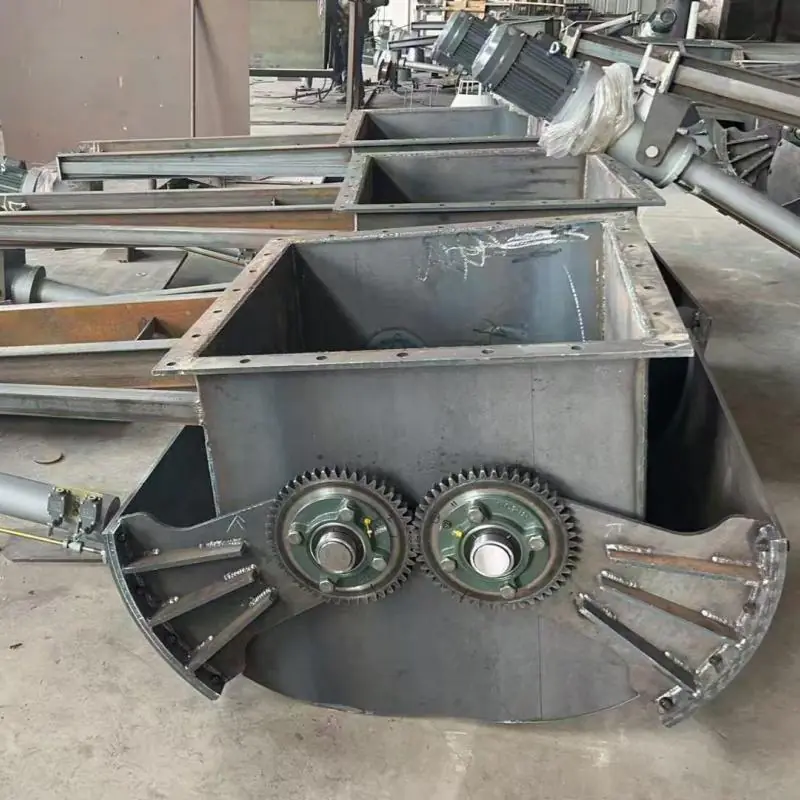
✅ Dual curved blades – form the central opening and interrupt the gravity flow of material.
✅ Synchronized gears – coordinate the rotation of both blade shafts.
✅ Drive unit – an electro-hydraulic actuator or pneumatic cylinder provides opening and closing force.
✅ Shafts and bearings – support the blade assemblies and allow controlled rotation.
✅ Linkage and limit switches – transmit actuator movement and provide optional position feedback.
Clamshell Gate vs Sector Gate vs Slide Gate
| Item | Clamshell Gate | Sector Gate | Slide Gate |
|---|---|---|---|
| Blade Structure | Two opposing curved blades | One curved blade | One flat sliding blade |
| Movement | Symmetrical opening from the centre | One-sided rotational opening | Lateral sliding movement |
| Typical Materials | Granular, abrasive and lumpy solids | Granular and coarse solids | Powders and granules |
| Main Function | On/off discharge and optional coarse adjustment | On/off or coarse flow control | Isolation or flow regulation |
| Powder Sealing | Limited without special sealing | Limited depending on structure | Generally better for fine powders |
| Typical Position | Silos, hoppers and loading bins | Silo outlets and bulk loaders | Powder silos and conveying systems |
The correct gate type depends on the material size, required opening pattern, sealing requirement and downstream equipment.
For very coarse or irregular lumps requiring multiple removable rods rather than synchronized curved blades, see our rod gate.
How to Select a Clamshell Gate
Correct selection depends on both the material conditions and installation layout. Please provide:
✅ Material name, bulk density and flowability
✅ Normal particle size and maximum lump size
✅ Material temperature, moisture and abrasiveness
✅ Required discharge capacity
✅ Silo or hopper outlet dimensions
✅ Material-column height above the gate
✅ Downstream equipment and available installation space
✅ Preferred drive type, power supply and control requirements
✅ Site layout or interface drawing
Material-column height affects the load on the blades and the required actuator force. The downstream chute, feeder or conveyor must also be able to receive the material released when the gate opens.
Installation and maintenance access should be planned according to the site layout and applicable local safety requirements. For general reference, see the OSHA requirements for materials handling and storage.
Manufacturing and Inspection
LVRUI manufactures each clamshell gate according to the approved production drawing.
Before shipment, we check:
✅ Body and flange dimensions
✅ Blade alignment and gear synchronization
✅ Shaft, bearing and actuator operation
✅ Full-open, full-close and limit-switch functions
✅ Wear plates, coating, marking and packing
LVRUI provides technical drawings, installation instructions and remote technical guidance. On-site installation is completed by the customer or its appointed local contractor.
Explore LVRUI industrial valves for additional silo discharge, flow control, isolation and material-diverting solutions.
Clamshell Gate FAQs
What is a clamshell gate used for?
A clamshell gate controls gravity discharge beneath silos, hoppers, bunkers and loading bins. It is commonly used for clinker, aggregate, limestone, coke, ore and other coarse bulk solids.
What drive options are available for a clamshell gate?
LVRUI clamshell gates can use an electro-hydraulic actuator or pneumatic cylinders. Selection depends on the gate size, material load, operating frequency, available compressed air, power supply and control requirements.
Can a clamshell gate regulate material flow?
The gate can provide coarse flow adjustment when the actuator and control system support partial positioning. Accurate dosing normally requires a downstream feeder, weigh hopper or weighing system.
Is a clamshell gate suitable for cement powder or fly ash?
A standard clamshell gate is not intended for tight powder sealing because fine material may pass through blade clearances. A solid-blade slide gate is normally more suitable for powder isolation.
What is the difference between a clamshell gate and a sector gate?
A clamshell gate uses two opposing curved blades that open from the centre. A sector gate normally uses one curved blade that rotates from one side of the outlet.
What information is required for a quotation?
Please provide the material, particle size, bulk density, temperature, outlet dimensions, material-column height, capacity, downstream equipment, preferred drive type and control requirements.
Request a Customized Clamshell Gate
Send LVRUI your material data, outlet dimensions, material-column height, downstream equipment and preferred drive type. We will recommend a suitable clamshell gate configuration for your application.
✅ Electro-hydraulic or pneumatic drive options
✅ Customized opening dimensions and wear-resistant blades
✅ Optional limit switches and PLC interfaces
✅ Technical drawings and remote technical guidance