
Slide Gate Valve for Cement, Fly Ash and Bulk Powder Handling
Heavy-Duty Shut-Off Valve for Silos, Hoppers and Dry Bulk Material Systems
What Is a Slide Gate Valve?
A slide gate valve is a dry bulk material shut-off device that uses a flat blade to open or close the discharge passage beneath silos, hoppers, conveyors and transfer chutes. It is commonly used for cement, fly ash, lime powder, mineral powder and other compatible dry bulk materials.
The valve is primarily intended for isolation and on/off discharge control. Manual, pneumatic and electric operating options are available. For continuous or more accurate powder flow regulation, a dedicated flow control gate valve is normally more suitable.
Related conveying system: Air slide conveyor for powder and cement handling
Features
✅ Carbon steel or stainless-steel structure for industrial use
✅ Suitable for cement, fly ash, lime powder, mineral powder, grain, pellets, and dry bulk solids
✅ Sliding plate design for full-open and full-close operation.
✅ Manual, pneumatic, and electric drive options available
✅ Compact structure for easy installation under silos and hoppers
✅ Sealing and blade configurations can be selected according to material properties and dust-control requirements.
✅ Pneumatic or electric drive options can be configured for frequent operation, depending on the application requirements.
✅ Can be integrated with screw conveyors, air slide conveyors, loading systems, and silo discharge systems
How Slide Gate Valves Work
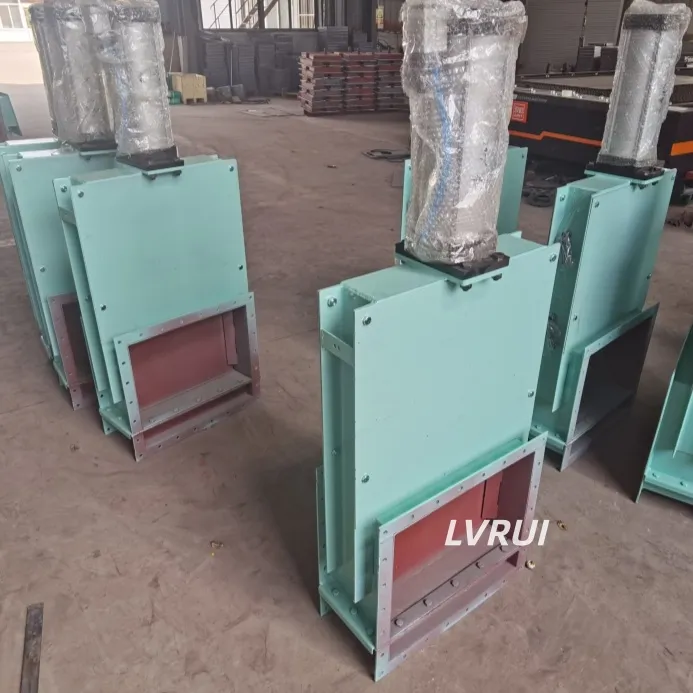
A slide gate valve uses a flat sliding blade to open or close the material passage beneath a silo, hopper or conveyor.
When the blade moves away from the opening, dry bulk material flows through the valve by gravity. When the blade moves back across the opening, the material path is shut off.
Depending on the operating frequency and control requirements, the valve can use:
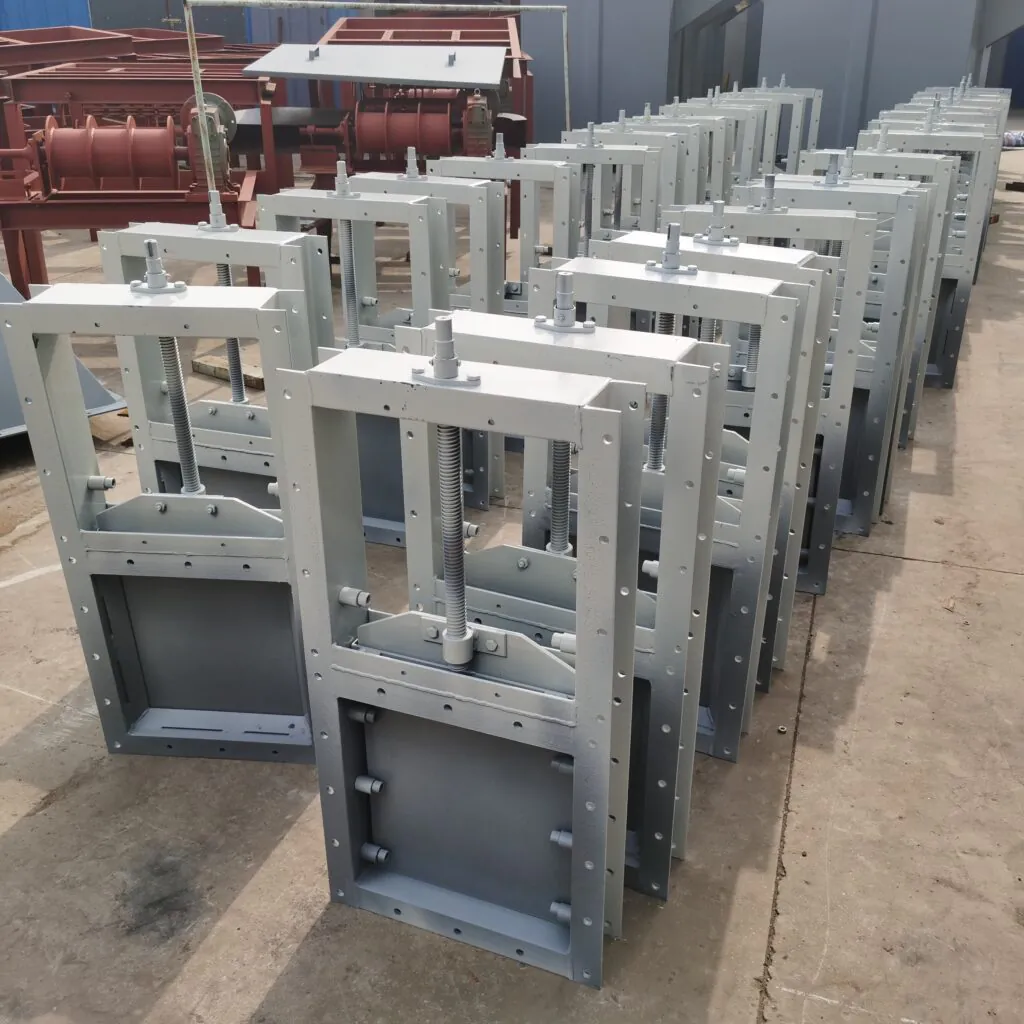
✅ Manual drive – suitable for infrequent operation or maintenance isolation.
✅ Pneumatic drive – a pneumatic slide gate valve uses an air cylinder for fast and frequent opening and closing. Solenoid valves, limit switches and PLC control can be added for automated operation.
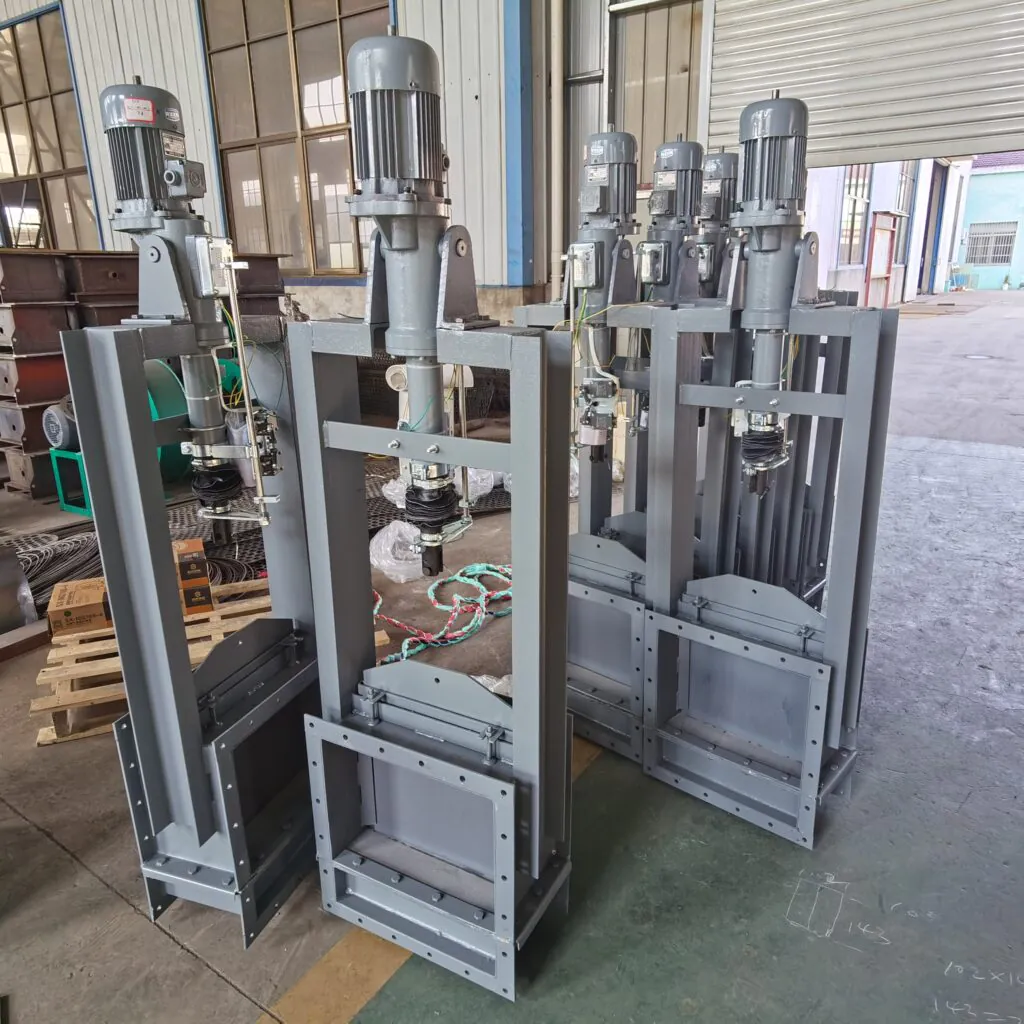
✅ Electric drive – suitable for remote operation where compressed air is unavailable or electrical control is preferred.
For more details about pneumatic cylinder operation, solenoid valve control and position feedback, see our pneumatic slide gate valves guide.
For simple isolation and on/off discharge, a slide gate valve is usually sufficient. For stable and adjustable powder flow regulation, a dedicated flow control gate valve is more suitable.
Slide Gate Valve vs Flow Control Gate Valve
| Item | Slide Gate Valve | Flow Control Gate Valve |
|---|---|---|
| Main function | Shut-off and simple discharge control | Adjustable opening for controlled powder discharge |
| Typical use | Silo outlet, hopper bottom, conveyor discharge | Cement flow adjustment, batching, controlled feeding |
| Operation | Normally full open or full close; partial opening only for rough throttling | Adjustable opening for controlled material flow |
| Best for | Isolation and material discharge | Stable flow control in process systems |
| Materials | Cement, fly ash, lime, grain, pellets | Cement, fly ash, lime powder and bulk powders |
Choose a slide gate valve for isolation and on/off discharge. Choose a flow control gate valve when stable and adjustable powder feeding is required.
Suitable Materials and Applications
LVRUI slide gate valves are designed for the shut-off and isolation of dry, free-flowing powders and compatible fine granular materials. The blade, body material, sealing arrangement and actuator should be selected according to the material properties and operating conditions.
Suitable Materials
✅ Cement powder
✅ Fly ash
✅ Lime powder
✅ Mineral powder
✅ Slag powder
✅ Dry mortar materials
✅ Other compatible dry powders and fine granules
Wet, sticky or heavily caking materials may accumulate around the blade and prevent reliable closing. Large hard lumps may also damage the blade or become trapped in the valve opening. Material particle size, moisture, temperature, abrasiveness and flowability should therefore be confirmed before selection.
Typical Applications
✅ Cement silo discharge and maintenance isolation
✅ Fly ash hopper outlet shut-off
✅ Air slide conveyor inlet and transfer points
✅ Screw conveyor inlet or discharge connections
✅ Powder packing and bulk loading systems
✅ Weigh hopper and batching-system isolation
✅ Dry powder transfer chutes
✅ Equipment isolation during inspection or maintenance
A slide gate valve is mainly intended for full-open and full-close operation. Partial opening may provide rough discharge adjustment, but applications requiring stable and continuous powder flow regulation should use a dedicated flow control gate valve.
For other shut-off, flow regulation, diverter and discharge applications, see our industrial valves for cement and bulk material handling.
Typical Technical Configuration
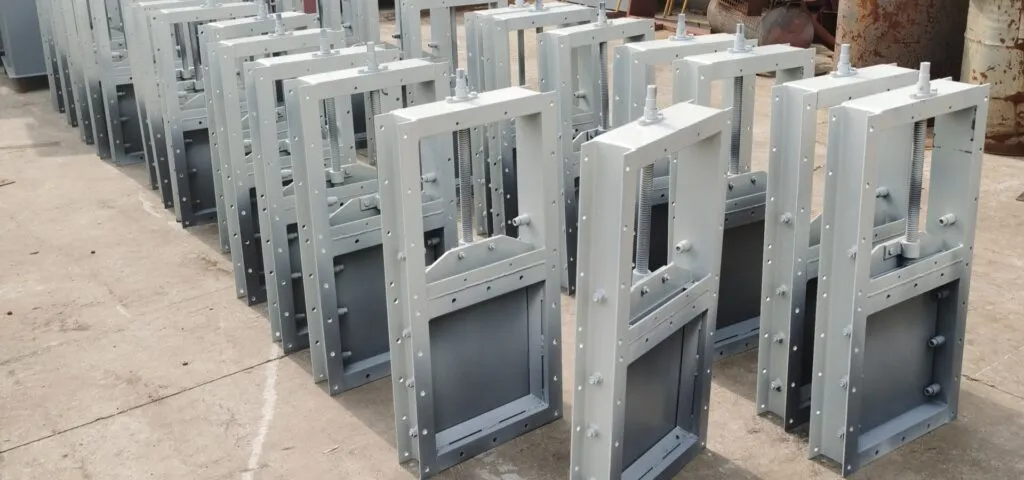
| Item | Typical Configuration |
|---|---|
| Product Type | Slide Gate Valve |
| Opening Shape | Square or rectangular |
| Common Opening Sizes | 300 × 300, 400 × 400, 500 × 500 and 600 × 600 mm (square openings) |
| Drive Options | Manual, pneumatic or electric |
| Body Material | Carbon steel; stainless steel optional |
| Blade Material | Carbon steel, stainless steel or wear-resistant plate |
| Position Feedback | Optional limit switches |
| Control Mode | Local, remote or PLC control |
| Main Operation | Full open and full close |
| Flange Dimensions | Customized according to project drawing |
| Installation | Silo, hopper, chute or conveyor connection |
How to Select the Right Slide Gate Valve
To choose the right slide gate valve, the following information should be confirmed:
Please provide:
✅ Material name, bulk density and particle size
✅ Moisture content and material temperature
✅ Required valve opening size and connection flange dimensions
✅ Material-column height above the valve
✅ Required operating frequency
✅ Preferred manual, pneumatic or electric drive
✅ Dust sealing and process pressure requirements
✅ Power supply, control signals and site drawing
The sealing arrangement, blade material and actuator force must be selected according to the actual material and operating conditions.
Manufacturing and Inspection
✅ Body and flange dimensions
✅ Blade movement and guide alignment
✅ Actuator stroke and limit-switch operation
✅ Open and closed position checking
✅ Surface coating, marking and packing
For additional engineering considerations, refer to base.imgix.net, published in the Bulk Solids Innovation Center Journal.
Product Showcase
Slide Gate Valve FAQs
What is a slide gate valve used for?
A slide gate valve is used to open, close or isolate dry bulk material flow beneath silos, hoppers, chutes and conveying equipment. It is mainly intended for full-open and full-close operation.
Can a slide gate valve handle cement and fly ash?
Yes. A properly selected slide gate valve can handle cement, fly ash, lime powder, mineral powder and similar dry materials. Blade clearance, sealing structure and construction material should be selected according to the powder properties and dust-control requirements.
What is a pneumatic slide gate valve?
A pneumatic slide gate valve uses an air cylinder to move the sliding blade between the open and closed positions. It is commonly used for fast and frequent shut-off at cement silos, fly ash hoppers, conveyor connections and bulk material transfer points. Solenoid valves, limit switches and PLC control can be added for automated operation.
What is the difference between a slide gate valve and a flow control gate valve?
A slide gate valve is mainly used for shut-off and equipment isolation. A flow control gate valve uses an adjustable opening to provide more stable and continuous powder flow regulation.
Can a slide gate valve be used in pneumatic conveying systems?
Yes, but the valve must be selected according to the actual conveying pressure, sealing requirement and installation position. A standard gravity-discharge slide gate should not automatically be used in positive-pressure or vacuum pneumatic conveying lines without confirming its pressure and sealing suitability.
What information is needed to select a slide gate valve?
To select a suitable slide gate valve, confirm the material, bulk density, particle size, moisture, temperature, connection dimensions, material-column height, operating frequency, preferred drive type, process pressure and control requirements. A site drawing is also helpful when the valve must match existing equipment.
Discuss Your Slide Gate Valve Requirements
Send us the material name, bulk density, particle size, connection dimensions, operating frequency and preferred drive type. LVRUI can review the application and recommend the valve structure, blade material, actuator configuration and connection dimensions before quotation.
✅ Manual, pneumatic or electric drive
✅ Square or rectangular openings
✅ Carbon steel or stainless steel
✅ Limit switches and PLC interface
✅ Technical drawing before production