
Industrial Damper Valve for Airflow and Gas Control
Butterfly and Louver Dampers for Dust Collection, Ventilation, Kiln Exhaust and Industrial Duct Systems
What Is an Industrial Damper Valve?
An industrial damper valve is an airflow and gas-control device installed in duct systems to regulate, balance, throttle or isolate air, exhaust gas and dust-laden airflow.
Industrial damper valves are commonly used in dust collection systems, baghouse ducts, fan inlet and outlet lines, kiln and preheater exhaust ducts, clinker cooler ventilation, furnace exhaust systems and other industrial process-air networks.
Unlike valves designed for direct bulk-solid discharge, a damper valve normally controls the air or gas stream inside a duct. In cement and bulk material handling plants, it can be used to balance dust-extraction airflow, isolate duct sections and regulate process ventilation.
The correct damper configuration depends on duct dimensions, airflow volume, operating temperature, pressure condition, dust loading, leakage requirements and the required control function.
Main Types of Industrial Damper Valves
| Damper Type | Structure | Best Used For |
|---|---|---|
| Butterfly Damper Valve | Single rotating blade | Compact ducts, general airflow regulation and isolation |
| Louver Damper Valve | Multiple linked blades | Medium-to-large ducts, high airflow volumes and smoother airflow balancing |
Butterfly Damper Valve
A butterfly damper valve uses a single rotating blade to regulate or isolate airflow. Its compact structure makes it suitable for round or rectangular ducts where relatively simple airflow control, shut-off or fast positioning is required.
Typical applications include dust collector ducts, cyclone outlets, fan lines and general industrial ventilation systems.
Louver Damper Valve
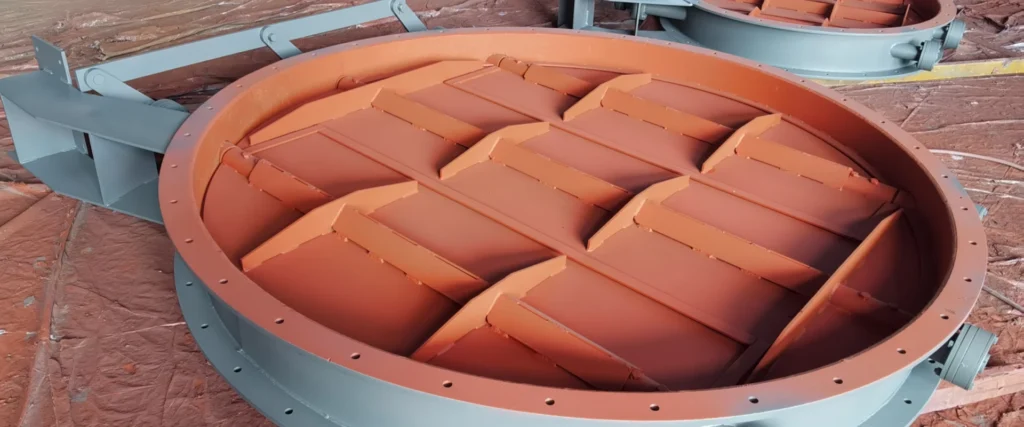
A louver damper valve uses multiple linked blades to control airflow across a larger duct section.
Compared with a single-blade butterfly damper, a louver design is generally more suitable for large ducts where smoother modulation, airflow balancing or more uniform flow distribution is required.
Typical applications include baghouse systems, kiln and preheater exhaust ducts, clinker cooler ventilation and large industrial process-air networks.


High-Temperature Industrial Damper Valves
Industrial damper valves can be designed for elevated-temperature air and exhaust-gas applications, but the allowable operating temperature depends on the final construction rather than the damper type alone.
For high-temperature service, the following conditions should be confirmed:
✅ normal operating temperature;
✅ maximum or peak temperature;
✅ gas composition;
✅ dust concentration and abrasiveness;
✅ duct pressure;
✅ required leakage level;
✅ operating frequency.
Higher temperatures may require changes to:
✅ body and blade material;
✅ shaft design;
✅ bearing arrangement;
✅ sealing materials;
✅ thermal clearance;
✅ actuator installation.
Both butterfly and louver damper structures can be considered for high-temperature applications depending on duct size and control requirements.
The final temperature limit should therefore be confirmed from the selected materials and mechanical design.
Manual, Electric and Pneumatic Damper Actuation
The actuator should be selected according to damper size, operating frequency, response requirements, available utilities and the required level of automation.
| Actuation | Typical Use | Control |
|---|---|---|
| Manual | Fixed or occasional airflow adjustment | Handwheel or lever |
| Electric | Remote modulation and automated process control | Local / PLC / DCS |
| Pneumatic | Fast opening and closing or interlocked operation | Solenoid / PLC |
Manual Damper
Manual operation is suitable where damper position changes infrequently and local adjustment is acceptable.
Electric Damper
Electric actuators are suitable for remote opening, closing or intermediate position control. Where required, the actuator can support local/remote operation and position signals such as 4–20 mA.
Pneumatic Damper
Pneumatic actuation is suitable where compressed air is available and relatively fast opening, closing or interlocked operation is required.
Actuator sizing should be based on damper dimensions, blade load, pressure conditions and required operating torque.
Damper Valves Control Airflow, Not Direct Bulk Powder Discharge
Industrial damper valves are primarily designed to control air, exhaust gas and dust-laden airflow inside ducts. They are not normally used as the main shut-off or regulating device for cement powder, fly ash, lime powder or other bulk solids flowing directly through a silo or hopper outlet.
For direct bulk-solid discharge from a silo or hopper, a flow control gate valve is normally more suitable when flow regulation is required, while a slide gate valve is generally used for simple material isolation.
Typical Industrial Damper Configuration
| Item | Typical Options |
|---|---|
| Damper Structure | Butterfly / Louver |
| Duct Shape | Round / Square / Rectangular |
| Duct Size | Customized according to project drawing |
| Body Material | Carbon steel / Stainless steel / Heat-resistant steel |
| Blade Design | Single blade / Parallel louver / Opposed louver |
| Actuation | Manual / Electric / Pneumatic |
| Operating Medium | Air / Dust-laden air / Exhaust gas / Hot gas |
| Control Function | Shut-off / Isolation / Balancing / Throttling |
| Sealing Requirement | Standard / Low leakage / Project-specific |
| Installation Orientation | Horizontal / Vertical / Customized |
| Position Feedback | Limit switch / Position indication / Optional feedback signal |
| System Integration | PLC / DCS according to actuator configuration |
| Connection | Flanged / Welded / Customized duct connection |
Final dimensions, blade structure, materials, shaft arrangement, sealing design and actuator torque should be confirmed according to the actual duct size, airflow, temperature, pressure condition, dust loading and required control function.
Damper Valve Sealing and Leakage Requirements
Standardized damper performance tests for parameters such as air leakage, pressure drop and operating torque are defined in ANSI/AMCA Standard 500-D for damper performance testing.
Industrial damper valves can be designed with different sealing arrangements depending on the required isolation performance.
A standard damper should not automatically be considered airtight or bubble-tight.
For applications where air or gas leakage is critical, the project should specify:
✅ allowable leakage;
✅ operating pressure;
✅ operating temperature;
✅ gas or dust characteristics;
✅ blade and frame sealing requirements;
✅ shaft sealing requirements.
Low-leakage designs may use additional blade, frame or shaft sealing arrangements.
If a project specifically requires bubble-tight shut-off, this requirement should be confirmed separately before design and should not be assumed from the term “damper valve” alone.
Industrial Damper Valve Applications and Installation Positions
| Installation Position | Main Purpose |
|---|---|
| Dust Collector Inlet / Outlet | Isolate or regulate airflow through the dust collection system |
| Baghouse Branch Duct | Balance suction between filter sections or extraction points |
| Fan Inlet / Exhaust Duct | Regulate airflow volume and system operating conditions |
| Cement Mill / Raw Mill Ventilation | Control process ventilation and dust extraction |
| Kiln / Preheater Exhaust Duct | Regulate hot process gas and exhaust airflow |
| Clinker Cooler Exhaust | Control ventilation and exhaust-air flow |
| Transfer Point Dust Extraction | Balance suction around loading, conveying and transfer points |
| Furnace / Boiler Exhaust | Regulate industrial exhaust or hot-gas flow |
Industrial damper valves may also be used as gas damper valves, exhaust damper valves or dust collector dampers depending on the duct medium and operating function.
For cement plant applications such as kiln exhaust, baghouse ducts, mill ventilation and clinker cooler exhaust, see our guide to damper valve selection for cement plants.
Butterfly Damper vs Louver Damper
| Selection Factor | Butterfly Damper | Louver Damper |
|---|---|---|
| Blade Structure | Single rotating blade | Multiple linked blades |
| Typical Duct | Compact round or rectangular ducts | Medium to large duct |
| Modulation | General airflow adjustment | Smoother airflow balancing |
| Installation Space | Compact | Requires linkage space |
| Typical Use | Dust ducts, cyclone outlets, fan lines | Baghouse, kiln, preheater and large process ducts |
For a detailed comparison of blade structure, duct size and airflow-control requirements, see our Butterfly Damper Valve vs Louver Damper Valve guide.
How to Select an Industrial Damper Valve
| Selection Factor | What to Confirm | Why It Matters |
|---|---|---|
| Duct Size & Shape | Round/square/rectangular dimensions, flange or welded connection | Determines damper dimensions and blade structure |
| Airflow Volume | Air volume, flow velocity, fan capacity | Affects flow area and blade configuration |
| Operating Temperature | Normal and peak temperature | Determines material, shaft, bearing and sealing requirements |
| Pressure Condition | Positive/negative pressure and design pressure | Affects mechanical strength and actuator torque |
| Dust / Gas Characteristics | Dust concentration, abrasiveness, corrosion or gas composition | Affects material and sealing selection |
| Control Purpose | Shut-off, isolation, balancing, throttling or modulation | Determines suitable damper structure |
| Leakage Requirement | Standard, low leakage or project-specific requirement | Affects blade and sealing design |
| Actuation | Manual, electric or pneumatic | Determines control method and utilities |
| Control Signal | Open/close, local/remote, 4–20 mA, PLC/DCS | Determines actuator and feedback configuration |
| Installation Orientation | Horizontal/vertical duct, shaft direction, actuator space | Affects shaft loading and maintenance access |
Providing a duct drawing together with airflow, temperature, pressure, dust or gas conditions and control requirements makes it easier to determine whether a butterfly or louver damper is more suitable.
Industrial Damper Valve Manufacturer for Cement and Dust Collection Systems
LVRUI manufactures industrial damper valves for airflow, exhaust gas and dust-laden duct systems used in cement plants, dust collection systems and industrial ventilation applications.
Damper valves can be customized according to project requirements, including:
✅ butterfly or louver blade structure;
✅ round, square or rectangular duct connections;
✅ manual, electric or pneumatic actuation;
✅ carbon steel, stainless steel or heat-resistant materials selected according to operating conditions;
✅ standard or low-leakage sealing arrangements;
✅ local or remote operation;
✅ open/close or modulating control;
✅ position feedback and PLC/DCS interface where required.
For customized industrial damper valves, provide the duct dimensions, airflow volume, operating temperature, pressure condition, dust or gas characteristics, required control function and installation drawing.
Industrial Damper Valves FAQs
Can an industrial damper valve be retrofitted into an existing duct?
Yes, in many cases. Retrofit feasibility depends on the existing duct dimensions, flange or welded connection, shaft orientation, available actuator space and maintenance access. Existing duct drawings or site dimensions should be reviewed before the damper is designed.
Can one damper valve be used for both isolation and airflow regulation?
It can, depending on the blade structure, actuator and required control accuracy. A damper intended mainly for isolation may not provide the same modulation performance as one designed specifically for adjustable airflow control.
What can cause an industrial damper valve to become difficult to operate?
Common causes include dust buildup around the blade or shaft, bearing contamination, shaft misalignment, thermal deformation, insufficient actuator torque and mechanical interference. The cause should be checked before increasing actuator size.
Why can damper leakage increase after long-term operation?
Leakage can increase because of dust buildup, wear, blade deformation, damaged sealing components or changes in shaft alignment. Inspection should focus on the blade edge, frame contact area, shaft seals and closing position.
Can a manual damper be upgraded to electric or pneumatic actuation later?
In many cases, yes, provided that the shaft, mounting arrangement and required operating torque are suitable for the new actuator. If future automation is expected, it is better to consider actuator mounting and shaft design during the original equipment design.
What maintenance access should be reserved around an industrial damper valve?
Enough space should be provided for actuator inspection, shaft and bearing maintenance, blade inspection and removal of accumulated dust. Access requirements should be considered during duct-layout design, especially for large or high-temperature dampers.
Request an Industrial Damper Valve Quote
Send us your duct dimensions, airflow volume, operating temperature, pressure condition, dust or gas characteristics, required control function and preferred actuator type. LVRUI can review these parameters and determine whether a butterfly or louver damper is more suitable, then recommend the blade structure, materials, sealing arrangement, actuator configuration and duct connection for your project.
✅ Butterfly or louver damper structure
✅ Manual, electric or pneumatic actuation
✅ Round or rectangular duct connection
✅ Standard or low-leakage sealing options
✅ PLC/DCS control options according to project requirements