
Air Slide Conveyor for Cement and Fly Ash Handling
Low-Pressure Air Gravity Conveying for Dry and Fluidizable Powders
What Is an Air Slide Conveyor?
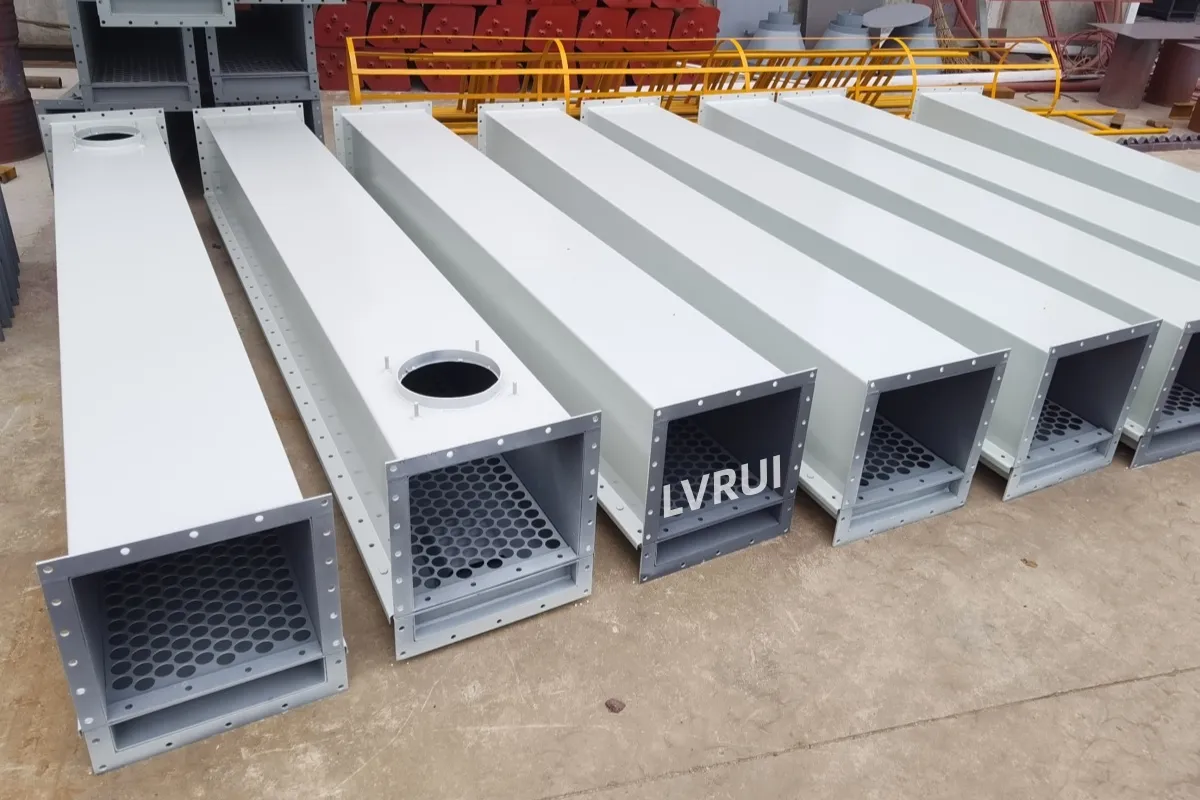
An air slide conveyor is a low-pressure air gravity conveying system used to transfer dry, fine and fluidizable powders through an enclosed, downward-sloping chute. Also called an airslide conveyor or air gravity conveyor, it uses air passing through a permeable fabric to reduce resistance between powder particles, allowing the material to flow under gravity. LVRUI manufactures customized air slide conveyor systems for cement, fly ash, raw meal, lime powder, slag powder and mineral powder handling in cement plants, grinding stations, silo discharge systems, packing lines and bulk loading facilities.
Key Benefits
✅ Few internal moving parts
Powder is conveyed by fluidization and gravity, reducing mechanical wear inside the chute.
✅ Enclosed powder conveying
The enclosed upper chamber helps contain the material and reduce dust escape at transfer points.
✅ Low maintenance requirements
There are no screws, chains or conveying belts inside the material passage.
✅ Suitable for continuous operation
A correctly selected system provides stable conveying for compatible dry powders.
✅ Flexible layout options
Straight sections, turning bends, multiple outlets and air slide diverters are available.
✅ Easy system integration
The conveyor can connect with silos, hoppers, valves, packing machines and bulk loading equipment.
How Does an Air Slide Conveyor Work?
An air slide conveyor consists of an upper material chamber and a lower air chamber. A permeable air slide fabric separates the two chambers and is supported by a porous or grid plate.
A blower supplies low-pressure air to the lower chamber. The air passes through the support plate and fabric into the powder layer above. This reduces friction between the particles and allows the fluidized powder to flow toward the outlet under gravity.
Because the conveyor does not mechanically push the powder, stable operation depends on:
✅ Suitable material fluidization properties
✅ A continuous downward slope
✅ Correct air volume and pressure
✅ Uniform material feeding
✅ Proper inlet and outlet design
✅ Good sealing between conveyor sections
Air slide conveyors are not suitable for vertical or uphill conveying.
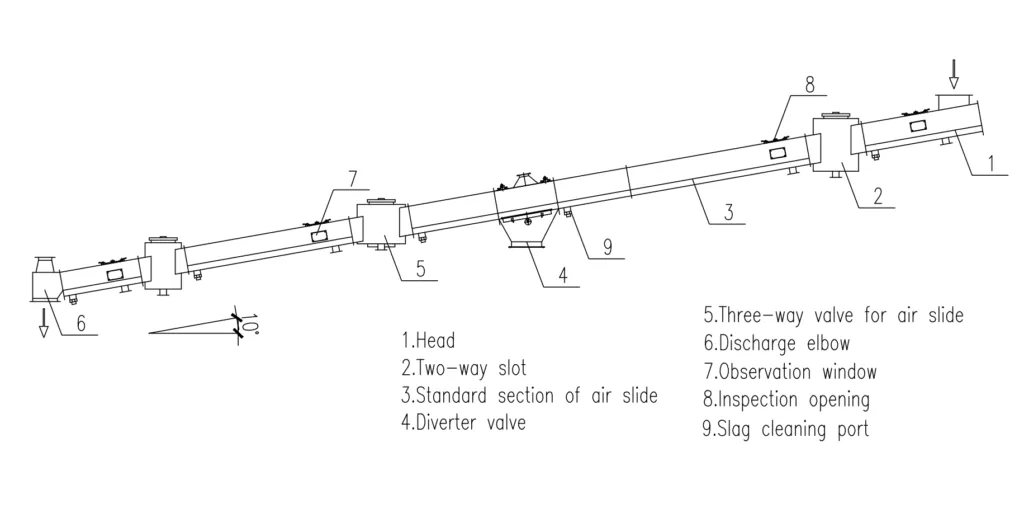
Main Components
✅ Upper Conveying Trough
Contains the powder and guides it toward the outlet.
✅ Air Slide Fabric
Allows air to pass into the powder while separating the upper and lower chambers.
✅ Porous or Grid Support Plate
Supports the fabric, keeps it flat and maintains the airflow passage in the lower chamber.
✅ Lower Air Chamber
Distributes low-pressure air beneath the complete conveying surface.
✅ Blower
Provides the air required to fluidize the powder.
✅ Inlet, Outlet and Inspection Components
Connect the conveyor with upstream and downstream equipment and provide access for inspection and maintenance.
Typical Air Slide Conveyor Design Parameters
| Parameter | Typical Selection Basis |
|---|---|
| Conveyor Width | Standard XZ/AS models from 200 to 800 mm; final width is selected according to material properties and required capacity. |
| Conveying Slope | Typically selected according to material fluidization, conveying distance and available elevation difference. Reference capacity data is available from 4° to 12°. |
| Conveyed Materials | Cement, fly ash, raw meal, slag powder, lime powder, limestone powder and other dry fluidizable powders. |
| Air Supply | Low-pressure air supplied to the lower chamber by a blower. Required airflow and pressure depend on conveyor width, fabric resistance, material properties and conveying length. |
| Air Slide Fabric | Permeable fabric separates the upper material chamber from the lower air chamber and provides uniform fluidizing air across the conveying surface. |
| Section Arrangement | Long conveying routes can be divided into multiple sections according to transportation limits and site layout. |
| Inlet / Outlet | Dimensions and positions are customized according to upstream and downstream equipment. |
Available Configurations
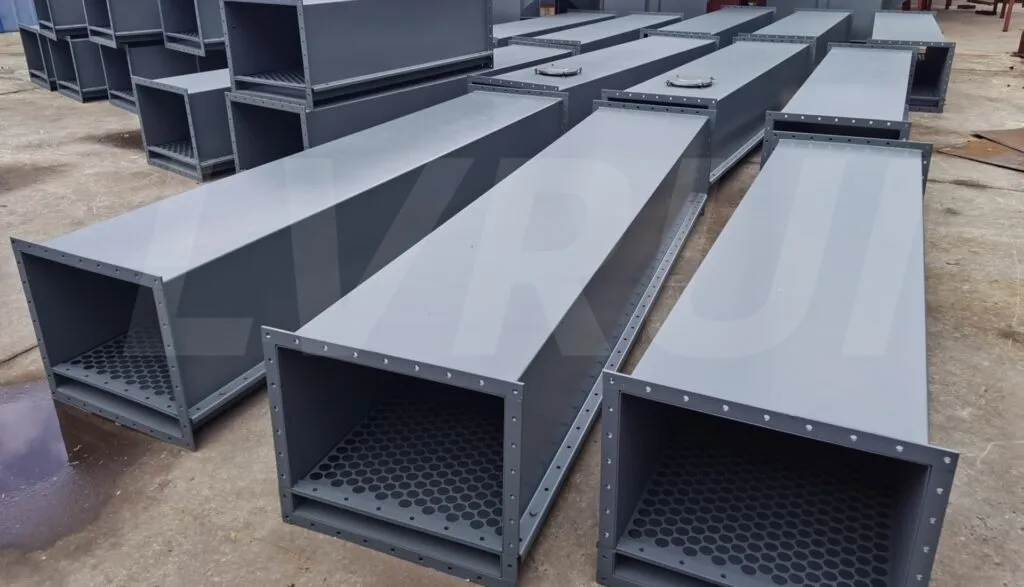
✅ Straight Air Slide Sections
Used for continuous conveying between fixed inlet and outlet points.
✅ Turning Bend Chutes
Change the conveying direction where a completely straight route is not possible.
✅ Multiple-Outlet Systems
Distribute powder to different silos, bins, packing lines or loading points.
✅ Air Slide Diverters
Direct fluidized powder into one of two downstream air slide routes.
The final configuration depends on the conveying route, available height difference, outlet quantity and plant layout.
Air Slide Conveyor Technical Specifications
The following capacities are reference values for preliminary model selection.
| Slide Model | XZ200\AS200 | XZ250\AS250 | XZ315\AS315 | XZ400\AS400 | XZ500\AS500 | XZ630\AS630 | XZ800\AS800 |
|---|---|---|---|---|---|---|---|
| Capacity at α = 4° – Cement | 22 t/h | 40 t/h | 70 t/h | 130 t/h | 220 t/h | 320 t/h | 400 t/h |
| Capacity at α = 4° – Raw Material | 16 t/h | 30 t/h | 55 t/h | 100 t/h | 165 t/h | 245 t/h | 310 t/h |
| Capacity at α = 6° – Cement | 40 t/h | 65 t/h | 120 t/h | 250 t/h | 400 t/h | 610 t/h | 765 t/h |
| Capacity at α = 6° – Raw Material | 30 t/h | 55 t/h | 90 t/h | 185 t/h | 300 t/h | 455 t/h | 565 t/h |
| Capacity at α = 8° – Cement | 50 t/h | 80 t/h | 140 t/h | 300 t/h | 470 t/h | 720 t/h | 900 t/h |
| Capacity at α = 8° – Raw Material | 35 t/h | 65 t/h | 110 t/h | 225 t/h | 355 t/h | 540 t/h | 670 t/h |
| Capacity at α = 10° – Cement | 60 t/h | 100 t/h | 170 t/h | 380 t/h | 570 t/h | 900 t/h | 1080 t/h |
| Capacity at α = 10° – Raw Material | 45 t/h | 80 t/h | 140 t/h | 285 t/h | 425 t/h | 670 t/h | 800 t/h |
| Capacity at α = 12° – Cement | 70 t/h | 120 t/h | 205 t/h | 455 t/h | 685 t/h | 1080 t/h | 1295 t/h |
| Capacity at α = 12° – Raw Material | 50 t/h | 95 t/h | 165 t/h | 340 t/h | 510 t/h | 805 t/h | 960 t/h |
Actual capacity depends on the material properties, bulk density, moisture, conveyor width, installed slope, conveying distance, fabric permeability, air supply and outlet arrangement. Final dimensions and performance must be confirmed according to the project data and approved technical drawings.
Preliminary Selection Example
For example, if a cement conveying line requires approximately 150 t/h at a 6° installed slope, the reference capacity of an XZ315 is 120 t/h, which would be below the required throughput. An XZ400 would therefore be the next preliminary model for evaluation.
This does not mean the XZ400 should be selected from capacity alone. Material bulk density, moisture, conveying distance, available elevation difference, air supply, fabric permeability and inlet/outlet conditions must still be checked before the final model is confirmed.

Suitable Materials and Applications
Air slide conveyors are suitable for dry, fine powders that can be fluidized by low-pressure air.
Typical Materials
✅ Cement
✅ Fly ash
✅ Cement raw meal
✅ Slag powder
✅ Lime powder
✅ Limestone powder
✅ Mineral powder
Wet, sticky, coarse or lumpy materials are generally unsuitable because they may block the fabric or fail to fluidize consistently.
If stored cement or mineral powder contains occasional hardened lumps, an upstream lump breaker can be used to reduce oversized agglomerates before they enter the air slide conveyor.
Typical Applications
✅ Cement silo discharge
✅ Fly ash conveying systems
✅ Grinding station powder transfer
✅ Raw meal and mineral powder handling
✅ Cement packing-line feeding
✅ Transfer between silos and hoppers
✅ Feeding a complete bulk loader system
✅ Multi-point powder distribution
Cement and powder transfer points should be enclosed and connected to suitable dust-control equipment according to the operating conditions and local requirements. For general industry reference, see the U.S. EPA information on Portland cement manufacturing and material-handling emission sources.
How to Select an Air Slide Conveyor
The model should not be selected from conveying capacity alone. Please provide the following information before quotation:
✅ Material name
✅ Bulk density
✅ Particle size
✅ Moisture content
✅ Material temperature
✅ Required conveying capacity
✅ Horizontal conveying distance
✅ Inlet and outlet elevations
✅ Available height difference
✅ Number of discharge points
✅ Connection dimensions
✅ Site layout or section drawing
The available elevation difference is especially important because the complete conveying route must maintain a continuous downward slope.
When the route cannot maintain a continuous downward slope or requires controlled mechanical feeding, compare an air slide conveyor with a screw conveyor before selecting the equipment.
Manufacturing and Inspection
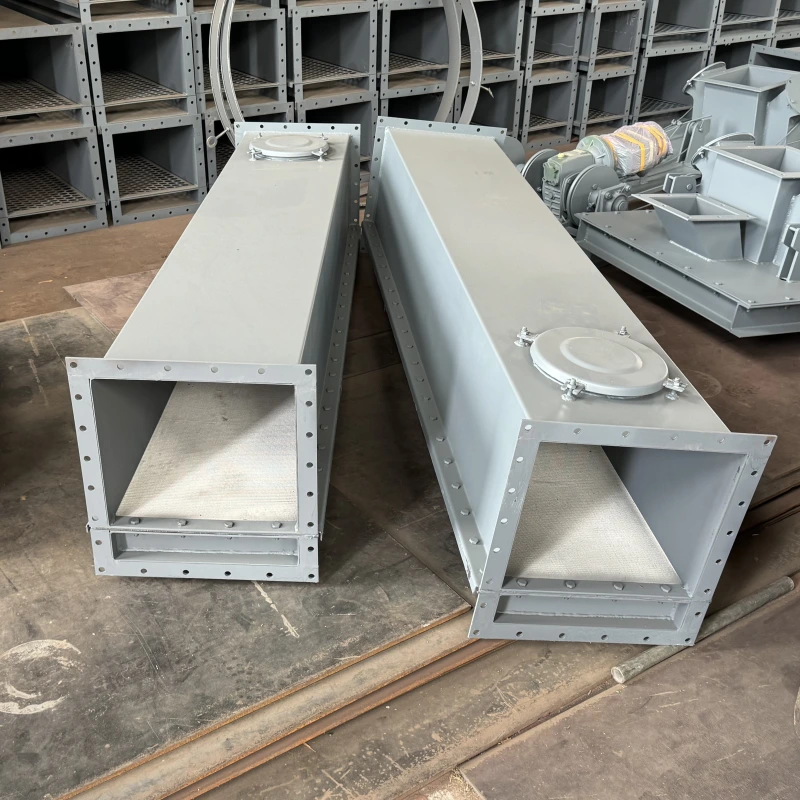
LVRUI manufactures each air slide conveyor according to the confirmed dimensions and approved production drawing.
Before shipment, the main checks include:
✅ Section dimensions and flange positions
✅ Upper and lower chamber alignment
✅ Support plate and fabric installation
✅ Inlet, outlet and air connection dimensions
✅ Inspection-cover installation
✅ Surface coating and component marking
✅ Packing and section identification
Long conveying routes may be divided into several sections for transportation. LVRUI provides technical drawings, installation instructions and remote technical guidance. On-site installation is completed by the customer or its appointed local contractor.
Project Reference: LVRUI supplied approximately 130 m of XZ400, XZ500 and XZ630 air slide conveyors for a new-build cement conveying project at Jidong Cement (Yangquan), designed for 250 t/h at a 6° installation angle. View more cement and bulk material handling projects.
Air Slide Conveyor FAQs
What is an air slide conveyor used for?
It is used to transfer dry, fluidizable powders such as cement, fly ash, raw meal, lime powder, and mineral powder between silos, hoppers, packing lines, and bulk loading systems.
How does an air slide conveyor move powder?
Low-pressure air passes through a permeable fabric beneath the powder. The material becomes fluidized and flows along the downward-sloping chute under gravity.
Can an air slide conveyor move material uphill?
No. It requires a continuous downward slope. Another conveying method is required for vertical or uphill transport.
Can an air slide conveyor handle wet or sticky powder?
Generally no. Excess moisture and sticky material can block the fabric and prevent stable fluidization.
How is the correct model selected?
Selection depends on the material properties, required capacity, conveyor width, conveying distance, available height difference, installed slope, air supply, and outlet arrangement.
What information is required for a quotation?
Please provide the material, bulk density, moisture, temperature, required capacity, conveying distance, inlet and outlet elevations, connection dimensions, and site layout.
Related Equipment for Air Slide Conveyor Systems
Air slide conveyor systems often operate with flow control, material distribution, silo aeration, and shut-off equipment. LVRUI can configure these components according to the silo outlet, conveying route, and control requirements.

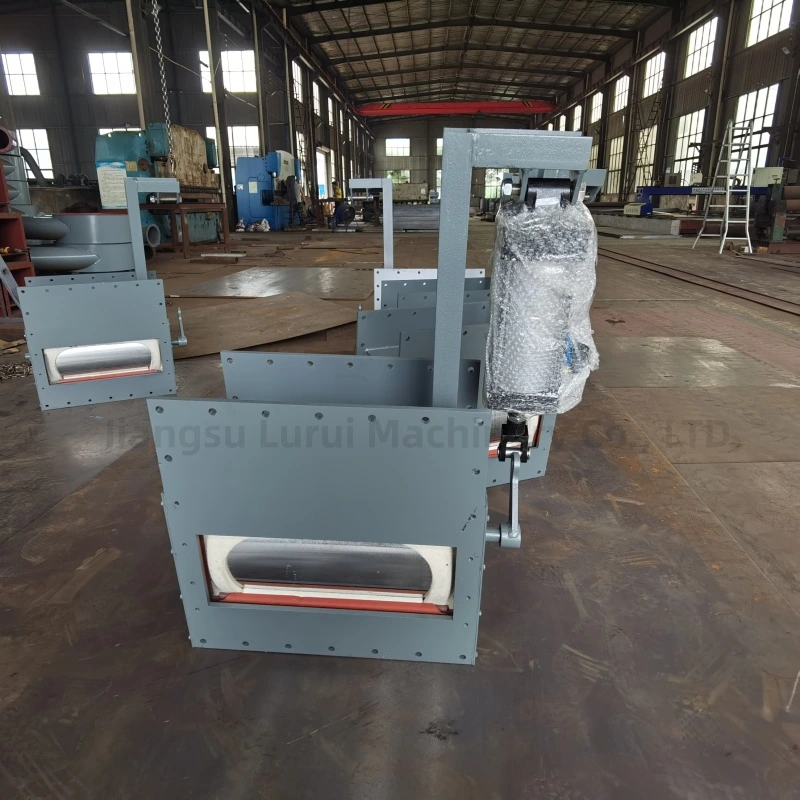
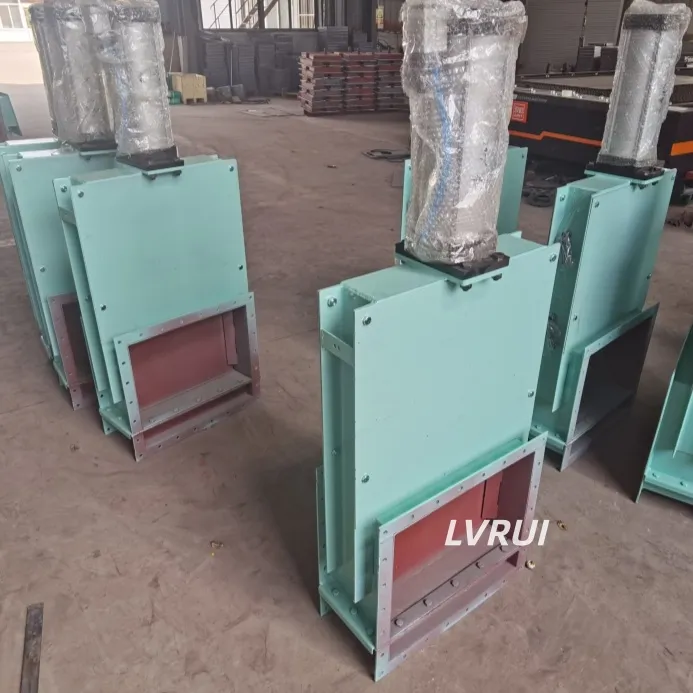
Directs fluidized cement, fly ash, or similar powder into one of two downstream air slide routes.
Controls the powder feed rate from the silo or upstream chute and helps maintain stable material flow into the air slide conveyor.
Provides rapid opening and closing at the silo outlet or transfer point. The valve structure should be selected according to the material and installation arrangement.
Need Help Selecting an Air Slide Conveyor?
Send LVRUI your material, required capacity, conveying distance, available slope, inlet/outlet dimensions and site layout. LVRUI will recommend a suitable air slide conveyor width, section arrangement, conveying route and connection configuration for your operating conditions.
✅ Conveyor width selected according to material and required capacity
✅ Straight sections, bends, outlets and diverter arrangements available
✅ Customized inlet, outlet and connection dimensions
✅ Layout recommendation based on conveying distance and available slope