
Cement Plant Valves for Powder, Clinker and Airflow Control
Industrial valves for material isolation, flow regulation, gravity discharge and duct airflow control
What Are Cement Plant Valves?
Cement plant valves are used to isolate, regulate, discharge or redirect bulk materials and control airflow in different parts of cement production and material handling systems.
LVRUI supplies industrial valves for cement silos, air slide conveyors, clinker storage, aggregate hoppers, dust collectors, pneumatic conveying equipment and industrial duct systems.
The appropriate valve depends on the material being handled and the required operating function. Powder flow control, coarse material isolation, gravity discharge and duct airflow regulation require different valve structures.
The following product categories help engineers and purchasing teams identify suitable equipment for their applications.
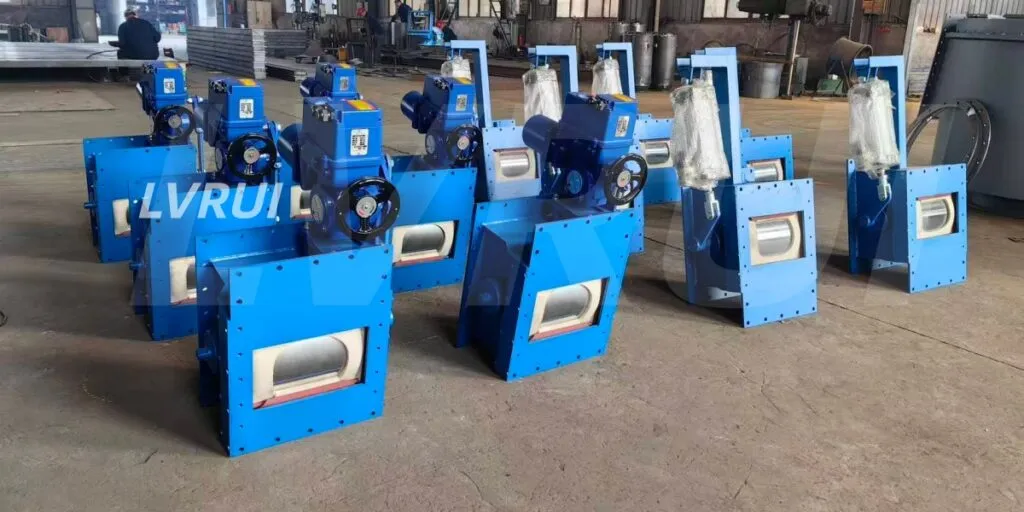
Industrial Valve Types by Function
Powder Flow Control and Isolation Valves
These valves are used at cement silo outlets, powder hoppers, air slide conveyor connections and other dry bulk material handling points.
Flow Control Gate Valve
A flow control gate valve adjusts the discharge opening to regulate the flow of cement, fly ash, raw meal and other compatible dry powders.
It is commonly used where adjustable powder feeding is required. Manual, pneumatic and electric configurations are available according to the required operating and control functions.
Slide Gate Valve
A slide gate valve uses a flat blade to open or close the material passage beneath silos, hoppers and conveying equipment.
It is primarily used for material isolation and on/off discharge rather than continuous flow regulation.
Pneumatic Shut-Off Valve
A pneumatic shut-off valve uses a pneumatic actuator for remotely controlled opening and closing in compatible bulk powder handling systems.
The valve structure and sealing arrangement should be selected according to the actual material, operating pressure and installation requirements.
Clinker and Aggregate Discharge Gates
Coarse and lumpy materials require appropriate gate structures according to their particle size, material load and gravity-discharge requirements.
Rod Gate
A rod gate uses parallel withdrawable steel rods to isolate clinker, aggregates and other coarse or lumpy bulk solids at silo and hopper outlets.
LVRUI supplies single-layer and double-layer configurations with single-direction or double-direction withdrawal. Manual, pneumatic and electric operation is available.
Sector Gate
A sector gate uses a single curved blade to open, close or provide coarse regulation of gravity discharge.
It can be combined with an upstream rod gate in clinker and aggregate handling systems, separating material isolation from downstream discharge control.
Clamshell Gate
A clamshell gate uses two opposing curved blades synchronized by an external gear arrangement.
It is used for gravity discharge of clinker, aggregates, limestone and other suitable granular or lumpy materials. Electro-hydraulic and pneumatic drive configurations are available according to project requirements.
Dust Collector Hopper Discharge Valves
Dust collectors and process hoppers require discharge equipment appropriate for the collected material and the system’s pressure conditions.
Rotary Valve
A rotary valve, also known as a rotary airlock valve or star discharge valve, uses a rotating multi-pocket rotor to discharge powder or granules.
It can provide continuous material discharge while helping limit air leakage between connected equipment. The required rotor, clearances and construction materials depend on the operating conditions.
Double Flap Valve
A double flap valve uses two vertically arranged flaps operating in sequence.
It is used beneath dust collectors, hoppers and compatible process equipment where controlled material discharge and reduced air leakage are required.
Material Diversion Valves
Material diversion equipment allows compatible bulk solids to be directed between different conveying or discharge routes.
Air Slide Diverter
An air slide diverter redirects dry powders such as cement, fly ash and raw meal between designated air slide conveying routes.
It is used where a conveying system needs to switch material between different destinations.
Y-Type Three-Way Diverter Valve
A Y-type three-way diverter valve directs compatible bulk materials from one inlet into either of two outlet branches.
Depending on its construction and operating requirements, it can be configured for suitable clinker, granular, lump and dry powder handling applications.
Industrial Airflow Control Dampers
Unlike bulk material discharge gates, industrial damper valves control air and gas flow inside duct systems.
Damper Valve
LVRUI’s industrial damper valves are designed for airflow regulation, balancing and isolation in dust collection, ventilation and process exhaust systems.
The main configurations include butterfly dampers and louver dampers.
Butterfly Damper Valve
A butterfly damper valve uses a single rotating blade to regulate or isolate airflow inside an industrial duct.
It is used in ventilation systems, dust extraction ducts and other compatible process-air applications.
Louver Damper Valve
A louver damper valve uses multiple linked blades to control airflow across larger duct openings.
LVRUI mainly supplies parallel-blade configurations, while opposed-blade arrangements can be customized according to project requirements.
The damper structure, blade material, shaft design, sealing arrangement and actuator must be selected according to the actual airflow, pressure, temperature and dust-loading conditions.
How to Choose Valves for Cement Plant Applications
Valve selection should begin with the material, installation position and required operating function. Different applications may require material isolation, adjustable discharge, continuous feeding, route switching or airflow control.
| Application | Typical Valve Type | Main Function |
|---|---|---|
| Cement silo discharge | Flow Control Gate / Slide Gate | Powder regulation or isolation |
| Air slide conveyor | Flow Control Gate / Air Slide Diverter | Feeding or route switching |
| Clinker silo outlet | Rod Gate / Sector Gate / Clamshell Gate | Isolation and gravity discharge |
| Dust collector hopper | Rotary Valve / Double Flap Valve | Dust discharge and reduced air leakage |
| Bulk material route switching | Y-Type Three-Way Diverter | Material diversion |
| Industrial ventilation duct | Butterfly / Louver Damper | Airflow regulation and isolation |
The appropriate valve should be confirmed according to the material characteristics, outlet or duct dimensions, operating conditions and required control function. For abrasive materials or high-temperature applications, wear protection and construction materials must be evaluated for the specific equipment. For applications involving pressurized conveying or airlock requirements, the valve’s actual pressure and leakage performance must also be confirmed.
Related Equipment: Lump Breaker
For applications involving compacted powder or oversized agglomerates, a lump breaker may be installed as separate size-reduction equipment before downstream conveying or discharge components.
Lump breakers are not isolation or flow-control valves. Their suitability depends on the material characteristics and system requirements.
Typical Industries and Applications
LVRUI supplies industrial valves for cement production and compatible bulk material handling operations. For technical background on cement production processes and associated emission sources, see the U.S. EPA’s Portland Cement Manufacturing reference.
Typical applications include cement and fly ash silo discharge, clinker storage and loading, aggregate hopper discharge, air slide conveyor systems, dust collector hopper discharge, dry bulk material diversion and industrial duct airflow control.
Different industries may use similar equipment, but valve suitability depends on the actual material properties and operating conditions.


LVRUI Valve Supply and Customization
LVRUI supplies industrial valves and gates according to the application and approved project requirements.
Available supply and customization capabilities include:
✅ Material-specific valve and gate configurations
✅ Manual, pneumatic, electric or other applicable drive options according to the selected product
✅ Customized inlet, outlet, flange and connection dimensions
✅ Applicable construction materials and wear-protection arrangements
✅ Technical drawings and equipment configuration review
✅ Export packing and remote technical support
Valve selection and final manufacturing details are confirmed according to the approved equipment drawings and operating requirements.
Cement Plant Valves FAQs
What are cement plant valves used for?
Cement plant valves are used for powder flow regulation, material isolation, clinker discharge, route switching, dust collector hopper discharge and duct airflow control. Different valve structures are required for different materials and operating functions.
What is the difference between a flow control gate and a slide gate?
A flow control gate is used to adjust the discharge opening for powder flow regulation. A slide gate is primarily used for full-open or full-close material isolation. Applications requiring accurate dosing normally need suitable downstream feeding or weighing equipment.
Which valves are used for clinker and aggregate discharge?
Rod gates are mainly used for material isolation, while sector gates and clamshell gates can control gravity discharge. These devices may be used separately or combined according to the material properties and system requirements.
Which valves are suitable for dust collector hopper discharge?
Rotary valves and double flap valves are commonly used to discharge collected dust. The choice depends on material properties, required discharge capacity, pressure conditions, air leakage requirements and downstream equipment.
What is the difference between a butterfly damper and a louver damper?
A butterfly damper uses a single rotating blade, while a louver damper uses multiple linked blades. Both are designed for industrial airflow control, with the configuration selected according to duct dimensions, airflow requirements and operating conditions.
What information is needed for an industrial valve quotation?
Please provide the material or gas characteristics, operating temperature, required function, installation dimensions, operating conditions and preferred drive method. For an existing installation, drawings and site photographs are particularly useful.
Request Industrial Valves for Your Cement Plant
If you need equipment for powder flow control, material isolation, gravity discharge or industrial airflow regulation, please provide your operating requirements and available installation drawings.
LVRUI can review your application and provide technical suggestions for selecting the appropriate valve or gate configuration.
✅ Multiple valve and gate categories
✅ Customized equipment dimensions and connections
✅ Drive options according to product and project requirements
✅ Technical drawings and remote guidance