Engineering Guide to Selecting Dampers for Kiln, Preheater, Baghouse, Mill Ventilation and Cement Plant Airflow Control
Introduction
In modern cement plants, airflow control is essential for stable kiln operation, dust collection, process ventilation and heat exchange. A damper valve for cement plant applications is used to regulate, balance or isolate air, exhaust gas and dust-laden airflow within industrial duct systems.
Effective cement production airflow control depends on the complete fan and duct system rather than the damper alone. Damper position, fan operating conditions, duct resistance, airflow volume, temperature and dust loading should therefore be evaluated together when selecting the appropriate damper configuration.
1. Why Damper Valve Selection Matters in Cement Plants
Cement production involves high temperatures, abrasive dust, fluctuating pressure, and continuous operation. An unsuitable damper configuration can contribute to excessive leakage, unstable airflow, unnecessary system resistance, accelerated wear and difficult maintenance. In accordance with requirements for industrial ventilation systems, proper airflow regulation and isolation are essential for safe and efficient plant operation.
- Air leakage and unstable airflow
- Increased fan energy consumption
- Excessive wear and frequent maintenance
- Reduced system efficiency and process control accuracy
Choosing the correct industrial damper valve supports stable airflow control, suitable isolation performance and reliable integration with the cement plant ventilation system.
2. Key Airflow Control Applications in Cement Plants
A damper valve for cement plant airflow control can be installed at different points in the production airflow system, where airflow volume, gas temperature, dust concentration and control requirements vary significantly.
Damper valves are widely used in:
- Kiln inlet and outlet ducts
- Preheater and pre-calciner systems
- Clinker cooler exhaust air control
- Baghouse and ESP dust collection systems
- Raw mill and cement mill ventilation
Stable airflow control through the cement kiln and preheater system depends on the interaction between fan operation, duct resistance, damper position and actual process conditions.
Each application presents different airflow velocities, temperatures, and dust concentrations, directly affecting damper valve selection.
3. Main Types of Damper Valves Used in Cement Plants
3.1 Butterfly Damper Valve
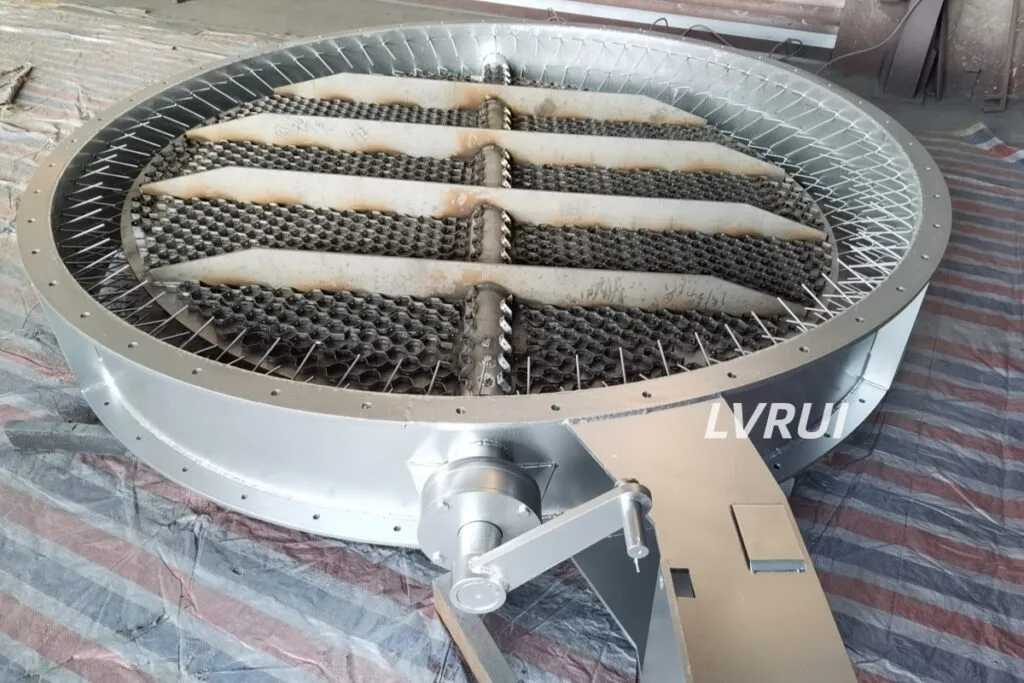
✅ Suitable for compact to medium duct sections requiring straightforward airflow regulation or isolation
✅ Features a single rotating blade with a relatively simple mechanical structure
✅ Applications: Dust collection systems, exhaust ducts, ventilation lines
3.2 Louver Damper Valve
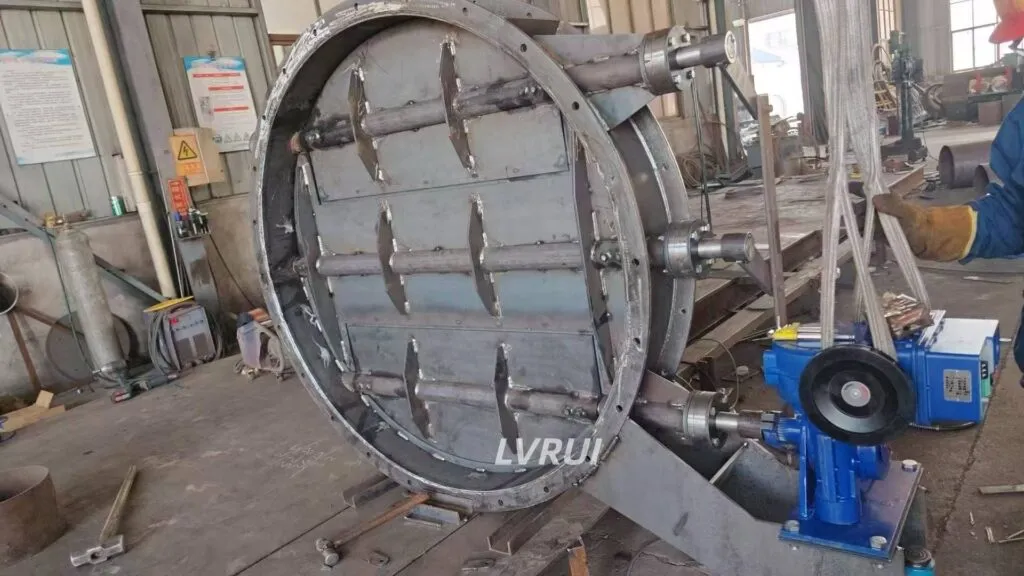
✅ Uses multiple linked blades for airflow regulation across a larger duct section
✅ Suitable where smoother airflow modulation or balancing is required
✅ Typical applications include baghouse ducts, kiln and preheater exhaust, clinker cooler ventilation and other large process-air ducts
For a detailed comparison of blade structure, airflow modulation, leakage requirements and application conditions, see our Butterfly Damper vs Louver Damper guide.
4. Critical Factors to Consider When Selecting a Damper Valve
4.1 Operating Temperature
✅ Operating temperature varies significantly according to the installation position. Kiln, preheater and hot-gas ducts may operate at elevated temperatures, while dust collection and general ventilation ducts may operate under very different conditions.
✅ Confirm the normal and maximum gas temperature before selecting body material, blade material, shaft arrangement, bearings, seals and actuator location.
4.2 Dust Load and Abrasiveness
✅ Cement, raw meal and kiln-process dust can create abrasive or erosive conditions depending on particle characteristics, dust concentration and airflow velocity.
✅ Long-term exposure accelerates wear on airflow components
✅ Reinforced blades, wear-resistant liners, and appropriate clearances ensure reliability
4.3 Sealing Performance
✅ Sealing requirements should be selected according to the airflow-control or isolation function.
✅ Required leakage performance should be defined according to the isolation function and process requirements.
✅ Blade, frame and shaft sealing arrangements should be selected according to temperature, pressure and dust conditions.
A standard industrial damper should not automatically be assumed to provide airtight or bubble-tight shut-off.
4.4 Pressure Drop and Flow Control Accuracy
Damper position changes system resistance, but it does not independently determine the final airflow volume. Fan operating point, duct resistance, airflow velocity and process conditions should also be considered when evaluating airflow control.
For standardized laboratory methods used to evaluate damper air leakage, pressure drop and operational performance, refer to ANSI/AMCA Standard 500-D.
4.5 Actuation Method: Manual, Electric or Pneumatic
Manual operation is suitable for infrequent local adjustment. Electric actuators are commonly used for remote positioning, modulating control and PLC/DCS integration. Pneumatic actuators can be considered where compressed air is available and relatively fast open-close or interlocked operation is required.
5. Common Damper Valve Selection Mistakes
- Choosing valves based on diameter only
- Ignoring dust accumulation and wear
- Underestimating operating temperature
- Assuming a standard damper provides airtight isolation without defining the allowable leakage requirement
Avoiding these mistakes helps reduce unnecessary maintenance and improves the reliability of the airflow-control system.
6. How Proper Damper Valve Selection Improves Cement Plant Performance
Proper damper selection can support more stable airflow control and better coordination between the fan, duct system and process equipment.
A suitable damper configuration can help provide:
- stable airflow regulation;
- appropriate isolation performance;
- balanced dust-extraction airflow;
- reduced unnecessary system resistance;
- improved maintenance access;
- more suitable actuator and sealing performance.
The actual operating result still depends on fan performance, duct resistance, process conditions and the overall airflow-control system.
Conclusion
Selecting the right damper valve for cement plant airflow control requires evaluating the actual duct and process conditions rather than relying on damper type alone.
Kiln and preheater exhaust, clinker cooler ventilation, baghouse systems, mill ventilation and dust-extraction ducts may have very different airflow, temperature, pressure and dust conditions.
Butterfly dampers are generally suitable for compact airflow regulation or isolation, while louver dampers are often considered for larger ducts requiring smoother airflow modulation or balancing.
The final selection should be based on duct dimensions, airflow volume, operating temperature, pressure condition, dust or gas characteristics, leakage requirements and the required control method.

FAQs – Damper Valve for Cement Plants
Can an existing cement plant duct be retrofitted with a new damper valve?
In many cases, yes. Retrofit feasibility depends on the existing duct dimensions, connection method, available installation space, shaft orientation, actuator clearance and maintenance access. Existing drawings or site measurements should be reviewed before the damper is designed.
Why can airflow remain unstable even after adjusting the damper?
Damper position is only one part of the airflow-control system. Unstable airflow may also result from fan operating conditions, duct resistance, dust buildup, pressure variation or changes in the cement production process.
What can cause a damper valve to become difficult to open or close?
Common causes include dust accumulation, shaft misalignment, bearing contamination, thermal deformation, linkage problems or insufficient actuator torque. The actual cause should be identified before increasing actuator size.
Why can damper leakage increase after long-term operation?
Leakage may increase because of blade wear, dust buildup, damaged seals, shaft misalignment or deformation caused by temperature. Inspection should focus on the blade, frame contact area, shaft seals and closing position.
Can a manual damper be upgraded to electric or pneumatic actuation?
It may be possible if the shaft, mounting arrangement and operating torque are suitable for the new actuator. If future automation is expected, actuator mounting and shaft design should ideally be considered during the original equipment design.
What maintenance access should be reserved around a cement plant damper valve?
Enough space should be provided for actuator inspection, shaft and bearing maintenance, blade inspection and removal of accumulated dust. Large or high-temperature dampers may require additional access around the shaft and actuator area.
Need Help Evaluating a Damper Valve for Cement Plant Airflow Control?
Send us your duct dimensions, airflow volume, normal and maximum operating temperature, pressure condition, dust or gas characteristics, installation position and required control method.
LVRUI can review these conditions and help determine whether a butterfly or louver damper is more suitable, together with the blade structure, actuator arrangement, materials and sealing requirements.
Email: info@lvrui-conveyor.com
WhatsApp: +86-18261998937
WeChat: +86-18261998937