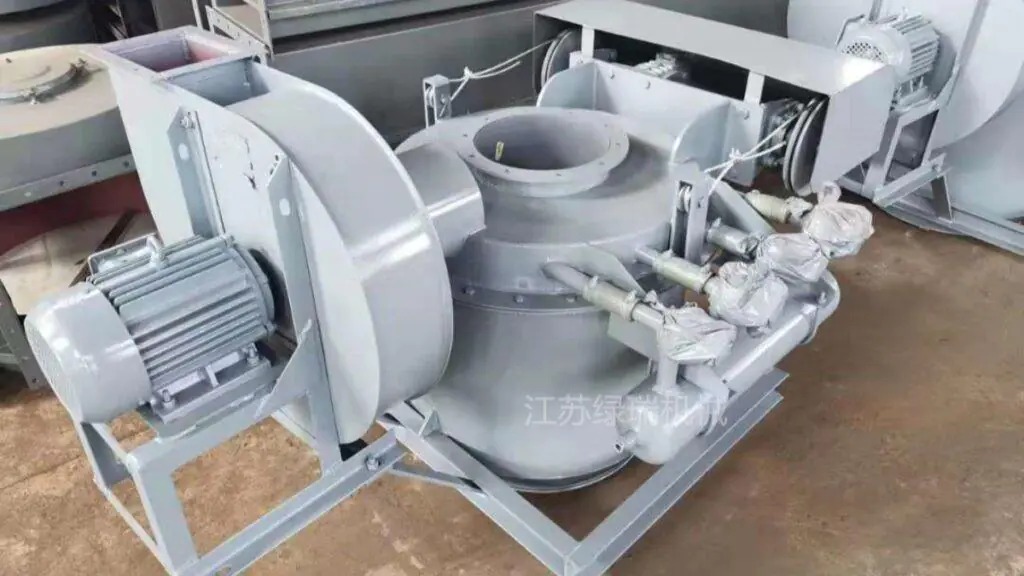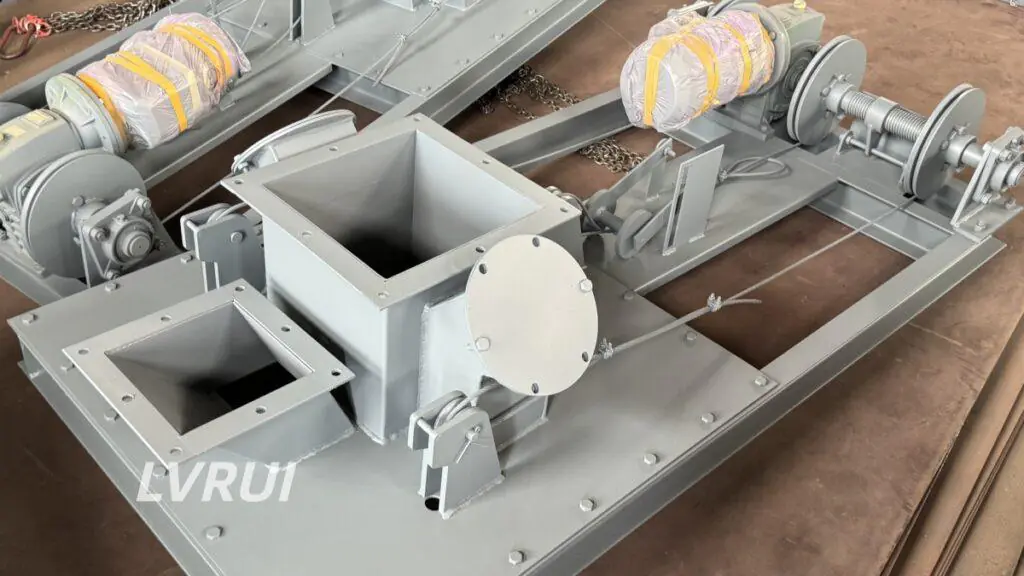
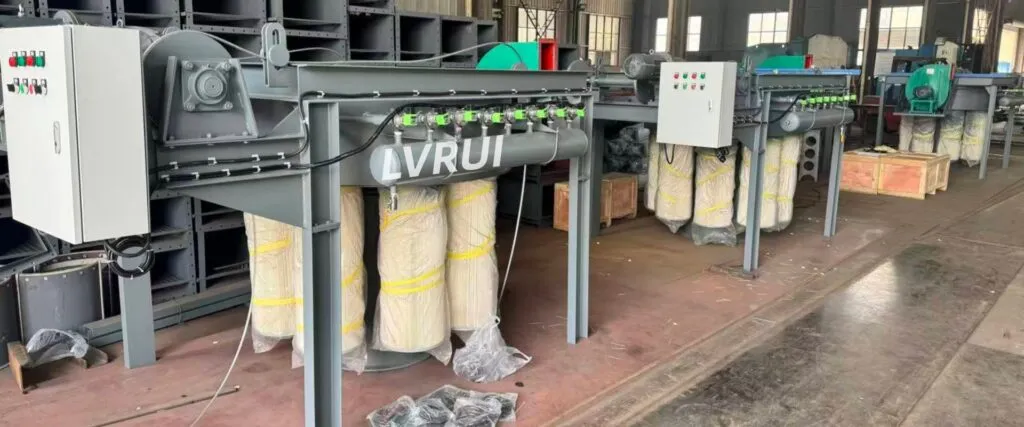
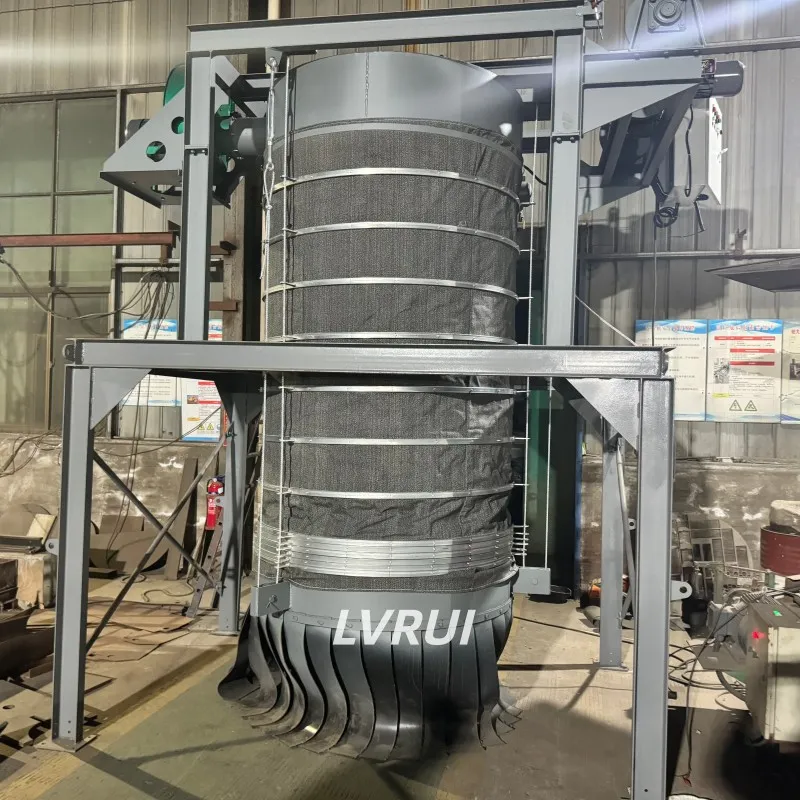
A fixed bulk loading unit that integrates a telescopic loading chute, filter cartridges, pulse-jet cleaning system and dust collection fan for loading clinker into open-top trucks and rail wagons.
Introduction
Clinker Bulk Loader with Dust Collection combines clinker loading and local dust collection in one integrated unit for loading open-top trucks, rail wagons and other compatible open vehicles.
During clinker loading, material falling into an open vehicle can generate significant dust as displaced air escapes from the loading area. A conventional arrangement may require a clinker bulk loader, a separately installed dust collector, external ductwork, a fan and additional supporting structures.
The integrated design simplifies this arrangement. The telescopic loading chute, filter cartridges, pulse-jet cleaning system and dust collection fan are incorporated into the same fixed equipment structure. The main machine remains stationary while the telescopic chute moves vertically during loading.
Instead of installing a bulk loader and standalone dust collector separately, the integrated system provides both loading and local dust collection at one dedicated loading point. This can reduce external ductwork, simplify equipment arrangement and make installation more compact.
What Is an Integrated Clinker Bulk Loader with Dust Collection?
An integrated clinker bulk loader with dust collection is a fixed loading unit designed for clinker loading into open-top vehicles.
Its main difference from a conventional arrangement is that the local dust collection system is built into the loader assembly rather than installed as a separate machine. The loader body remains fixed, while the telescopic loading chute extends and retracts vertically during operation.
This configuration is particularly suitable for dedicated loading points where compact equipment arrangement, local dust extraction and reduced external ductwork are required.
How Loading and Dust Collection Work Together
During operation, clinker enters the bulk loader from the upstream silo, hopper or conveying equipment and flows downward through the telescopic loading chute.
The chute is lowered toward the receiving vehicle to reduce unnecessary material free-fall distance.
As clinker enters the open vehicle, air displaced by the incoming material can carry clinker dust upward around the loading point. The integrated fan creates suction through the dust collection path and draws dust-laden air toward the filter section.
Dust particles are captured by the filter cartridges while the cleaned air passes through the filtration system.
During operation, the pulse-jet cleaning system periodically removes accumulated dust from the filter cartridge surfaces to maintain filtration performance.
Because the dust collection components are integrated into the bulk loader, the loading point does not require a separately installed standalone dust collector and long external dust ducts. NIOSH also identifies telescoping loadout spouts combined with local exhaust ventilation as an effective approach for reducing dust liberation during bulk loading.
Main Components of the Integrated System
| Component | Main Function |
|---|---|
| Fixed loader body | Supports the loading and integrated dust collection assemblies |
| Telescopic loading chute | Extends vertically toward the receiving vehicle during loading |
| Material passage | Guides clinker from the upstream feed point into the vehicle |
| Filter cartridges | Capture dust from extracted loading air |
| Pulse-jet cleaning system | Cleans accumulated dust from the filter cartridge surfaces |
| Integrated dust fan | Provides airflow for local dust extraction |
| Lifting mechanism | Raises and lowers the telescopic loading chute |
| Dust collection path | Connects the loading zone with the integrated filter section |
The exact configuration should be matched to clinker characteristics, loading capacity, vehicle dimensions, available installation height and dust collection requirements.
Integrated Clinker Bulk Loader vs Separate Bulk Loader and Dust Collector
| Item | Integrated Clinker Bulk Loader | Separate Loader + Dust Collector |
|---|---|---|
| Equipment arrangement | Loading and dust collection integrated into one unit | Two separate equipment systems |
| Dust collector | Built into the loader assembly | Installed separately |
| Dust fan | Integrated with the unit | Normally installed with separate collector |
| External ductwork | Reduced | Usually requires additional duct connections |
| Installation space | More compact around the loading point | Requires space for separate collector and ductwork |
| Structural supports | Mainly designed around one integrated unit | Separate equipment may require additional supports |
| Installation coordination | Fewer separate equipment interfaces | Loader, collector and ducting must be coordinated |
| Application flexibility | Well suited to compact dedicated loading points | Separate system may offer greater layout flexibility |
An integrated machine is not automatically the best solution for every project. A separate dust collector may still be preferable when one central dust collection system serves several loading points or when the plant layout requires the collector to be installed away from the loader.
For a dedicated clinker loading point, however, an integrated unit can simplify the equipment arrangement by combining the loading chute and local dust collection system into one machine.
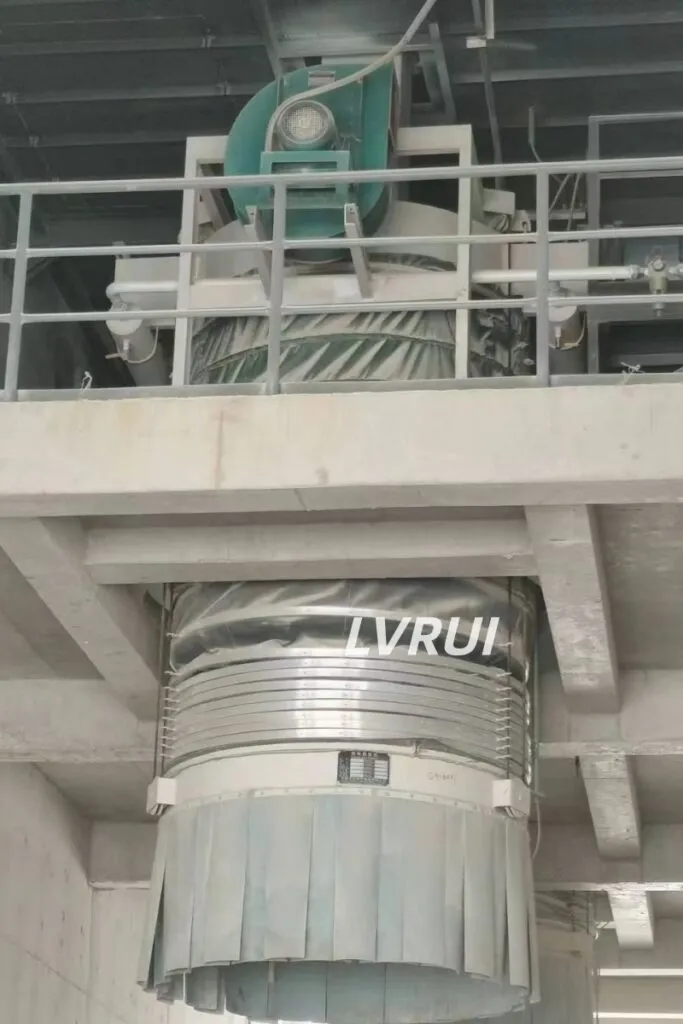
Fixed Installation with a Telescopic Loading Chute
Although the telescopic loading chute moves vertically during operation, the complete machine is installed at a fixed loading position.
The main equipment body is mounted at a fixed loading position and connected to the upstream clinker feeding system.
During loading, only the telescopic chute moves vertically to adjust the discharge position relative to the vehicle.
This arrangement allows the chute to remain closer to the clinker bed as the vehicle is filled, helping reduce excessive free fall and uncontrolled dust dispersion.
Because the complete machine does not travel horizontally, vehicle positioning and the loading-point layout must be considered during project design.
Where Is the Integrated Clinker Bulk Loader Used?
The equipment is mainly intended for clinker loading into open-top receiving vehicles.
Open-Top Trucks
For clinker loading into open trucks, the vehicle is positioned beneath the fixed loader and the telescopic chute is lowered toward the truck bed before loading begins.
Rail Wagons
The same operating principle can be applied to compatible open-top rail wagons where the vehicle can be positioned beneath the fixed loading point.
Other Open-Top Vehicles
The integrated system can also be considered for other compatible open receiving vehicles, provided that the vehicle dimensions, loading height and required chute travel match the equipment arrangement.
Key Parameters for Equipment Selection
For projects that do not require integrated dust collection, the general clinker bulk loader selection should first be evaluated according to material characteristics, loading capacity and vehicle type.
The integrated loader should be selected from the actual clinker characteristics and loading conditions rather than only from the required throughput.
Important project data include:
- clinker condition and maximum particle size;
- bulk density;
- required loading capacity;
- material temperature;
- upstream inlet or discharge interface;
- open-truck or rail-wagon dimensions;
- minimum and maximum loading height;
- required telescopic chute travel;
- available installation height;
- dust collection requirement;
- power supply;
- compressed-air conditions for pulse cleaning;
- operating frequency and duty cycle.
When Is a Clinker Bulk Loader with Dust Collection More Suitable?
An integrated clinker bulk loader is particularly suitable when the project has one dedicated loading point and the customer wants the loading and local dust collection equipment arranged as one unit.
It can be useful when:
the installation area around the loading point is limited;
a separate standalone dust collector would require additional structural support;
the customer wants to reduce external dust ductwork;
the loading point requires its own independent dust collection system;
the project prefers one integrated equipment package for installation and maintenance coordination.
However, if several loading points share one central dust collection system, a separate dust collector arrangement may still be more appropriate.
When the loading point also involves upstream material feeding, flow control, level detection and other coordinated equipment, the complete bulk loading system should be evaluated rather than selecting the loader alone.
Common Mistakes When Selecting an Integrated Clinker Bulk Loader
A common mistake is assuming that an integrated dust collector automatically means dust-free loading. Actual dust-control performance still depends on airflow, chute position, vehicle geometry, material condition and operating practice.
Another mistake is selecting the telescopic travel without confirming the highest and lowest loading positions of the vehicle.
Filter cartridge selection should also consider clinker dust characteristics and operating temperature rather than using a generic filter specification.
The pulse-cleaning system requires a suitable compressed-air supply, which should be considered during plant utility planning.
Finally, the installation layout must provide enough access for filter inspection, maintenance and replacement.
Conclusion
An integrated clinker bulk loader with dust collection combines two functions that are often installed separately: clinker loading and local dust collection.
The fixed machine incorporates a telescopic loading chute, filter cartridges, pulse-jet cleaning system and dust collection fan into one equipment arrangement. This can reduce the need for a separately installed standalone dust collector and extensive external dust ductwork around a dedicated loading point.
The equipment is particularly suitable for loading clinker into open-top trucks, rail wagons and other compatible open vehicles.
Final configuration should be based on clinker characteristics, required loading capacity, vehicle dimensions, telescopic travel, installation height and dust collection conditions.
FAQs About Integrated Clinker Bulk Loaders with Dust Collection
Does an integrated clinker bulk loader still need a separate dust collector?
Normally, no. The filter cartridges, pulse-jet cleaning system and dust collection fan are integrated into the loader assembly, so a separate local dust collector is not required for that loading point.
Is the complete clinker bulk loader movable?
No. The main equipment body is installed at a fixed loading position. Only the telescopic loading chute moves vertically to follow the loading height.
Can one integrated unit serve several loading points?
The equipment is mainly intended for a dedicated loading position. If several loading points need to share one dust collection system, a separate centralized dust collector may be more suitable.
Does the integrated system eliminate all clinker dust?
No. The system is designed to collect dust generated around the loading point, but actual performance depends on airflow, clinker characteristics, chute position, vehicle geometry and operating conditions.
Does the pulse-jet cleaning system require compressed air?
Yes. The filter cartridge cleaning system requires a suitable compressed-air supply. The required pressure and air consumption should be confirmed according to the final dust collection configuration.
What information is required before selecting the equipment?
Provide clinker particle size, bulk density, material temperature, required loading capacity, vehicle dimensions, minimum and maximum loading height, available installation space, power supply and compressed-air conditions.
Need Help Evaluating a Clinker Bulk Loader with Dust Collection?
Send us your clinker particle size, bulk density, temperature, required loading capacity, vehicle type and dimensions, available installation height and required telescopic travel.
LVRUI can evaluate whether an integrated loading-and-dust-collection arrangement is suitable for your loading point and recommend the equipment structure, telescopic chute travel and dust collection configuration. We can then provide a technical drawing and quotation based on your project conditions.
Contact Us: https://lvrui-conveyor.com/contact-us/
Email: info@lvrui-conveyor.com
WhatsApp: +86-18261998937
WeChat: +86-18261998937