
Cartridge Dust Collector for Fine & Dry Industrial Dust
Pulse-Jet Cleaning with Pleated Filter Cartridges for Compact Industrial Dust Collection
What Is a Cartridge Dust Collector?
A cartridge dust collector is an industrial dust filtration unit that uses pleated filter cartridges as the primary filtration elements. The pleated structure provides a relatively large filtration area within a compact collector body, making this type of equipment suitable for many fine, dry dust applications where installation space is limited.
Dust-laden air enters the collector and passes through the cartridge media. Dust particles are retained on the outer surface of the cartridges, while filtered air passes through the media and exits the collector.
Many industrial cartridge dust collectors use pulse-jet compressed-air cleaning to remove accumulated dust from the cartridge surface. In this configuration, “cartridge” describes the filter element, while “pulse jet” describes the cleaning method. This is also the main distinction from pulse-jet bag collectors that use filter bags instead of cartridges.
Cartridge Dust Collector Features
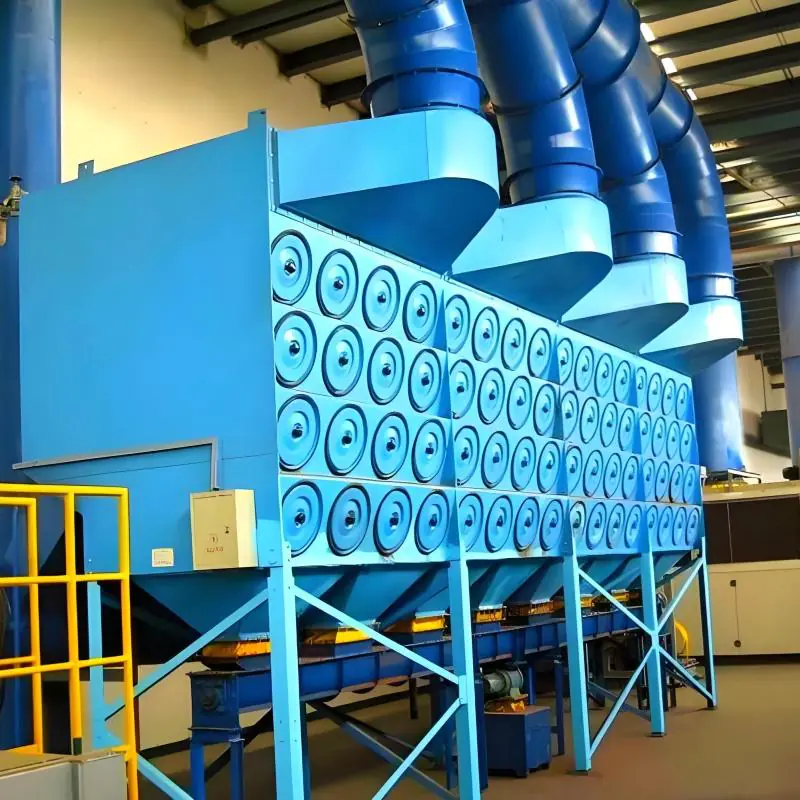
Cartridge dust collectors combine pleated filter media, pulse-jet cleaning, and a compact modular design for fine, dry dust applications.
✅ Pleated Filter Cartridges
Pleated media provides a large filtration area within a compact collector housing.
✅ Pulse-Jet Cleaning
Compressed-air pulses remove accumulated dust from the cartridge surface and help maintain stable airflow.
✅ Compact & Modular Design
Cartridge quantity and arrangement can be configured according to airflow, dust loading, installation space, and operating conditions.
✅ Easy Inspection & Replacement
Filter cartridges can be inspected and replaced without replacing the complete filtration unit.
Main Components of a Cartridge Dust Collector
A cartridge dust collector typically includes filtration, pulse-cleaning, dust discharge, monitoring, and airflow connection components.
✅ Collector Housing
Contains the filtration chamber and provides connections for dusty-air inlet, clean-air outlet, cartridges, and hopper.
✅ Pleated Filter Cartridges
The main filtration elements, selected according to dust characteristics, temperature, moisture, and operating conditions.
✅ Pulse-Jet Cleaning System
Compressed-air pipes and pulse valves deliver short air pulses to remove accumulated dust from the cartridge surface.
✅ Dust Hopper and Discharge Device
Collected dust falls into the hopper and is discharged through a rotary valve, screw conveyor, or another suitable device.
✅ Monitoring and Control
Differential-pressure monitoring and control functions help manage cartridge condition, pulse cleaning, and operating alarms.
✅ Fan and Duct Connections
The collector can connect to an external fan and duct network or operate as part of a complete dust collection system.
How Does a Cartridge Dust Collector Work?
A cartridge dust collector separates airborne dust from the extraction airflow through pleated filter cartridge media.
Dust-laden air enters the filtration chamber, where dust particles are captured on the outer surface of the cartridges while filtered air passes through the media to the clean-air section.
As dust accumulates, filtration resistance increases. Pulse-jet compressed-air cleaning removes accumulated dust from the cartridge surface, allowing the dust to fall into the hopper for discharge.
A typical operating sequence is:
Dust-laden air → cartridge filtration → clean-air section → pulse-jet cleaning → dust hopper
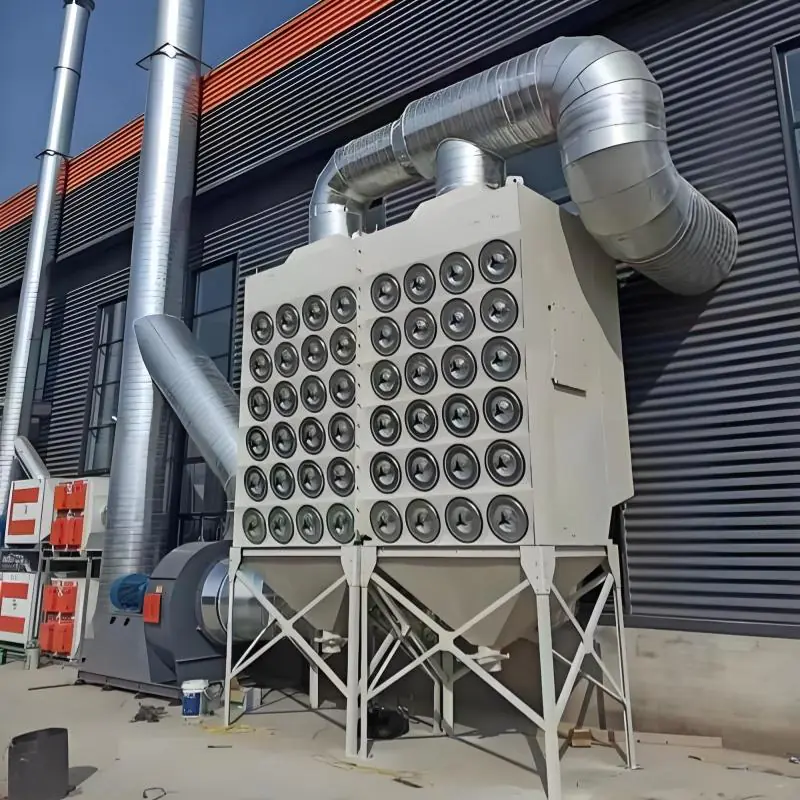
Suitable Dust Conditions and Applications
Cartridge dust collectors are generally most suitable for fine, dry dust applications where pleated cartridge media is compatible with the material, temperature, moisture, and operating environment.
✅ Cement and Powder Transfer Points
Suitable for localized dust extraction around cement packing lines, conveyor transfer points, bucket elevators, and other enclosed powder handling interfaces.
✅ Fly Ash and Fine Powder Handling
Can be used for fly ash, cement, mineral powder, and similar fine dry materials when cartridge media and dust discharge arrangements are properly selected.
✅ Compact Powder Processing Stations
Cartridge collectors can be integrated with mixers, filling equipment, feeders, and other compact processing equipment where installation space is limited.
Cartridge collectors are not suitable for every dust condition. High moisture, sticky dust, elevated temperature, heavy dust loading, or abrasive particles should be evaluated before equipment selection.
For broader dust management across conveying, transfer, loading, and discharge points, see our Dust Control System.
Cartridge Dust Collector vs Bag-Type Dust Collectors
Cartridge Dust Collector vs Pulse Jet Bag Dust Collector
Cartridge dust collectors use pleated filter cartridges, while pulse-jet bag dust collectors use cylindrical filter bags supported by cages.
Both collector types may use compressed-air pulse cleaning. The main difference is therefore the filter element and collector configuration, not the cleaning principle.
Cartridge collectors are often considered for compact fine-dust applications, while pulse-jet bag collectors can be configured for a wider range of cement and bulk powder dust-loading conditions.
For compact bag-type dust collection equipment, see our Pulse Jet Dust Collector.
Cartridge Dust Collector vs Baghouse
Industrial baghouses use filter bags and are typically selected for larger airflow, centralized dust extraction, or larger filtration requirements.
Cartridge collectors are generally more compact, while baghouses are more suitable for larger centralized dust collection duties.
Selection should consider airflow, dust concentration, particle characteristics, temperature, moisture, installation space, and maintenance requirements.
For centralized cement plant dust collection, see our Bag Filter.
Information Required for Cartridge Dust Collector Selection
Cartridge dust collector selection should be based on actual dust characteristics, airflow requirements, and operating conditions rather than collector size alone.
Please provide:
✅ Dust or material name
✅ Required airflow and dust concentration
✅ Particle characteristics and bulk density, if available
✅ Operating temperature and moisture conditions
✅ Required filtration or emission conditions
✅ Available installation space and connection dimensions
✅ Dust hopper and discharge arrangement
✅ Available compressed-air pressure and power supply
✅ Continuous or intermittent operating requirements
This information helps determine the collector size, cartridge arrangement, cleaning system, dust discharge method, and connection configuration.
Filter Cartridge Media Selection
Filter cartridge media should be selected according to dust characteristics, operating temperature, moisture, abrasiveness, chemical exposure, filtration requirements, and cleaning conditions.
Cartridges suitable for ordinary dry mineral dust may not be suitable for high-temperature, sticky, oily, or chemically aggressive dust.
The final media specification should therefore be confirmed according to actual operating conditions rather than cartridge dimensions alone.
For additional technical background on cartridge filtration and pulse-jet cleaning, refer to the U.S. EPA guidance on cartridge collectors.
Inspection and Maintenance
Routine inspection helps maintain stable airflow and identify cartridge or pulse-cleaning problems before they affect dust collection performance.
Operators should regularly check:
✅ Differential pressure
✅ Cartridge condition
✅ Pulse valves and compressed-air pressure
✅ Seals and access-door leakage
✅ Hopper and dust discharge operation
✅ Fan and duct condition
✅ Abnormal airflow or pressure changes
A continuously increasing differential pressure may indicate insufficient pulse cleaning, cartridge blockage, excessive dust loading, or unsuitable dust conditions. Abnormally low differential pressure may indicate damaged cartridges, leakage, or incorrect installation.
Filter cartridges should be replaced according to their actual condition and operating performance rather than a fixed service interval alone.
Cartridge Dust Collector FAQs
What is a cartridge dust collector?
A cartridge dust collector uses pleated filter cartridges to separate airborne dust from an extraction airflow. Its compact filtration arrangement makes it suitable for many fine, dry industrial dust applications.
Does a cartridge dust collector use pulse-jet cleaning?
Many industrial cartridge collectors use pulse-jet compressed-air cleaning to remove accumulated dust from the cartridge surface and control filtration resistance.
What is the difference between a cartridge dust collector and a pulse jet bag dust collector?
A cartridge dust collector uses pleated filter cartridges, while a pulse jet bag dust collector uses filter bags supported by cages. Both types may use pulse-jet cleaning.
What types of dust are suitable for cartridge dust collectors?
They are commonly considered for fine, dry dust where the selected cartridge media is compatible with the material, temperature, moisture, dust concentration, and operating conditions.
Can a cartridge dust collector handle high-temperature or abrasive dust?
It may be possible when suitable cartridge media and collector construction are selected. Maximum operating temperature, particle abrasiveness, dust concentration, and filter media compatibility should be confirmed before selection.
What information is required to select a cartridge dust collector?
Typical information includes dust type, airflow requirement, dust concentration, operating temperature, moisture conditions, installation space, filtration requirements, compressed-air supply, and dust discharge arrangement.
Need Help Selecting a Cartridge Dust Collector?
Send LVRUI your dust or material type, required airflow, dust concentration, operating temperature, moisture conditions, available installation space and dust discharge requirements. LVRUI will recommend a suitable cartridge arrangement, filter media, pulse-cleaning configuration and system connection for your operating conditions.
✅ Cartridge arrangement selected according to airflow and dust conditions
✅ Filter media selected according to dust properties, temperature and moisture
✅ Pulse-cleaning and dust discharge configuration matched to operating requirements
✅ Inlet, outlet and system connection recommendations based on site layout