
Air-Fluidized Double Shaft Mixer for Cement and Fly Ash
Dry Powder Blending with Bottom Aeration Boxes and Double-Shaft Mixing Blades
What Is a Double Shaft Mixer?
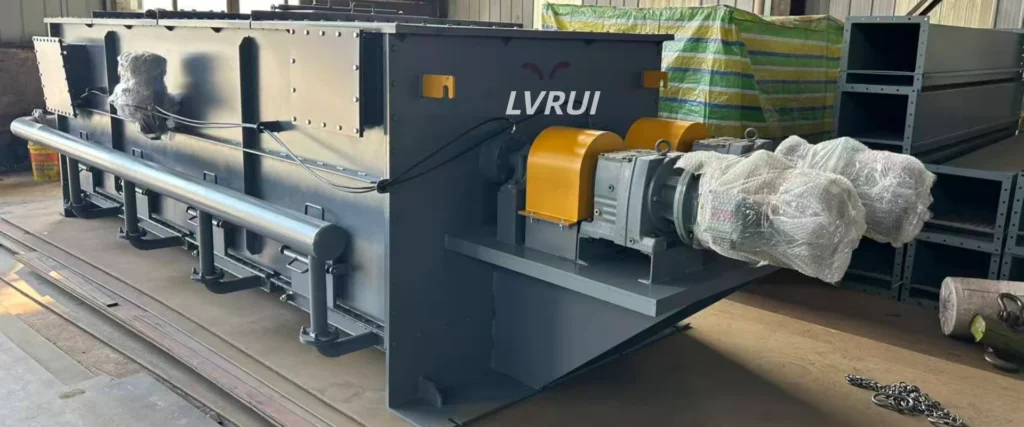
The LVRUI double shaft mixer is an industrial dry powder mixing machine equipped with two counter-rotating shafts, multiple mixing blades and bottom aeration boxes. Low-pressure air supplied by a Roots blower passes through the aeration boxes to loosen and partially fluidize cement, fly ash, mineral powder and other fine dry materials. The rotating blades then lift, circulate and cross-mix the loosened powders inside the chamber before the blended material is discharged. Unlike a fly ash conditioner or pugmill mixer, this machine is designed for dry powder blending without water addition.
Key Features
✅ Bottom air fluidization
Aeration boxes distribute low-pressure air beneath the powder bed to reduce compaction and improve powder mobility during mixing.
✅ Counter-rotating double shafts
Two parallel shafts rotate in opposite directions to create repeated lifting, circulation and cross-mixing inside the chamber.
✅ Dry mixing without water addition
The machine blends dry cementitious powders without changing their moisture content.
✅ Suitable for fine industrial powders
Typical materials include cement, fly ash, slag powder, mineral powder, lime powder and other compatible dry materials.
✅ Wear-resistant internal components
Mixing blades and replaceable liners can be selected according to the abrasiveness of the handled powder.
✅ Customized system connections
Inlet, outlet, aeration piping, discharge gate and downstream conveyor interfaces are manufactured according to the project layout.
How Does an Air-Fluidized Double Shaft Mixer Work?
Dry powders enter the mixing chamber while a Roots blower supplies low-pressure air to the bottom aeration boxes. Air passes through the permeable fabric, loosening and partially fluidizing the powder near the chamber floor.
Two counter-rotating shafts then drive the mixing blades to lift, circulate and cross-mix the materials. After the required mixing cycle, the blended dry powder is discharged through the outlet gate.
✅ Powder feeding
✅ Bottom air fluidization
✅ Double-shaft mechanical mixing
✅ Final material discharge
Mixing time depends on the material ratio, bulk density, particle-size difference, filling level and required blending consistency.
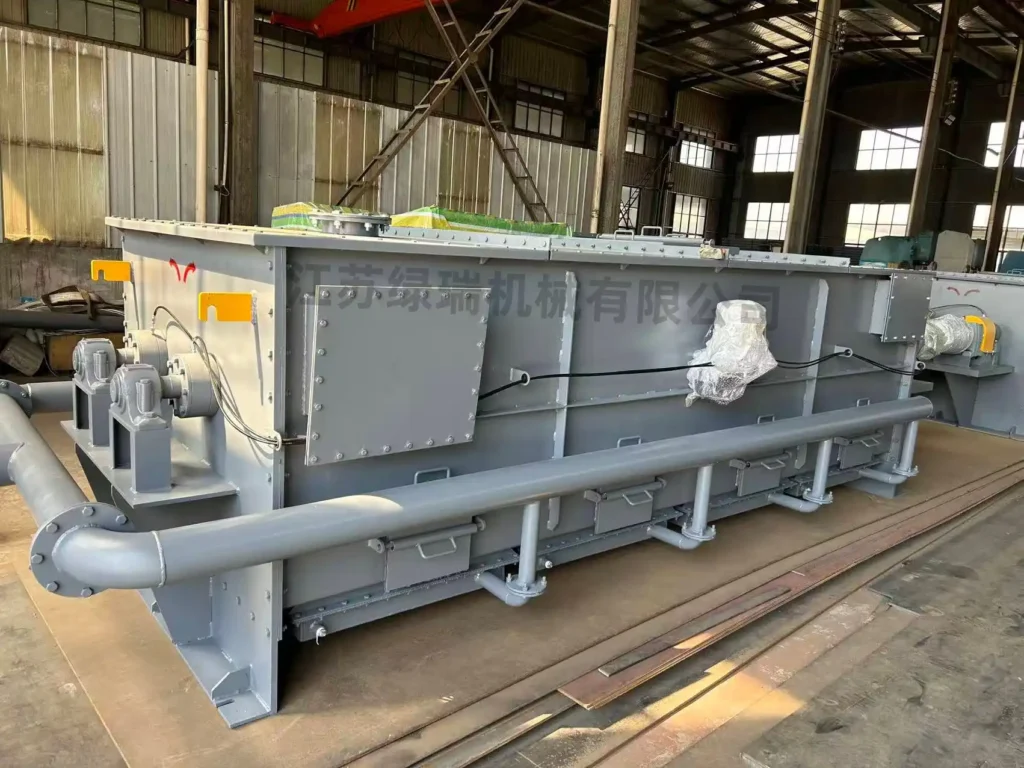
Powder fluidization behaviour varies with material flow properties, so the aeration airflow and pressure should be selected from actual material data rather than mixer size alone. See this AIChE research on powder fluidization and flow properties for broader technical background.
Why Bottom Aeration Is Important
Fine powders such as cement, fly ash and mineral powder can compact around the bottom of a conventional mixer. The bottom aeration system uses low-pressure air to loosen the powder bed, reduce stagnant material and support more effective double-shaft mixing.
Aeration assists rather than replaces the mixing blades. The air improves powder mobility, while the double shafts and blades perform the main blending action. Airflow should be correctly controlled to avoid insufficient fluidization or excessive dust entering the vent system.
For related low-pressure powder fluidization equipment, see LVRUI’s aeration pads for cement silos and powder discharge systems.
Main Components
| Component | Function |
|---|---|
| Mixing Chamber | Contains the dry powders during blending |
| Double Shafts | Provide counter-rotating mechanical movement |
| Mixing Blades | Lift, turn, circulate and cross-mix the powders |
| Drive Motor and Reducer | Provide shaft speed and mixing torque |
| Bottom Aeration Boxes | Distribute fluidizing air beneath the powder bed |
| Air Slide Fabric | Allows air to pass while supporting the powder above |
| Roots Blower Connection | Supplies low-pressure air to the aeration system |
| Wear Liners | Protect the chamber from abrasive powders |
| Discharge Gate | Releases the blended material after mixing |
| Sealed Cover and Vent | Help limit dust escape and manage displaced air |
The aeration boxes should use suitable permeable fabric and support structures so that air can pass evenly across the bottom mixing zone.
Where fine dust is displaced during powder feeding or aeration, the mixer vent can be connected to a bag filter or the plant’s existing dust collection system.
Technical Specifications
The following values are for preliminary model selection. Actual output depends on the material properties, filling ratio, mixing requirements, feeding arrangement and discharge cycle.
| Model | DSG100 | DSG150 | DSG200 |
|---|---|---|---|
| Reference Throughput | 50–100 t/h | 80–150 t/h | 120–200 t/h |
| Reference Mixing Time | 60–120 s | 60–120 s | 60–120 s |
| Main Drive Power | 11–18.5 kW | 18.5–22 kW | 22–30 kW |
| Mixing Structure | Counter-rotating double shafts | Counter-rotating double shafts | Counter-rotating double shafts |
| Bottom Aeration | Roots blower and aeration boxes | Roots blower and aeration boxes | Roots blower and aeration boxes |
| Discharge Gate | Pneumatic | Pneumatic | Pneumatic |
| Wear Protection | High-manganese or alloy-steel options | High-manganese or alloy-steel options | High-manganese or alloy-steel options |
Final mixer dimensions, blade arrangement, motor power, aeration-box layout, Roots blower parameters and discharge configuration must be confirmed according to the approved technical drawing.
The reference throughput and mixing time should not be treated as guaranteed values for every material combination.
Suitable Materials and Applications
The double shaft dry powder mixer is intended for fine, dry and compatible bulk powders.
Typical Materials
✅ Cement
✅ Fly ash
✅ Slag powder
✅ Mineral powder
✅ Lime powder
✅ Limestone powder
✅ Gypsum powder
✅ Cementitious powder blends
Wet, sticky, pasty or heavily lumpy materials are not suitable for the standard dry-mixing design. Material moisture, particle-size distribution, bulk density, abrasiveness and fluidization behaviour should be confirmed before selection.
Typical Applications
✅ Cement and fly ash blending
✅ Cement and mineral powder mixing
✅ Slag powder and cementitious material blending
✅ Dry powder proportioning and homogenization
✅ Powder mixing before silo storage or downstream processing
✅ Dry ash blending in cement plants and bulk powder terminals
After mixing, the blended powder can be discharged to an air slide conveyor, screw conveyor, downstream silo or bulk loading system.
How to Select a Double Shaft Mixer
Please provide:
✅ Material names, mixing ratio, bulk density and particle size
✅ Moisture content and material temperature
✅ Required capacity and blending consistency
✅ Feeding method and discharge arrangement
✅ Downstream equipment and connection dimensions
✅ Power supply, control, venting and site drawing
The mixer size, shaft power and bottom aeration layout are selected according to the actual material load, powder properties and required airflow distribution.
How to Choose the Right Double Shaft Mixer
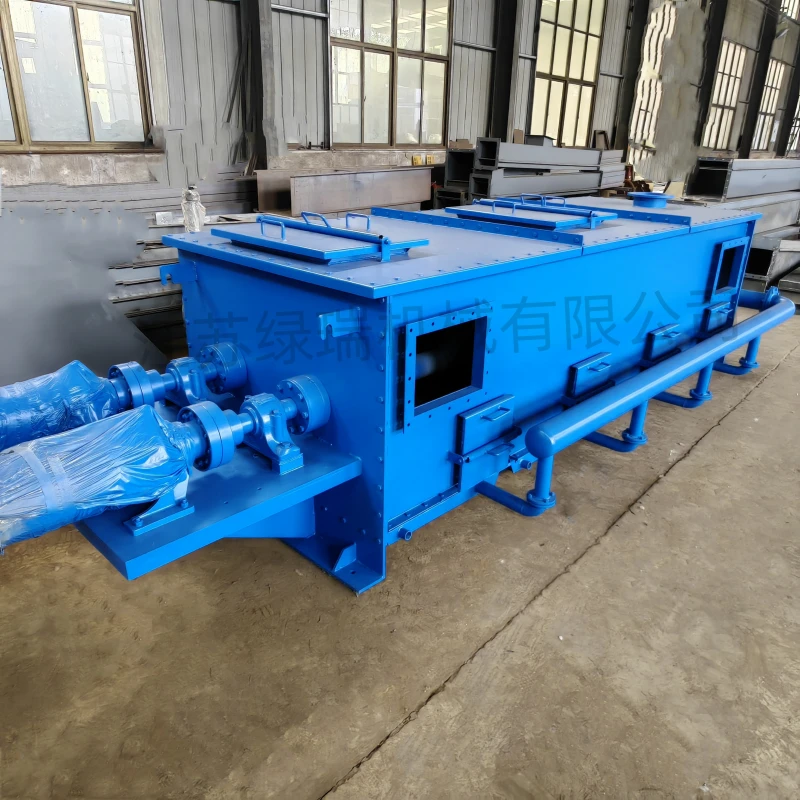
Selecting the right double shaft mixer requires more than choosing a capacity model. The mixer should match the material properties, moisture requirement, discharge method, compressed air condition and downstream conveying system.
| Selection Factor | What to Confirm |
|---|---|
| Material Name | Cement, fly ash, lime powder, dry mortar, sludge or mineral powder |
| Bulk Density | t/m³ or kg/m³ |
| Required Capacity | t/h |
| Moisture Requirement | Dry mixing or moisture conditioning |
| Material Abrasion | Whether wear-resistant liner is required |
| Feeding Method | Screw conveyor, air slide conveyor, silo outlet or manual feeding |
| Discharge Method | Pneumatic gate, gravity discharge or conveyor connection |
| Bottom Aeration Requirement | Whether compressed air aeration is required from the mixer bottom |
| Compressed Air Data | Air pressure, air volume and available air source |
| Motor Power | Based on capacity and material load |
| Dust Control | Whether sealed cover or dust collector interface is required |
| Site Layout | Inlet height, outlet height and maintenance space |
For fine powder materials such as cement, fly ash and lime powder, bottom aeration is especially useful when the material may become compacted or difficult to discharge. The air pressure and air volume should be confirmed according to material flowability, mixer model and site operating conditions.
Double Shaft Mixer with Bottom Aeration vs Conventional Powder Mixer
A conventional double shaft mixer relies mainly on mechanical paddles, so fine powder may compact near the chamber bottom. LVRUI’s bottom-aerated powder mixer uses low-pressure air from aeration boxes to loosen the powder bed, while the double shafts and blades complete the mixing.
It is designed for dry cementitious powders and differs from wet pugmill mixers, fly ash conditioners, air-only powder mixers and conventional fluidized-zone mixers.
Manufacturing and Inspection
Each air-fluidized double shaft mixer is manufactured according to the confirmed material data and approved drawing.
Before shipment, LVRUI checks:
✅ Mixer dimensions and connection interfaces
✅ Shaft alignment, blade arrangement and internal clearance
✅ Motor, reducer and discharge-gate operation
✅ Aeration-box installation, fabric and air-chamber sealing
✅ Surface coating, marking and packing
Technical drawings, operating instructions and remote guidance are provided. On-site installation is completed by the customer or its local contractor.
Double Shaft Mixer FAQs
What is a double shaft mixer used for?
A double shaft mixer blends cement, fly ash, slag powder, mineral powder and other compatible dry materials. LVRUI’s design combines counter-rotating mixing blades with bottom aeration for fine powder applications.
How does bottom aeration improve dry powder mixing?
Low-pressure air from a Roots blower passes through the bottom aeration boxes and loosens the powder bed. This reduces material compaction near the chamber floor and helps the blades circulate and mix fine powders more effectively.
Does the mixer add water to the material?
No. The LVRUI double shaft mixer is designed for dry powder blending. Its bottom aeration system uses air rather than water and does not perform humidification or moisture conditioning.
Is a Roots blower required for the bottom aeration system?
Yes. A Roots blower supplies the low-pressure air required by the bottom aeration boxes. The blower airflow and pressure should be selected according to the mixer size, powder properties and aeration-box layout.
What materials are suitable for the mixer?
The mixer is suitable for dry cement, fly ash, slag powder, mineral powder, lime powder, gypsum powder and similar fine bulk materials. Wet, sticky or heavily lumpy materials require separate evaluation.
What information is required for a quotation?
Please provide the material names, mixing ratio, bulk density, particle size, moisture, temperature, required capacity, feeding method, discharge arrangement, power supply and site drawing.
Request a Customized Double Shaft Mixer
Send LVRUI your material data, mixing ratio, required capacity and process layout. Our team will recommend a suitable mixer model, blade arrangement and bottom aeration configuration.
✅ Dry powder mixing without water addition
✅ Roots blower and aeration-box configuration
✅ Customized inlet and discharge connections
✅ Wear-resistant blades and liners
✅ Technical drawings and control interfaces
✅ Remote technical guidance