
Canvas Shrouds for Loading Spouts and Bulk Material Transfer
Flexible Dust-Control Covers for Powder, Granular and Coarse Bulk Material Loading
What Are Canvas Shrouds?
Canvas shrouds are flexible fabric covers or sleeves installed around bulk material loading, transfer and discharge points to help contain airborne dust while accommodating limited movement, vibration or alignment variation between connected equipment.
They can be used in systems handling cement, fly ash and other fine powders, as well as clinker, aggregates, sand, gravel and other granular or lumpy bulk materials.
For coarse or abrasive materials such as clinker and aggregates, the canvas shroud normally acts as an outer dust-control enclosure. The material itself passes through an internal chute, loading passage or wear-resistant section rather than directly against the fabric cover.
Depending on the installation, a canvas shroud may also be referred to as a canvas chute sleeve, loading spout outer sleeve or conveyor dust shroud. LVRUI supplies custom canvas shrouds for new equipment and replacement applications according to the installation dimensions, movement requirements and operating conditions.
Key Features
✅ Custom Sizes and Shapes
Round, square, rectangular, tapered and other configurations can be produced according to equipment drawings or existing samples.
✅ Flexible Connection
The fabric structure accommodates limited vibration, movement and dimensional variation between adjacent equipment.
✅ Dust Control for Different Bulk Materials
Suitable configurations can help reduce dust escape during the loading or transfer of powders, clinker, aggregates and other bulk solids.
✅ Multiple Fabric Options
Fabric can be selected according to temperature, abrasion, movement frequency and environmental conditions.
✅ Replacement Customization
Existing shrouds, photographs, drawings or site dimensions can be used to confirm replacement size and fixing details.
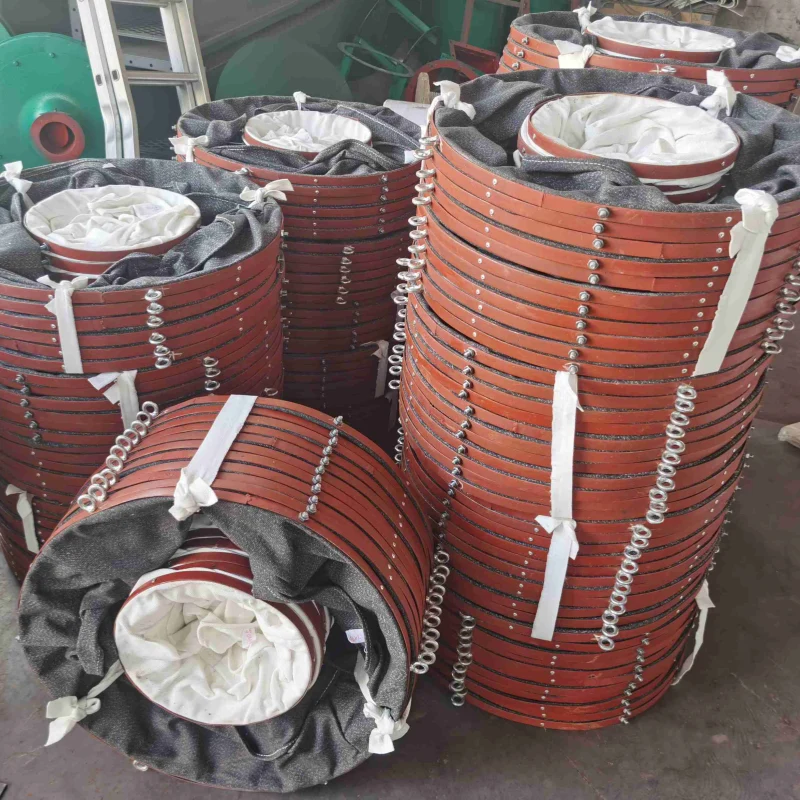
Typical Applications
Canvas shrouds can be used around a variety of bulk material handling equipment and transfer points.
Typical applications include:
✅ Cement and fly ash loading
✅ Clinker loading
✅ Aggregate, sand and gravel loading
✅ Loading spouts and loading bellows
✅ Fixed and moving discharge chutes
✅ Conveyor transfer and discharge points
✅ Silo and hopper outlet connections
✅ Dust extraction enclosures around bulk loading points
For fine powders, the shroud helps contain displaced dust around the material transfer area. For clinker, aggregates and other coarse or abrasive materials, the shroud is generally used mainly for dust containment around the loading point, while the bulk material flows through an internal aggregate loading chute or other wear-resistant loading passage.
For general reference on dust containment at bulk material transfer points, see the NIOSH guidance on dust control in mineral processing.
Common Canvas Shroud Configurations
Loading Spout Canvas Shrouds
Installed around loading spouts or loading heads to form a flexible outer enclosure during bulk loading.
For cement and fly ash, the shroud helps contain fine airborne powder. For clinker, aggregates, sand and gravel, it normally surrounds the loading passage and assists with dust collection without serving as the main material-contact surface.
Canvas Chute Sleeves
Flexible sleeves can be installed between fixed or moving chute sections where a rigid connection would not accommodate vibration or alignment variation.
They are commonly used around powder and bulk material discharge transitions.
Conveyor Dust Shrouds
Conveyor dust shrouds are installed around transfer or discharge points to reduce open gaps where dust can escape.
For abrasive granular materials, the shroud should remain outside the primary material flow wherever possible.
Silo and Hopper Outlet Sleeves
Flexible sleeves can connect silo or hopper outlets with downstream equipment where limited vibration, movement or easy replacement is required.
The dimensions and fabric should be selected according to the actual connection and material conditions.
Fabric Options
The correct fabric should be selected according to operating temperature, abrasion, movement and environmental conditions.
| Fabric Option | Typical Characteristics | Suitable Applications |
|---|---|---|
| Standard Canvas | General-purpose flexible fabric for moderate temperature and wear conditions | Standard dry bulk loading and transfer points |
| Coated Canvas | Improved resistance to dust penetration and external exposure | Loading spouts, chutes and transfer points requiring a coated surface |
| Rubber-Coated Fabric | Increased flexibility and resistance to certain mechanical wear conditions | Applications with repeated movement, vibration or moderate abrasion |
| Silicone-Coated Fabric | Suitable for applications requiring higher temperature resistance or specific surface properties | Higher-temperature loading or transfer points after operating conditions are confirmed |
| Other Fabric Options | Selected according to temperature, dust characteristics, abrasion and movement frequency | Customized applications requiring specific fabric performance |
Final fabric selection should be confirmed according to the actual operating conditions and installation requirements.
Canvas Shroud Technical Options
| Item | Available Options |
|---|---|
| Product Type | Flexible Canvas Shroud / Fabric Sleeve |
| Shape | Round / Square / Rectangular / Tapered / Custom |
| Fabric | Canvas / Coated Canvas / Rubber-Coated / Silicone-Coated |
| Width / Diameter | Customized |
| Sleeve Length | According to installation dimensions |
| Seam | Standard / Reinforced |
| Fixing Method | Flange / Clamp / Bolt-On / Custom |
| Movement | Fixed or limited-movement application |
| Material Application | Powder / Granular / Coarse Bulk Material |
| Supply Type | New Installation / Replacement |
For replacement projects, opening dimensions, overall sleeve length and fixing structure should be confirmed before production.
Canvas Shroud vs Loading Bellows Sleeve
The two terms can overlap in some loading applications, but they do not always refer to the same component.
| Item | Canvas Shroud | Loading Bellows Sleeve |
|---|---|---|
| Main Function | Flexible dust cover or equipment connection | Flexible sleeve integrated into loading bellows |
| Typical Installation | Chute, transfer point, silo outlet or loading spout | Telescopic bulk loading equipment |
| Movement | Limited or application-specific | Repeated extension and retraction |
| Structure | Simple or reinforced fabric sleeve | Must match the loading bellows structure |
| Replacement | Often supplied as an individual component | Must match the original bellows configuration |
If the required sleeve belongs to an existing loading bellows, the original dimensions, movement range and connection details should be confirmed before replacement.
How to Select a Canvas Shroud
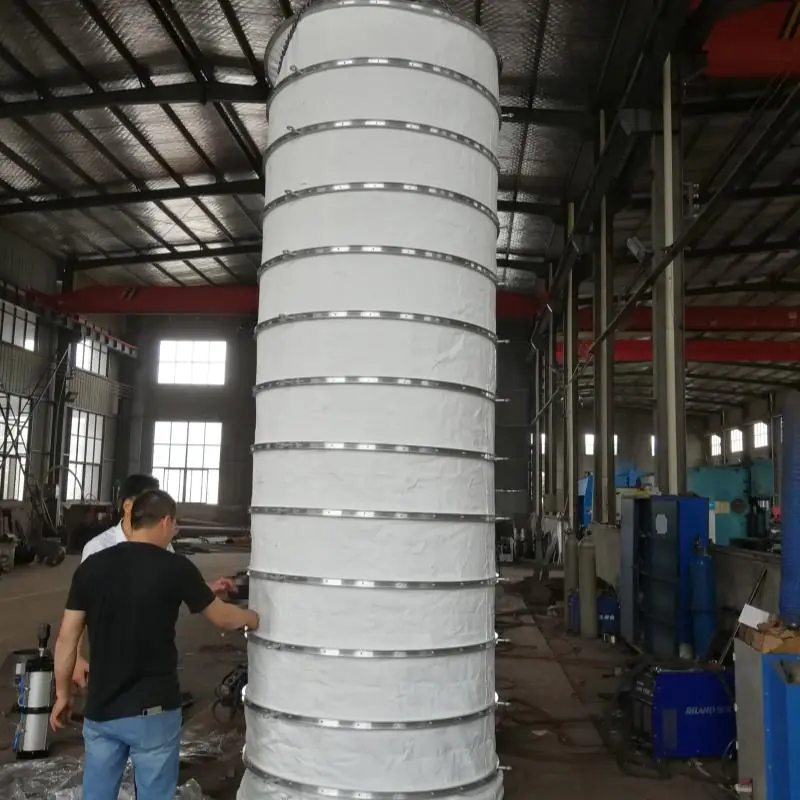
Selection should be based on the complete installation rather than fabric type alone.
Please provide:
✅ Installation position
✅ Material handled
✅ Working temperature
✅ Opening dimensions
✅ Required sleeve length
✅ Required shape
✅ Existing drawing, photograph or sample
For clinker, aggregates or other abrasive materials, also provide information about the internal material passage so that the shroud can be positioned away from direct material impact where required. LVRUI will confirm the fabric type, dimensions, seam structure and fixing configuration according to the application.
When Should a Canvas Shroud Be Replaced?
Replacement should be considered when there is:
✅ Visible tearing, holes or severe wear
✅ Broken seams or damaged fixing edges
✅ Persistent dust leakage around the sleeve
✅ Fabric hardening or permanent deformation
✅ Worn mounting holes or loose fixing points
✅ Restricted movement caused by damaged fabric
Before replacing the shroud, the flange, clamp, fixing surface and internal loading passage should also be checked. Dust leakage may result from incorrect installation or damaged surrounding components rather than the fabric alone.
Manufacturing and Inspection
LVRUI manufactures each canvas shroud according to the confirmed dimensions, fabric specification, fixing method and approved drawing or existing sample.
Before shipment, the main checks include:
✅ Overall dimensions and sleeve length
✅ Fabric material and surface condition
✅ Shape and opening dimensions
✅ Seam and reinforcement quality
✅ Product identification and packing
For replacement canvas shrouds, the finished dimensions can also be checked against the original drawing, sample or confirmed site measurements before shipment.
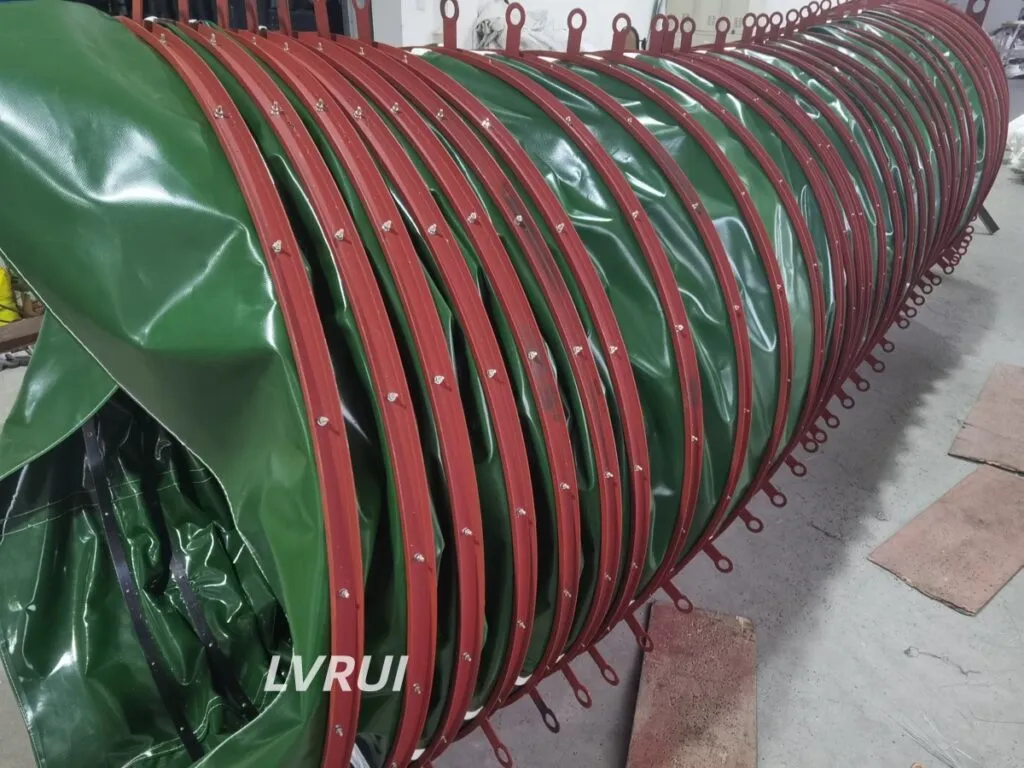
Canvas Shrouds FAQs
What is a canvas shroud used for?
A canvas shroud is a flexible fabric cover used around bulk material loading, transfer or discharge points. It helps contain airborne dust while accommodating limited movement, vibration or alignment variation between connected equipment.
Can canvas shrouds be used for clinker and aggregate loading?
Yes. Canvas shrouds can be used around clinker, aggregate, sand and gravel loading points to help contain airborne dust. In these abrasive applications, the material normally passes through an internal chute or wear-resistant loading passage, while the canvas shroud acts mainly as the outer dust-control enclosure.
Where are canvas shrouds commonly installed?
Typical locations include loading spouts, loading heads, discharge chutes, conveyor transfer points, silo outlets, hopper connections and other bulk material loading or transfer interfaces.
What is the difference between a canvas shroud and a loading bellows sleeve?
A canvas shroud is a general flexible dust-control cover or connection used around loading and transfer points. A loading bellows sleeve is specifically designed as part of a telescopic loading bellows and must match its movement, dimensions and connection structure.
What fabric materials are available for canvas shrouds?
Available options may include standard canvas, coated canvas, rubber-coated fabric and silicone-coated fabric. The appropriate material should be selected according to operating temperature, abrasion, movement and environmental conditions.
What information is required for a replacement canvas shroud?
Provide the installation position, material handled, opening dimensions, required sleeve length, fixing method and working conditions. Photographs, drawings or an existing sample are especially useful for confirming replacement dimensions and construction.
Need Help Selecting a Canvas Shroud?
Send LVRUI your installation position, opening dimensions, required sleeve length, working temperature, existing drawing, photo or sample. LVRUI will confirm a suitable fabric, shape and connection configuration for your application.
✅ Custom round, square or rectangular dimensions
✅ Fabric selected according to temperature and wear conditions
✅ Replacement dimensions matched to existing equipment