
Dust Free Bulk Truck Loading System for Trucks and Tankers
Dust-Controlled Loading for Cement, Fly Ash, Clinker and Other Dry Bulk Materials
What Is a Dust Free Bulk Truck Loading System?
A dust free bulk truck loading system is a truck or tanker loading arrangement designed to control dust release, material spillage and overfilling while dry bulk material is transferred into the receiving vehicle.
Dust control during loading depends on several coordinated factors, including material feed rate, loading-head sealing, free-fall distance, displaced-air handling, dust extraction and the loading stop sequence.
Closed tankers and open trucks require different loading arrangements. LVRUI configures the loading equipment according to the material, required capacity, vehicle opening, installation height, available dust extraction and plant interface.
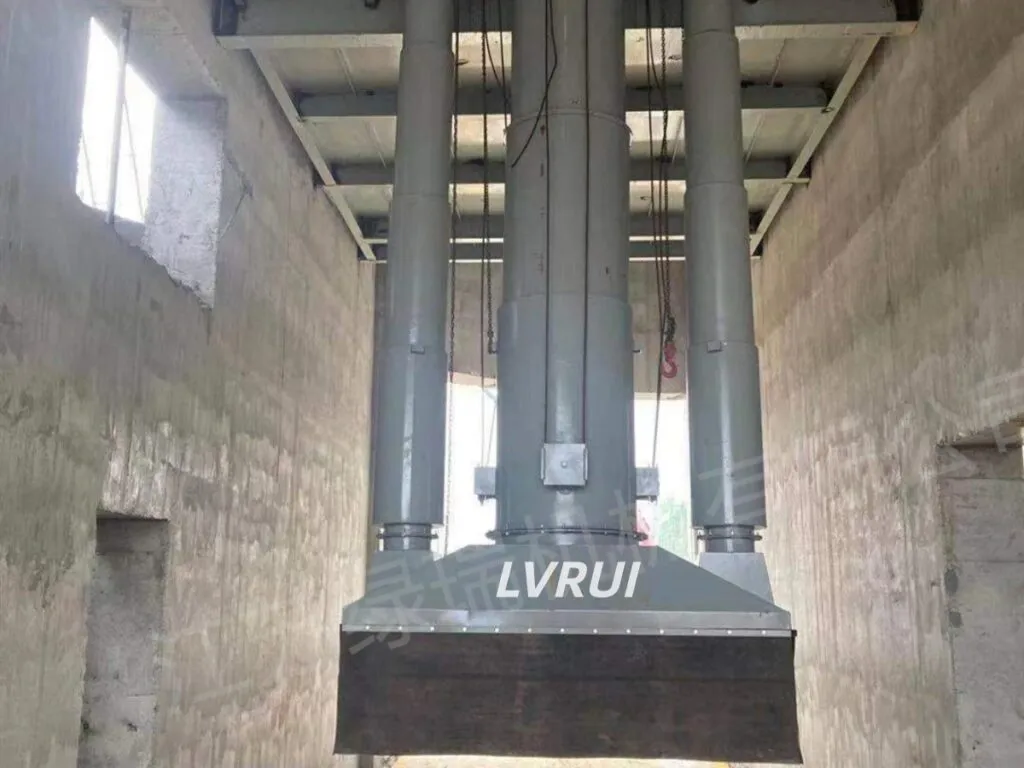
Where Is Dust Generated During Bulk Loading?
Dust during truck loading mainly comes from:
✅ Material free fall inside the chute or vehicle
✅ Air displaced as material enters a tanker or truck
✅ Gaps around the loading connection
✅ Excessive or unstable material feeding
✅ Material remaining in the chute during retraction
A loading spout alone cannot eliminate every dust problem. The loading connection, feed rate, extraction system and stopping signal must operate together.
Closed Tanker Loading vs Open Truck Loading
Closed Tanker Loading
Closed tankers normally use a sealed loading head, dust-return connection and high-level detection.
The loading head connects with the tanker inlet while displaced air is directed toward an integrated filter or external dust collection system. This arrangement is mainly used for fine powders that generate significant displaced air during filling.
Open Truck Loading
Open trucks normally use a telescopic loading chute that remains close to the material surface.
Reducing the free-fall distance limits the area in which dust can spread. A flexible skirt or dust extraction connection may be added according to the material and required dust-control level.
The two loading methods should not be treated as interchangeable. Vehicle opening, material characteristics, displaced-air volume, loading height and required dust-control level determine the appropriate loading arrangement.
Equipment Involved in Dust-Controlled Truck Loading
Effective truck-loading dust control depends on the loading equipment and several supporting interfaces working together. The following components directly affect dust containment and loading stability.
Loading Spout or Loading Chute
The loading spout directs material into the receiving vehicle and limits uncontrolled free fall.
A sealed loading head is generally used for closed tankers. A wider telescopic chute with a flexible outlet is more suitable for open trucks.
Flow Control Equipment
A flow control gate regulates the material feed rate from the silo or conveyor. A shut-off valve or upstream conveyor stop isolates the material after loading.
Flow control equipment does not prevent overfilling by itself.
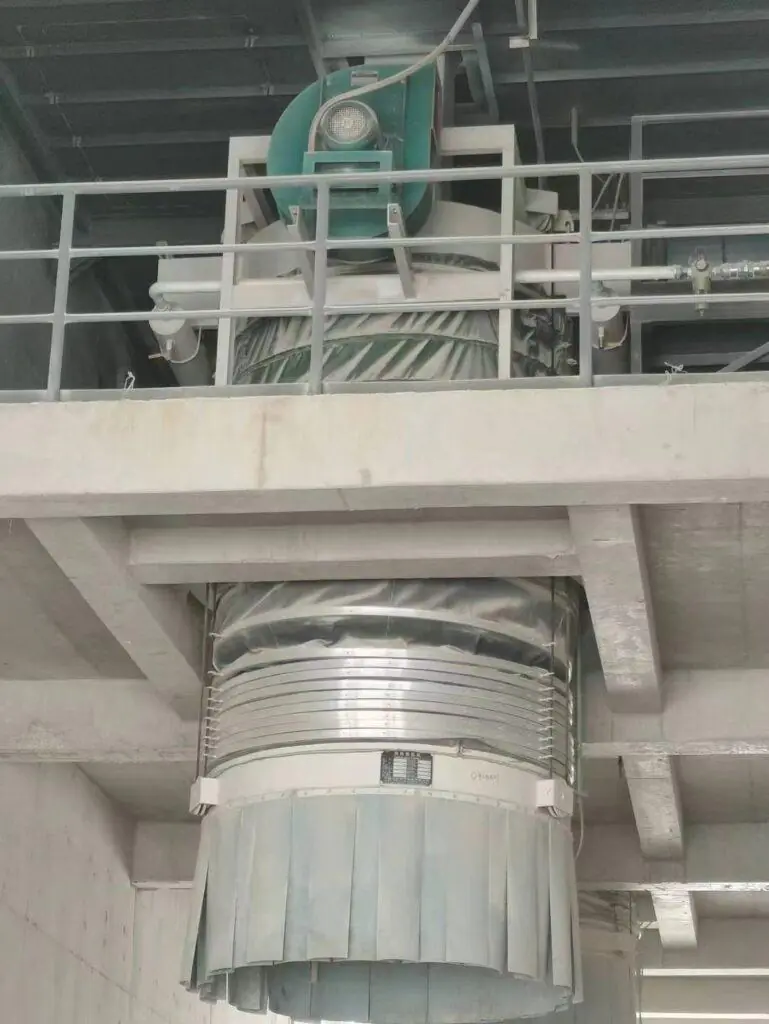
Dust Collection Connection
Dust may be collected through:
✅ An integrated filter mounted on the loader
✅ A separate bag filter or pulse jet dust collector
✅ A return-air duct connected to an existing dust collection system
The correct configuration depends on the required extraction airflow, duct resistance, loading rate and available space.
Level Detection
A high-level sensor detects when the material reaches the required filling level.
The loading stop signal may also come from an external weighing system, truck scale or plant PLC, depending on the project configuration.
Lifting and Positioning System
An electric hoist or lifting mechanism lowers and retracts the loading spout. Limit switches control the permitted travel and stop positions.
Electrical Interlock
The control system coordinates the dust collector, upstream conveyor, flow-control equipment, loading spout and level signal.
The final sequence is configured according to the selected equipment and plant-control requirements.
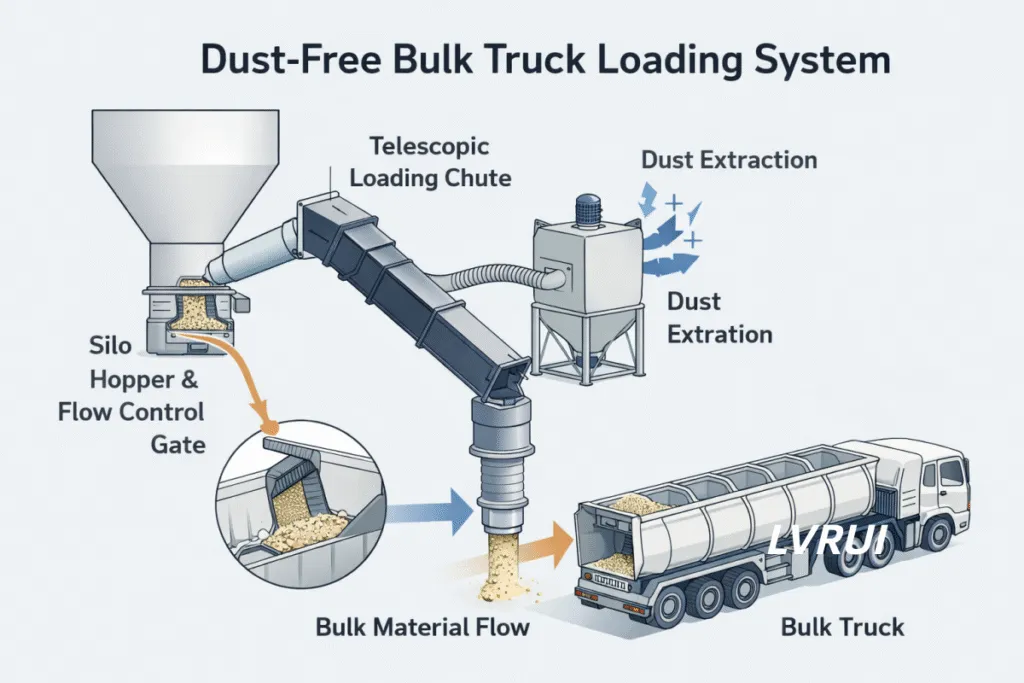
Typical Loading Sequence
A dust free bulk truck loading system typically follows this loading sequence:
- The truck or tanker moves into the loading position.
- The loading spout lowers toward the tanker inlet or truck bed.
- Dust extraction starts before material feeding.
- The flow-control device opens gradually.
- Material loading and dust extraction operate together.
- A high-level or weighing signal stops upstream feeding.
- Remaining material clears from the chute.
- The loading spout retracts after material flow has stopped.
Starting dust extraction before feeding and allowing the chute to clear before retraction help reduce dust release and spillage.
Dust-Control Arrangement by Material and Vehicle Type
| Material | Receiving Vehicle | Typical Dust-Control Arrangement | Main Dust-Control Check |
|---|---|---|---|
| Cement or fly ash | Closed tanker | Sealed loading head with return-air path, level detection and dust extraction | Tanker inlet sealing and displaced-air volume |
| Lime or mineral powder | Closed tanker | Sealed loading head with controlled feed and dust return | Flowability, loading rate and dust concentration |
| Clinker | Open truck | Heavy-duty telescopic chute with controlled drop height | Abrasion, particle size and free-fall distance |
| Aggregate or limestone | Open truck | Wide-outlet chute with flexible skirt | Truck-bed coverage and dust generated during impact |
| Fertilizer granules or grain | Open truck | Telescopic chute with suitable dust-containment arrangement | Material dustiness and loading pattern |
| Mixed-use loading bay | Tanker or open truck | Vehicle-specific loading heads or separate loading arrangements | Whether one station can maintain effective dust control for both vehicles |
Fine cement powder and abrasive clinker require different loading structures because their particle size, flow behaviour and receiving vehicles are different.
Granular and abrasive clinker normally requires a dedicated clinker bulk loader rather than a fine-powder tanker loader.
Dust Problems and Recommended Checks
| Loading Problem | Likely Cause | Recommended Check |
|---|---|---|
| Dust escapes around the tanker inlet | Poor sealing or insufficient extraction | Check the loading head, gasket and return-air flow |
| A dust cloud forms above an open truck | Excessive free-fall distance | Lower the chute and inspect the lifting control |
| Material overflows | Late level signal or delayed shutdown | Check sensor position, valve closing time and conveyor delay |
| Dust capture becomes weak | Blocked filters or low airflow | Inspect filters, fan, ducting and pulse cleaning |
| Loading rate fluctuates | Unstable silo discharge or feeding | Review the silo outlet, flow gate and conveyor capacity |
| Material remains inside the chute | Poor flowability or early retraction | Check moisture, chute angle and clearing time |
The complete loading line should be checked before replacing one component. A dust problem caused by the silo, conveyor or collector cannot always be solved by changing the loading spout.
The complete loading line should be checked before replacing one component. A dust problem caused by the silo, conveyor or dust collector cannot always be solved by changing the loading spout. For detailed root-cause checks related to dust escaping around the loading point, see our Loading Spout Dust Leakage Troubleshooting Guide.
Integration with Existing Silos and Conveyors
The loading system can connect with an existing silo, hopper, air slide conveyor, screw conveyor or other compatible feeding equipment.
Before integration, LVRUI reviews the outlet interface, available mounting height, structural support, dust extraction connection and control signals. The upstream equipment capacity must also match the required truck-loading rate.
For a coordinated station that includes upstream feeding, level control and electrical interlocks, refer to the complete bulk loader system.
Information Needed to Evaluate Truck Loading Dust Control
To evaluate the loading arrangement and identify the main dust-control requirements, please provide the following information:
✅ Material name, bulk density and particle size
✅ Moisture, temperature and abrasiveness
✅ Required loading capacity
✅ Closed tanker or open truck type
✅ Tanker inlet or truck-bed dimensions
✅ Mounting height and required chute travel
✅ Silo or conveyor outlet dimensions
✅ Existing dust collection arrangement
✅ Required level or weighing control
✅ Plant layout, drawings or site photographs
The required capacity must be checked across the silo outlet, valve, conveyor, loading spout and dust collection system. Actual output will be limited by the lowest-capacity stage.
Equipment Supply and Interface Support
LVRUI supplies loading spouts, flow-control equipment, level-detection components and dust-collection equipment for bulk truck and tanker loading applications.
Based on the confirmed site data, we can check the equipment interfaces, loading height, inlet and outlet dimensions, dust connection and control requirements and provide the necessary connection drawings for equipment supply.
On-site installation is completed by the customer or its appointed local contractor.
Dust Free Bulk Truck Loading System FAQs
What causes dust during bulk truck loading?
Dust during bulk truck loading is mainly generated by material free fall, displaced air, leakage around the loading connection and excessive or unstable feeding.
What is the difference between tanker and open-truck loading?
A closed tanker normally uses a sealed loading head, dust-return connection and high-level sensor. An open truck generally uses a telescopic chute that remains close to the material surface.
How does a loading spout reduce dust?
A loading spout directs material into the vehicle, shortens the free-fall distance and limits the area in which dust can spread. It may also provide a connection for dust extraction.
How is truck or tanker overfilling prevented?
A high-level sensor, weighing signal or plant-control interlock initiates the loading stop sequence. Depending on the system configuration, it may stop the upstream conveyor and close the material valve. A flow control gate alone is not sufficient overfill protection.
Can the system connect to an existing silo or conveyor?
Yes. The outlet interface, mounting height, support structure, loading capacity, dust connection and control signals must be reviewed before integration.
What determines the required dust extraction airflow?
Required airflow depends on the material loading rate, receiving opening, displaced-air volume, loading-head sealing, free-fall distance and duct resistance. The dust collector should be selected from the complete loading arrangement rather than the loading-spout diameter alone. For general principles on the design, commissioning and testing of dust extraction systems, refer to the HSE’s local exhaust ventilation guidance.
Discuss Your Dust Free Bulk Truck Loading System Requirements
Send LVRUI your material data, vehicle type, required loading capacity, installation height and existing dust-collection information. We can review the truck or tanker loading arrangement and recommend a suitable loading spout, feed-control, level-detection and dust-control configuration.