How Low-Pressure Air Helps Fine Powders Move More Freely During Mechanical Mixing
Quick Answer
Double shaft mixer bottom aeration is used to help loosen fine dry powder near the bottom of the mixing chamber and improve material mobility around the mixing blades.
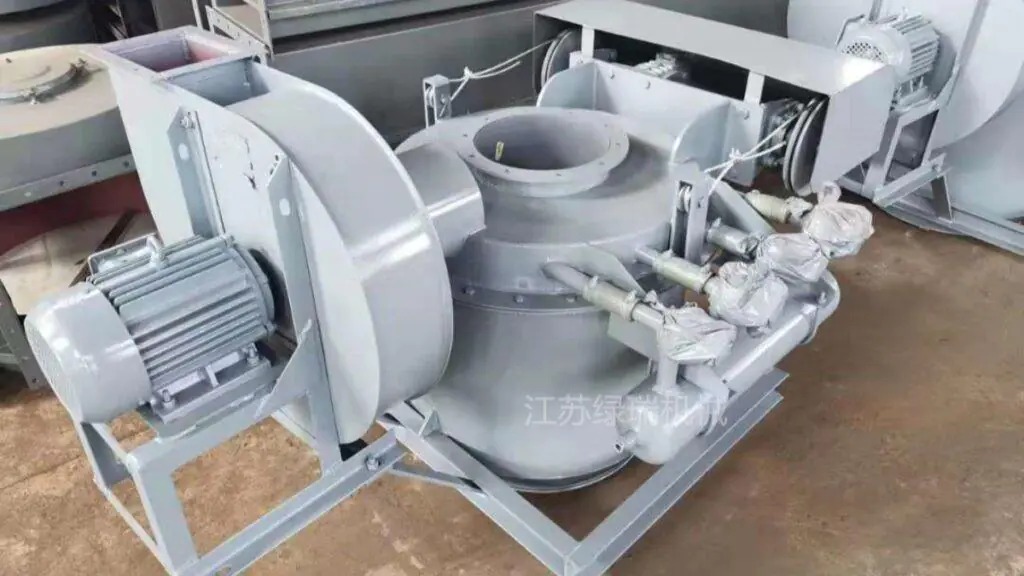
A Roots blower supplies low-pressure air through aeration boxes installed beneath the powder bed. The air passes through permeable fabric and enters the powder from below, reducing local compaction and helping the material move more freely around the mixing blades.
The operating principle is straightforward:
Bottom aeration improves powder mobility.
The double shafts and mixing blades perform the actual mixing.
For LVRUI dry powder double shaft mixers, the Roots blower typically operates at around 35 kPa, although the final airflow and blower configuration should be matched to the mixer size, aeration area and powder properties.
Why Can Fine Dry Powder Be Difficult to Mix?
Mechanical mixers rely on blades or paddles to lift, turn and circulate material.
For coarse or relatively free-flowing materials, mechanical movement alone may be sufficient. Fine powders can behave differently.
Typical materials include:
- Cement
- Fly ash
- Slag powder
- Mineral powder
- Lime powder
- Limestone powder
- Gypsum powder
These powders can settle and become denser under their own weight, particularly near the bottom of the mixing chamber.
When the lower powder bed becomes compacted, the mixing blades have to work through a denser material layer. Powder located close to the chamber floor may also circulate less actively than material directly within the main blade movement zone.
This does not necessarily mean the mixer lacks motor power.
In many cases, improving the mobility of the lower powder layer can make mechanical mixing more effective.
That is the main purpose of bottom aeration.
How Does Bottom Aeration Work in a Double Shaft Mixer?
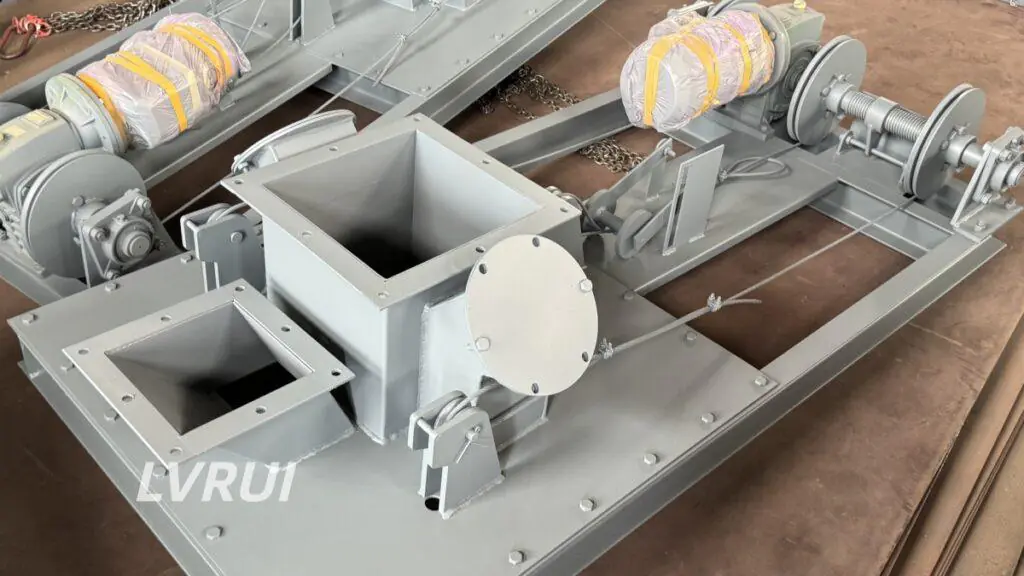
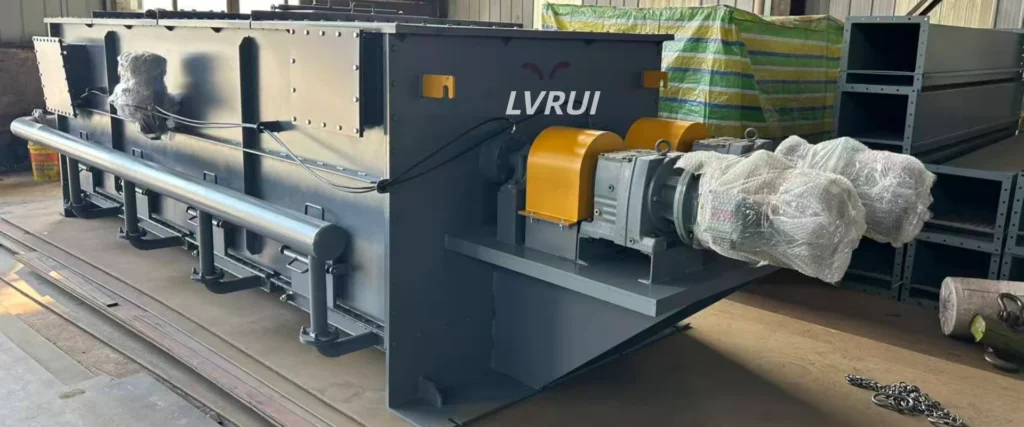
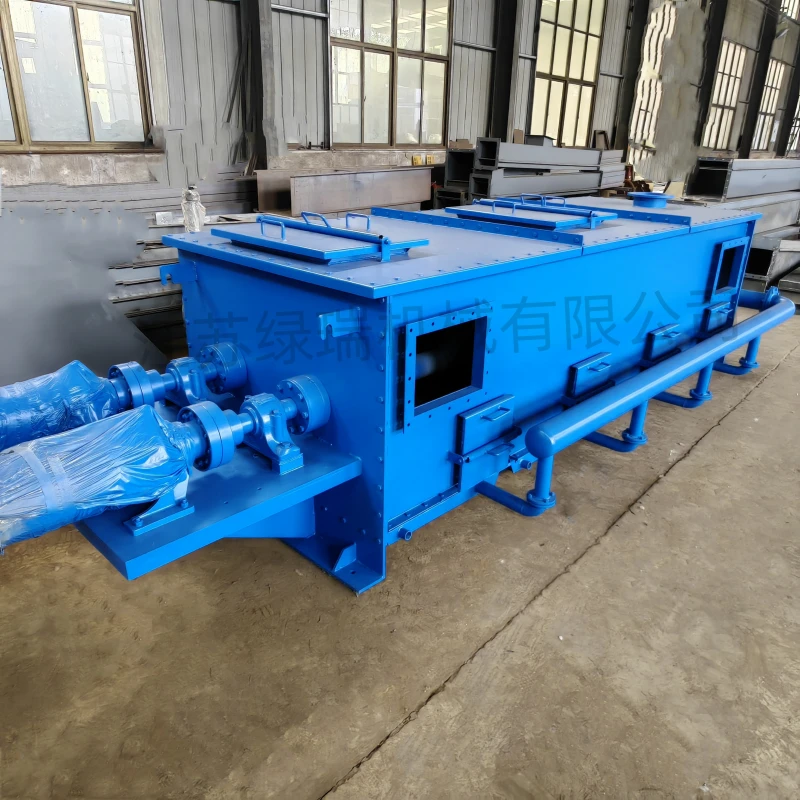
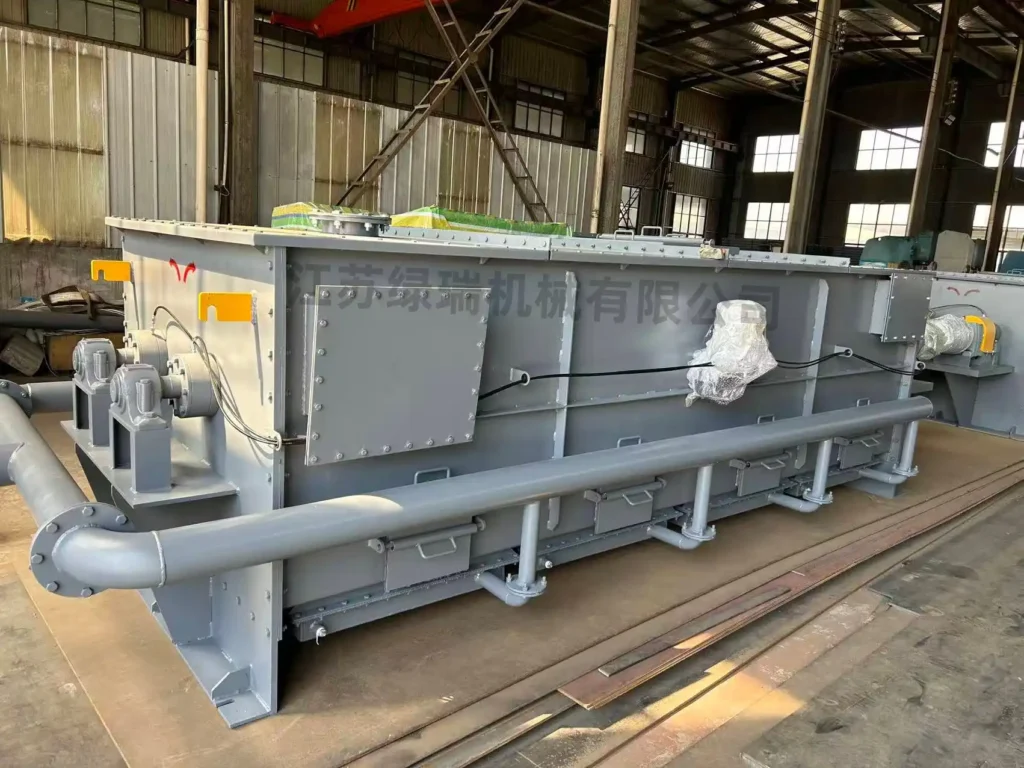
For the complete equipment structure, specifications and application range, see the LVRUI double shaft mixer product page.
A typical system follows this sequence:
Roots Blower
↓
Air Supply Pipe and Manifold
↓
Bottom Aeration Boxes
↓
Air-Permeable Fabric
↓
Dry Powder Bed
↓
Double-Shaft Mechanical Mixing
The Roots blower supplies low-pressure air to the aeration boxes installed below the mixing chamber.
Air passes through the permeable fabric and enters the powder bed from below.
The objective is not to create a strong air jet at one location. Instead, the aeration boxes distribute air across the lower mixing area so that the powder can become looser and easier to move.
At the same time, the two shafts rotate and drive the mixing blades through the material.
This creates two complementary functions:
Aeration → loosens the lower powder bed and improves mobility
Double shafts → lift, circulate and mechanically mix the material
The machine should therefore not be confused with a purely pneumatic mixer. Air supports the process, while mechanical agitation remains the primary mixing method.
Why Is Bottom Aeration Useful?
1. Reduces Compaction Near the Mixer Bottom
The lower part of the chamber supports the weight of the powder above it.
For fine materials, this can create a denser layer near the chamber floor.
Introducing air from below helps loosen this material locally and makes it easier for the blades to move through the powder.
This is particularly useful for cementitious powders that tend to settle densely after feeding.
2. Improves Powder Mobility Around the Mixing Blades
Mixing blades can only redistribute material effectively when the powder is able to move around them.
If the powder bed is heavily compacted, more blade movement is spent forcing material away from the blade surface.
When the lower powder becomes looser, the blades can move the material through the chamber more freely.
Bottom aeration therefore supports mechanical mixing by improving the condition of the powder.
3. Helps Reduce Stagnant Material in Lower Areas
Material movement inside a mixer is not equally strong at every location.
Areas close to the chamber floor may experience less circulation than zones directly affected by the rotating blades.
Distributed bottom aeration helps keep these lower areas more active and reduces the tendency for powder to remain densely packed.
Correct blade arrangement and mixer loading are still important. Aeration does not compensate for poor mechanical design.
4. Helps Different Fine Powders Circulate Together
Dry powder mixing often involves materials with different physical properties.
For example:
Cement + Fly Ash
or:
Cement + Mineral Powder
These materials may have different:
- Bulk densities
- Particle size distributions
- Fineness
- Flowability
- Aeration response
Even when several materials are all classified as fine powders, they do not necessarily move in exactly the same way inside the chamber.
Bottom aeration helps maintain powder mobility while the double shafts repeatedly circulate the materials through the mixing zone.
The objective is practical dry powder blending rather than a predefined laboratory mixing accuracy.
Why Use a Roots Blower for Bottom Aeration?
Continuous Low-Pressure Air Supply
Bottom aeration requires stable airflow rather than extremely high pressure.
A positive displacement blower, commonly known as a Roots blower, is suitable for this type of application because it can provide stable, continuous airflow for industrial aeration duties.
The air is distributed through the bottom aeration boxes and permeable fabric before entering the powder bed.
This is different from using isolated high-pressure compressed-air jets.
High-pressure air concentrated at a few locations may disturb the powder locally without providing even aeration across the lower chamber.
The goal is not:
Higher pressure = better mixing
The goal is:
Stable and reasonably uniform airflow through the aeration surface
Typical LVRUI Operating Pressure
For LVRUI dry powder double shaft mixer applications, the typical Roots blower pressure is approximately:
35 kPa
This is about 0.35 bar gauge pressure.
However, 35 kPa should not be treated as a universal value for every mixer.
Actual blower selection also depends on:
- Mixer size
- Aeration area
- Number of aeration boxes
- Air pipe resistance
- Fabric permeability
- Powder depth
- Powder bulk density
- Material flowability
Pressure alone does not determine whether the aeration system works correctly.
The blower must provide sufficient airflow through the complete system under actual operating resistance.
Why More Air Is Not Always Better
Increasing aeration airflow continuously does not necessarily improve mixing.
If airflow is too low:
- Powder may remain compacted
- Some aeration zones may not work effectively
- Material mobility may remain poor
If airflow is excessive:
- More fine dust may become suspended
- Mixer venting demand may increase
- Dust collection load may increase
- Powder movement may become unnecessarily turbulent
- Blower power consumption may increase
The purpose of aeration is to support material movement, not to turn the mixer into a pneumatic conveying system.
Mixing and Dosing Are Two Different Functions
A double shaft mixer does not determine how much of each powder enters the machine.
Material proportion is controlled upstream.
Depending on the plant arrangement, this may involve:
- Screw feeders
- Weighing systems
- Controlled silo discharge
- Other metering equipment
The mixer then blends the dry materials that have already been supplied to it.
The functions should therefore be separated clearly:
Feeding / dosing → determines the amount of each material
Double shaft mixer → mixes the supplied materials
Bottom aeration does not control the mixing ratio.
For this reason, the LVRUI double shaft mixer should not be described as a precision dosing system unless the complete upstream feeding and weighing arrangement is also included and independently verified.
A fixed mixing accuracy should also not be claimed without actual process testing.
Which Materials Are Suitable for Bottom-Aerated Mixing?
Bottom-aerated mixing is mainly suitable for fine, dry and reasonably aeratable powders, including cement, fly ash, mineral powder, slag powder and similar cementitious materials.
The concept is particularly useful when the powder tends to settle densely near the bottom of the mixer but can still respond to low-pressure aeration.
Wet, sticky, heavily caked or large-lump materials behave differently and should be evaluated separately.
Bottom aeration should not automatically be applied to every bulk material.
What Affects Bottom Aeration Performance?
Powder Properties
Powder fineness, bulk density, moisture and flowability all affect how easily air passes through the material.
Very fine powders may respond differently from denser or less permeable powders.
Moisture is especially important because it can increase particle cohesion and reduce fluidity.
Aeration Area and Layout
Air should reach the areas where powder is most likely to compact.
Simply providing one air inlet does not guarantee uniform aeration.
The number, size and arrangement of the aeration boxes should match the mixer structure.
Airflow Distribution
Good aeration depends on the complete air path:
Blower → Piping → Manifold → Aeration Box → Permeable Fabric → Powder
Air leaks, blocked branches or uneven fabric permeability can cause some areas to receive more air than others.
The air-permeable fabric separates the powder from the air chamber while allowing low-pressure air to pass through the aeration surface.
Mixer Filling Level and Venting
The amount of material inside the chamber affects powder depth and airflow resistance.
The air entering the mixer must also be able to leave.
For fine powder applications, suitable venting or connection to a dust-control system may therefore be required.
Poor venting can increase internal pressure and dust problems without improving the mixing process.
What Should Be Checked If Bottom Aeration Is Not Working Properly?
If powder mobility appears poor, simply increasing blower pressure should not be the first step.
A basic inspection should include the following.
Check the Roots Blower
Confirm that the blower is operating normally and delivering the expected pressure and airflow.
Check the Air Distribution Piping
Inspect for:
- Air leakage
- Loose connections
- Blocked branches
- Incorrectly adjusted valves
- Damaged flexible connections
Check the Aeration Boxes
Confirm that all aeration zones are receiving air.
A system where only the boxes closest to the blower receive sufficient airflow will not provide even aeration.
Inspect the Permeable Fabric
Damaged, blocked or heavily contaminated fabric can change airflow distribution.
The fabric should allow air to pass while preventing powder from entering the lower air chamber.
Check the Powder Condition
Unexpected moisture, caking or changes in bulk density can alter the way the powder responds to aeration.
A mixer operating well with one dry powder blend may behave differently if the material condition changes.
Check Venting and Dust Collection
Air entering the mixer must have a suitable escape path.
Restricted venting can create pressure and dust problems, especially if operators try to compensate by increasing blower airflow.
Frequently Asked Questions
What air pressure does a LVRUI double shaft mixer use?
For LVRUI dry powder mixer applications, the Roots blower typically supplies air at around 35 kPa. Final blower pressure and airflow should still be selected according to mixer size, aeration area, piping resistance and powder characteristics.
Does a double shaft mixer need compressed air or a Roots blower?
The LVRUI bottom-aerated design typically uses a Roots blower because the system requires continuous low-pressure airflow across the aeration surface rather than isolated high-pressure air jets.
Can bottom aeration be used for cement and fly ash?
Yes. Cement, fly ash and similar fine dry powders are typical materials for this type of system because low-pressure aeration can help loosen the lower powder bed and improve material mobility.
Does the mixer add water during mixing?
No. This configuration is designed for dry powder mixing without water addition. It is different from a fly ash conditioner or wet pugmill used for moisture conditioning.
Can increasing blower pressure improve mixing?
Not automatically. Excessive airflow can increase dust suspension, venting demand and energy consumption. The blower should provide the airflow required by the aeration system rather than simply operating at the highest possible pressure.
Does the mixer control the proportion of different powders?
No. Material proportion is normally controlled by upstream feeding or dosing equipment. The double shaft mixer blends the materials delivered to it.
Conclusion
Bottom aeration helps solve a practical problem in dry powder mixing: fine materials can become dense and less mobile near the bottom of the mixing chamber.
Low-pressure air supplied through bottom aeration boxes helps loosen this powder and improve movement around the mixing blades.
The two rotating shafts still perform the main mechanical mixing action.
For LVRUI dry powder double shaft mixers, a Roots blower typically supplies air at around 35 kPa, but the final blower and aeration configuration should be matched to the mixer size, powder characteristics and complete air distribution system.
For cement, fly ash, mineral powder and similar materials, double shaft mixer bottom aeration provides a practical way to improve powder mobility while the twin shafts perform the primary mechanical mixing.
Discuss Your Dry Powder Mixing Requirements
Jiangsu Lvrui Machinery Co., Ltd. supplies air-assisted double shaft mixers for cement, fly ash, mineral powder and other compatible dry powder applications.
For equipment selection, please provide:
✓ Material names
✓ Approximate material proportion, if known
✓ Bulk density
✓ Particle size or fineness
✓ Moisture and temperature
✓ Required handling capacity
✓ Feeding method
✓ Discharge arrangement
✓ Available plant layout or drawings
LVRUI can confirm the mixer structure, drive configuration, bottom aeration arrangement, Roots blower parameters and equipment interfaces according to the actual project conditions.
Technical drawings and quotations can be prepared after the operating requirements are confirmed.
Email: info@lvrui-conveyor.com
WhatsApp / WeChat: +86-18261998937