(EN)Cement Silo Bottom Air Distributor: Design, Working Principle & Selection Guide
(ID)Distributor Udara Dasar Silo Semen: Desain, Prinsip Kerja & Panduan Pemilihan
1. What Is a Cement Silo Bottom Air Distributor?
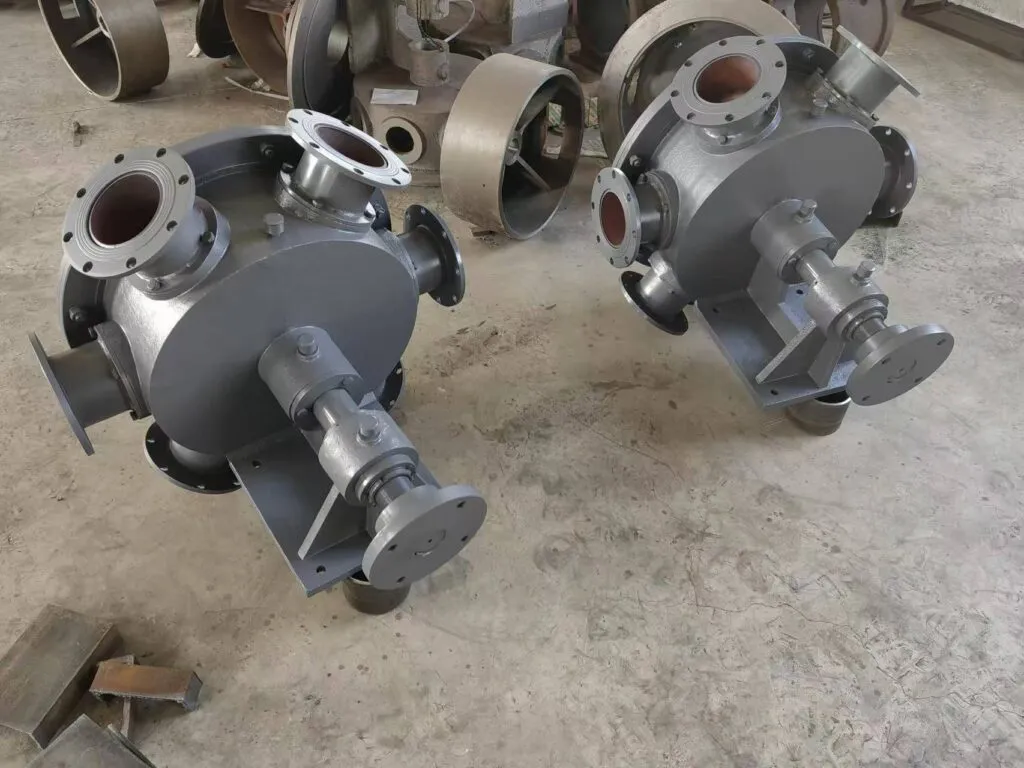
A cement silo bottom air distributor is a centralized air distribution device installed at the bottom of cement silos or powder storage silos. Its main function is to divide compressed air from one supply line into multiple evenly balanced airflows, which are then fed to aeration pads, air slides, or fluidizing cones.
In practical operation, uneven aeration is one of the most common causes of poor silo discharge. Fine powders such as cement, fly ash, and limestone dust are prone to forming arches, bridges, or stagnant zones. By using a silo bottom air distributor, airflow can be accurately controlled and uniformly delivered to all aeration zones, significantly improving discharge stability and reducing material blockage risks.
2. Working Principle of a Silo Bottom Air Distributor
Compressed air from a blower or compressor enters the main inlet of the air distributor. Inside the heavy-duty circular housing, the airflow is guided through internal chambers and flow channels that divide the air into several outlet ports.
Each outlet port is connected to:
✔ An aeration pad
✔ An air slide conveyor
✔ A fluidizing box
✔ Or a fluidizing cone
By maintaining balanced pressure at all outlets, the system ensures uniform fluidization of bulk materials at the silo bottom(This process is based on the principle of Fluidization.)This prevents:
✔ Material arching
✔ Ratholing
✔ Dead zones
✔ Irregular discharge rates
As a result, cement and powder materials flow more smoothly toward downstream equipment such as screw conveyors, bucket elevators, or telescopic loading chutes.
3. Structural Design and Main Components
A typical cement silo bottom air distributor consists of the following parts:
✔ Heavy-duty steel housing with flanged connections
✔ Main air inlet flange (connected to blower line)
✔ Multiple outlet flanges (connected to aeration pads or air slides)
✔ Internal flow distribution chambers
✔ Inspection cover for maintenance access
✔ Optional manual or motorized switching mechanism
The housing is usually made of carbon steel or stainless steel, with epoxy coating for corrosion resistance. Internal chambers are precision-machined to ensure even airflow distribution and minimal pressure loss.
4. Why Cement Silos Need an Air Distributor
In traditional silo aeration layouts, each aeration pad or air slide is supplied by an independent air pipe. While simple in theory, this design has several disadvantages:
✔ Uneven airflow due to pressure loss differences
✔ Complicated piping layout
✔ Higher installation and maintenance costs
✔ Difficult airflow adjustment
A centralized silo bottom air distributor solves these issues by acting as a single control point for all aeration zones. Compared with single-pipe systems, it offers:
✔ Better airflow balance
✔ Simplified piping
✔ Lower energy consumption
✔ Easier maintenance and troubleshooting
5. Typical Application Scenarios
Cement silo bottom air distributors are widely used in:
✔ Cement production lines
✔ Fly ash silos in power plants
✔ Limestone powder silos
✔ Bulk material storage bins
✔ Concrete batching plants
✔ Mineral powder handling systems
They are commonly integrated with:
- Air Slide Conveyor (for low-energy powder conveying)
- Flow Control Gate (for regulating powder discharge)
- Telescopic Loading Chute (for dust-free truck or ship loading)
Industry standards and conveying system practices are commonly referenced from CEMA.
6. Key Design Parameters
When selecting a silo bottom air distributor, engineers should consider the following parameters:
✔ Inlet diameter and number of outlet ports
✔ Required airflow rate and pressure
✔ Silo size and cone angle
✔ Type and bulk density of material
✔ Number and layout of aeration pads
✔ Operating temperature and humidity
Typical working pressure ranges from 0.3 to 0.8 MPa, while inlet diameters usually range from DN80 to DN300, depending on silo capacity and airflow demand.
7. Selection Guide for Cement Plants
To choose the right cement silo bottom air distributor, follow these steps:
✔ Step 1: Determine silo diameter and cone geometry
✔ Step 2: Calculate required airflow for aeration pads
✔ Step 3: Define number of aeration zones
✔ Step 4: Select suitable inlet and outlet diameters
✔ Step 5: Choose material (carbon steel or stainless steel)
✔ Step 6: Confirm flange standard and connection layout
A properly selected air distributor ensures long-term stable operation, reduces downtime, and improves overall plant efficiency.
8. Common Problems and Solutions
Problem: Uneven discharge from silo outlets
Solution: Use a centralized silo bottom air distributor to balance airflow to all aeration pads.
Problem: Frequent material blockage at silo bottom
Solution: Increase aeration pad coverage and optimize airflow distribution.
Problem: High energy consumption of aeration system
Solution: Replace multiple independent air lines with a single air distributor to reduce pressure losses.
FAQs About Cement Silo Bottom Air Distributors
What is a cement silo bottom air distributor used for?
A cement silo bottom air distributor is used to distribute compressed air evenly to multiple aeration pads or air slides at the bottom of a silo, ensuring smooth powder discharge and preventing material blockages.
Which materials can this air distributor handle?
It is suitable for cement, fly ash, limestone powder, mineral dust, and other fine bulk materials.
Can the number of outlets be customized?
Yes. Outlet numbers, diameters, and flange standards can be customized according to your silo design and airflow requirements.
What air pressure is required for operation?
Typical working pressure ranges from 0.3 to 0.8 MPa, depending on material properties and silo size.
Is this air distributor compatible with air slide conveyors?
Yes. It is commonly used together with air slide conveyors for efficient powder transport.
Indonesian Short Version
Distributor udara dasar silo semen digunakan untuk mendistribusikan udara bertekanan secara merata ke beberapa bantalan aerasi atau air slide di bagian bawah silo. Alat ini membantu mencegah penggumpalan material, mengurangi zona mati, dan meningkatkan efisiensi pengosongan silo pada sistem penanganan material curah seperti semen, abu terbang, dan serbuk mineral.
Need a reliable Cement Silo Bottom Air Distributor for your cement or powder handling system?
Contact LVRUI today for a professional solution and fast quotation.
✔ Get expert quotation within 12 hours
✔ Customized design for your silo aeration system
📧 Email: info@lvrui-conveyor.com
🌐 Website: https://lvrui-conveyor.com