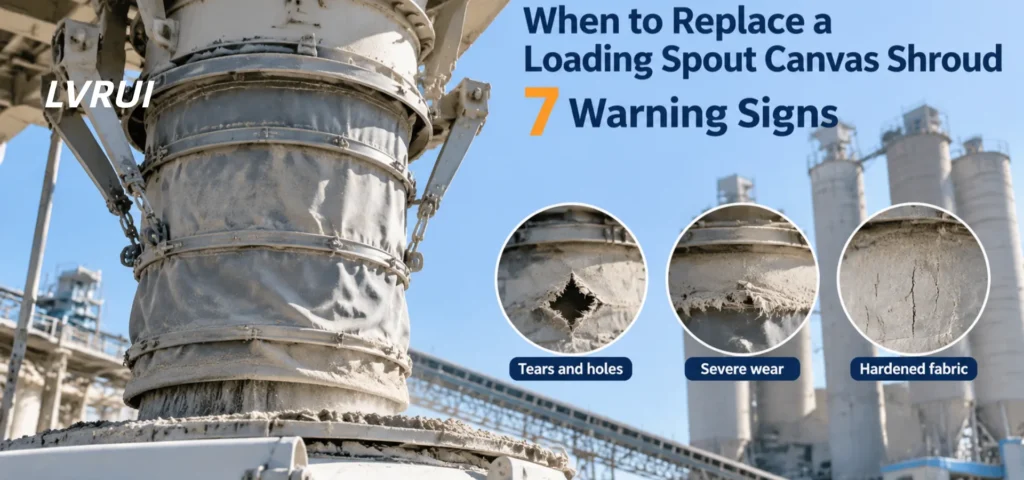
Loading spout canvas shroud replacement may be necessary when tears, seam failure, abrasion, or hardened fabric compromise dust containment. However, visible dust does not always mean the sleeve itself needs replacing.
Before ordering a replacement, inspect the shroud, its mounting connections, the surrounding equipment, and the dust extraction system.
This guide explains seven warning signs of a worn loading spout canvas shroud, how to identify the likely cause of failure, and what information to prepare before ordering a replacement.
1. Loading Spout Canvas Shroud Replacement: 7 Warning Signs
1.1 Visible Tears or Punctures
Tears and holes are clear signs that the fabric can no longer provide an intact dust-control enclosure.
Damage may occur because of mechanical contact, improper installation, sharp edges, excessive movement, or unsuitable fabric selection.
Small holes should not be ignored if they are located near a dust leakage path. Inspect the surrounding area to determine whether the damage is isolated or part of a larger wear pattern.
1.2 Severe Wear Around Support Rings or Contact Areas
Repeated movement can cause localized wear where the fabric contacts support rings, brackets, or adjacent equipment.
Look for thinning fabric, polished areas, abrasion marks, or exposed reinforcement.
If the same area repeatedly wears through after replacement, investigate alignment, clearances, support structure, and operating movement. Installing a new sleeve without correcting the underlying cause may result in another failure.
1.3 Seams Are Splitting or Reinforcement Is Failing
A canvas shroud can remain visually intact while its seams begin to separate.
Inspect the stitched or reinforced joints, especially near mounting edges and areas exposed to repeated movement.
Loose stitching, separated seams, and damaged reinforcement can allow dust to escape and may cause the sleeve to lose its intended shape.
The replacement should use a seam and reinforcement arrangement suitable for the actual operating conditions.
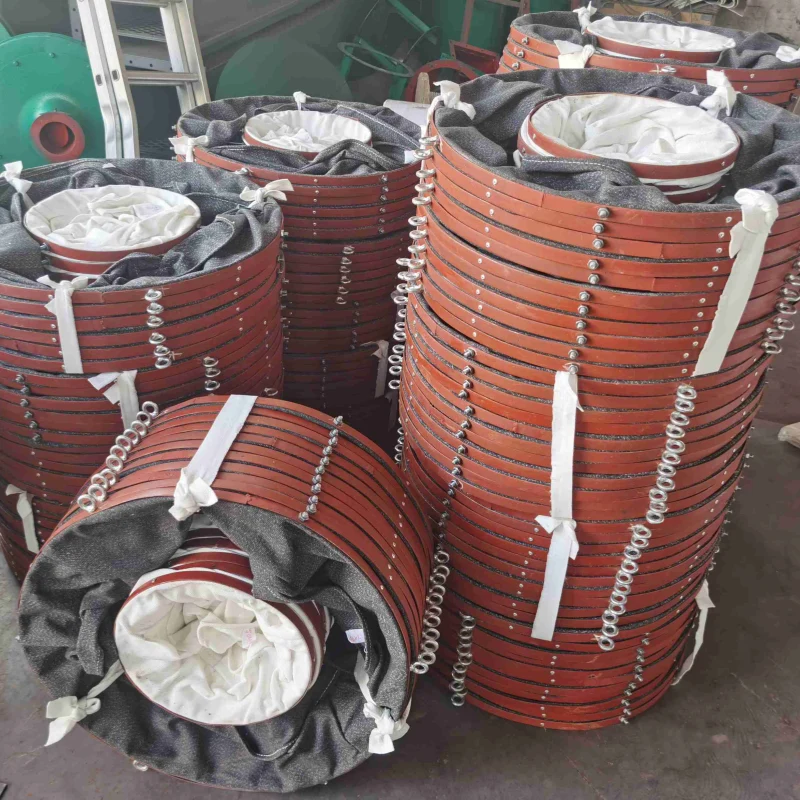
1.4 Mounting Edges or Fixing Points Are Damaged
The fabric may be in reasonable condition while the mounting edge has become torn, stretched, or deformed.
Check the areas attached to flanges, clamps, frames, or other fixing structures.
Also inspect the metal mounting surface and fasteners. A damaged clamp, sharp flange edge, or uneven connection can damage a replacement sleeve even when the fabric itself is suitable.
1.5 The Fabric Has Hardened, Cracked, or Permanently Deformed
Repeated exposure to heat, dust, moisture, environmental conditions, or mechanical stress may change the fabric’s flexibility and condition.
Warning signs include unusual stiffness, cracking, permanent deformation, surface deterioration, or loss of flexibility.
The appropriate replacement material should be selected according to the actual temperature, abrasion, movement, and environmental conditions. Do not assume that a different fabric will solve the problem without confirming the cause of deterioration.
1.6 Dust Leakage Persists After Other Causes Are Checked
Persistent dust leakage around a loading point can indicate a damaged shroud, but the fabric is only one part of the system.
Before replacing it, check:
- The sleeve for holes, seam failure, and loose connections
- Flanges and clamps for gaps or misalignment
- The dust extraction duct for leakage or blockage
- The dust collector and filter for operating problems
- The extraction airflow and loading conditions
For telescopic loading spouts, also check the relationship between the material discharge path and the surrounding dust extraction passage.
If the shroud is intact but dust continues to escape, investigate the complete loading and dust collection arrangement rather than replacing the fabric automatically.
1.7 The Sleeve No Longer Accommodates the Required Movement
For applications involving telescopic movement or repeated equipment motion, the sleeve must accommodate the required movement without excessive tension, folding, or contact with adjacent components.
Inspect the sleeve throughout its operating range, where this can be done safely.
Look for stretching, bunching, interference, restricted movement, or damage caused by incorrect dimensions.
If the sleeve length or connection geometry no longer suits the installation, a replacement based on the actual working positions may be necessary.
2. Identify the Cause Before Ordering a Replacement
A replacement canvas shroud should address the actual failure mechanism rather than simply restore the previous appearance.
Use the following checklist during inspection.
| Observed Problem | Possible Cause | Recommended Check |
|---|---|---|
| Tears near support rings | Repeated contact or abrasion | Check alignment, clearances, and support positions |
| Split seams | Mechanical stress or unsuitable reinforcement | Review seam construction and movement requirements |
| Damaged mounting edge | Poor clamping or sharp contact surfaces | Inspect the flange, clamp, and fixing method |
| Hardened or cracked fabric | Temperature or environmental exposure | Confirm operating temperature and fabric suitability |
| Persistent dust leakage | Damaged sleeve or system-level leakage | Inspect the enclosure, extraction path, and filter system |
| Repeated deformation | Incorrect length or movement allowance | Confirm dimensions and operating positions |
A fabric sleeve should not be expected to withstand direct impact from highly abrasive bulk material unless its design specifically allows for that duty.
For clinker, gravel, crushed stone, and similar materials, the canvas shroud is generally used as an outer dust-control enclosure. The internal material passage should use suitable steel or wear-resistant construction where required.
3. What Information Is Needed for a Replacement Canvas Shroud?
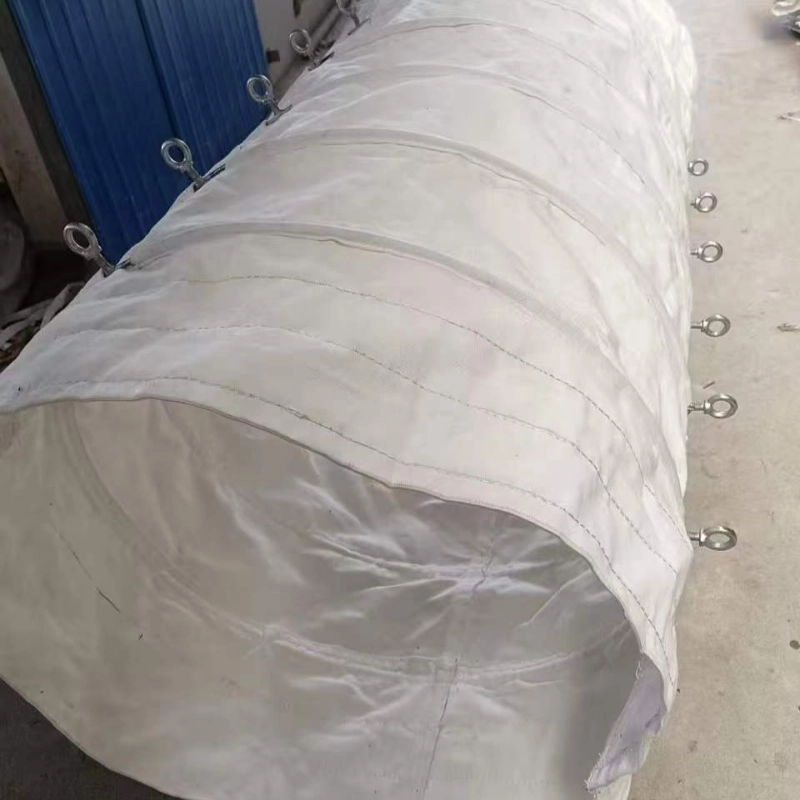
Before arranging a loading spout canvas shroud replacement, confirm the installation dimensions, mounting arrangement, operating conditions, and required sleeve movement. Accurate information helps reduce dimensional errors and repeat failures.
Opening Dimensions
Record the inlet and outlet dimensions as applicable. For a round sleeve, measure the diameter. For square or rectangular connections, record the width and height.
Clarify whether each measurement refers to the internal opening, external dimensions, or the mounting interface.
Overall Sleeve Length
Measure the required installed length and identify the equipment’s operating positions.
For a telescopic application, provide the relevant extended and retracted dimensions or movement range. A single measurement may not adequately describe a sleeve that must accommodate changing positions.
Fixing Structure
Confirm whether the sleeve is secured by a flange, clamp, bolt-on connection, or another arrangement.
Provide the mounting dimensions, hole positions, and any reinforcement requirements where applicable.
Operating Conditions
Describe the material handled, operating temperature, movement frequency, dust characteristics, and any known abrasion or chemical exposure.
These factors influence fabric selection, seam construction, reinforcement, and expected service life.
Photographs, Drawings, or an Existing Sample
Photographs of the installation and damaged areas can help identify wear patterns and connection details.
An existing sample or approved drawing is particularly useful when replacing a sleeve whose dimensions and fixing arrangement must match an installed machine.
Before production, confirm the final dimensions and construction against the agreed drawing or sample.
4. How to Select a Suitable Replacement Fabric
Fabric selection should be based on the operating conditions rather than price or appearance alone.
| Fabric Option | Main Consideration |
|---|---|
| Standard canvas | General-purpose applications within suitable temperature and wear conditions |
| Coated canvas | Applications requiring specific surface or dust-containment characteristics |
| Rubber-coated fabric | Applications requiring suitable flexibility and resistance to particular mechanical wear conditions |
| Silicone-coated fabric | Applications requiring higher-temperature performance, subject to confirmation of the actual material specification |
These are general categories, not interchangeable specifications. The final choice should be confirmed with the manufacturer according to temperature, movement, abrasion, dust characteristics, and environmental exposure.
For an existing loading spout, the replacement sleeve must also match the required dimensions and mounting arrangement.
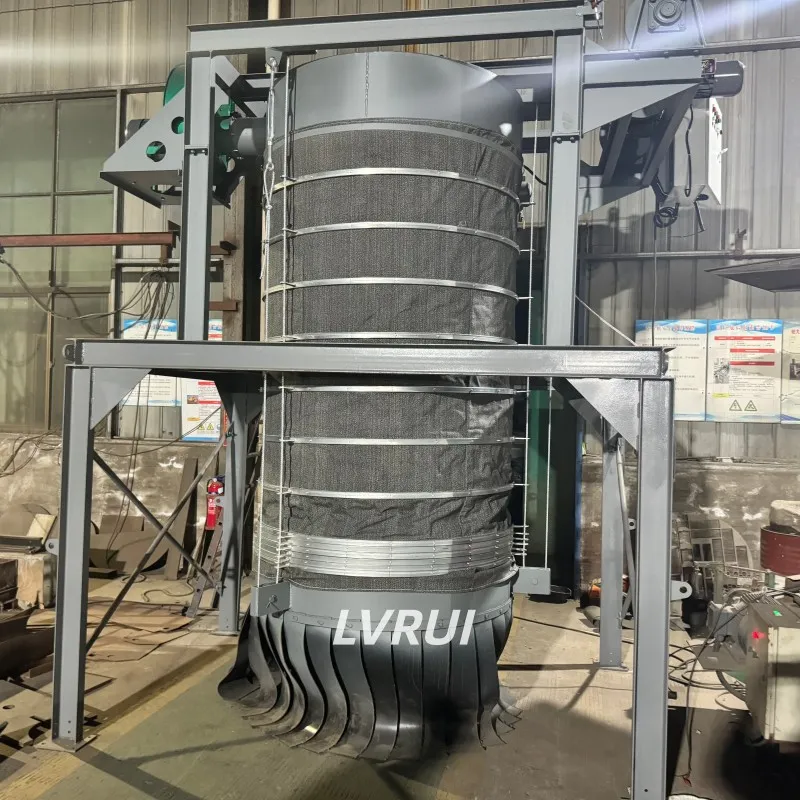
If the component is part of a telescopic loading bellows, confirm the complete assembly structure and movement requirements before ordering an individual sleeve.
For more information, see LVRUI’s Canvas Shrouds product page and Loading Spouts page.
5. Replacement and Installation Checks
Before inspection or replacement, isolate the equipment and follow the site’s lockout/tagout and maintenance safety procedures.
After installing the replacement, verify the following:
- The opening dimensions and sleeve length match the approved specifications.
- Flanges, clamps, and other fixing points are secure.
- The sleeve is not excessively stretched or compressed.
- The fabric does not interfere with adjacent equipment during its required movement.
- The dust extraction connections are properly fitted.
- The surrounding equipment and extraction system operate as intended.
Any operational test should follow the equipment manufacturer’s procedures and the site’s safety requirements.
If the same failure returns shortly after replacement, investigate the underlying cause before ordering another sleeve.
For applications using telescopic loading bellows, see our related guide to the Loading Bellows Working Principle.
For general information on dust control during material handling, refer to the NIOSH guidance on dust control at conveyor transfer points.
FAQ About Canvas Shrouds for Loading Spouts
How often should a loading spout canvas shroud be replaced?
There is no universal replacement interval for every application. Replacement should be based on inspection results, fabric condition, operating conditions, and the consequences of failure.
Does dust leakage always mean the canvas shroud is damaged?
No. Dust leakage may also result from inadequate extraction airflow, damaged ductwork, poor connections, incorrect loading conditions, or problems with the dust collector. Inspect the complete system before replacing the sleeve.
Can I order a replacement using the old sleeve alone?
An existing sleeve can be a useful reference, but it may already be stretched, distorted, or damaged. Confirm the required dimensions and fixing arrangement against the installed equipment or an approved drawing.
Can one fabric type be used for every loading application?
No. Fabric suitability depends on temperature, abrasion, movement, environmental exposure, and the intended function of the sleeve. The manufacturer should confirm the appropriate specification.
Can a canvas shroud be used for clinker or crushed stone?
It can be used as an outer dust-control enclosure in suitable applications. The internal material passage should be designed for the material’s impact and abrasion conditions; ordinary canvas should not automatically be treated as a wear-resistant material chute.
What information should I send when requesting a replacement quotation?
Provide the material handled, working temperature, opening dimensions, required sleeve length, fixing method, movement requirements, and installation photographs or drawings. An existing sample can also help confirm the required construction.
Need a Replacement Canvas Shroud?
For a loading spout canvas shroud replacement, Jiangsu Lvrui Machinery Co., Ltd. can review your installation dimensions, fabric requirements, and operating conditions to help determine a suitable replacement specification.
Send us your installation photographs, dimensions, existing drawing or sample, material characteristics, and operating conditions. We can review the required sleeve dimensions, fabric specification, reinforcement, and fixing arrangement before quotation.
Contact LVRUI
- Email: info@lvrui-conveyor.com
- WhatsApp: +86 182 6199 8937
- Website: https://lvrui-conveyor.com/
LVRUI — Bulk Material Handling Equipment and Replacement Components for Cement Plants.