Why cement tanker loading becomes slow and how to identify capacity losses from silo discharge to tanker venting
What Causes Slow Cement Tanker Loading?
Cement tanker loading becomes slow when one part of the loading system cannot pass cement or displaced air at the required rate.
The most common causes are:
√ Unstable cement discharge from the silo
√ Insufficient or uneven silo aeration
√ A flow control gate that does not open completely
√ Conveyor capacity lower than the required loading rate
√ Cement lumps or restricted transition sections
√ Reduced flow area inside the loading spout
√ Poor tanker venting or blocked dust-return piping
√ Sensors and interlocks repeatedly interrupting material flow
A larger cement bulk loader will not necessarily solve the problem. The correct solution depends on where the actual capacity loss occurs.
Calculate the Actual Cement Loading Rate First
When diagnosing slow cement tanker loading, first separate the effective cement loading time from the total truck cycle time.
The total cycle may include:
√ Truck positioning
√ Opening the tanker inlet
√ Lowering the loading spout
√ Weighing confirmation
√ Material loading
√ Final low-rate filling
√ Retracting the loading spout
√ Final weighing and truck departure
Only the effective material loading period reflects the actual capacity of the cement loading system.
Use the following calculation:
Actual loading rate = Net loaded weight ÷ Effective loading time × 60
For example, if a tanker receives 30 tonnes of cement in 18 minutes:
30 ÷ 18 × 60 = 100 t/h
If the complete truck cycle takes 26 minutes but cement flows for only 18 minutes, part of the delay may be caused by truck positioning, weighing, or operating procedures rather than the loading equipment.
Record both:
- Effective cement loading time
- Total truck turnaround time
This distinction prevents operators from modifying equipment that is not responsible for the delay.
Accurate time records are essential because slow cement tanker loading may result from material-flow restrictions or from non-loading operations such as positioning and weighing.
1. Silo Discharge and Aeration Problems
Slow cement tanker loading often begins at the silo outlet because the loading system cannot deliver more cement than the silo can discharge.
If cement leaves the silo slowly or inconsistently, the conveyor and loading spout will remain underfed even when their rated capacities are sufficient.
Typical signs include:
√ Low flow from the beginning of loading
√ Flow improves after the aeration blower starts
√ Loading speed changes with the silo level
√ Flow becomes unstable after long storage
√ Operators frequently use vibration or manual intervention
√ The downstream conveyor does not remain fully supplied
Possible causes include:
- Compacted cement near the silo outlet
- Insufficient outlet area
- Poor cone geometry
- Restricted transition sections
- Blocked aeration pipes
- Damaged aeration pads
- Uneven air distribution
- Moisture or condensation inside the silo
The key diagnostic question is:
Is the downstream equipment waiting for cement from the silo?
If the conveyor inlet repeatedly becomes empty or partially filled, increasing the loading spout diameter will not improve the loading rate.
Silo aeration should also be evaluated as a complete system. Higher air pressure alone does not guarantee better discharge. The aeration layout, pad position, air volume, silo geometry, cement condition, and outlet arrangement must work together.
For more detailed silo aeration information, see aeration pads placement design for cement silo cones.
2. Flow Control Gate and Conveyor Restrictions
Flow Control Gate Does Not Fully Open
A flow control gate may become the narrowest section between the silo and the conveyor. When slow cement tanker loading occurs consistently from the beginning of each cycle, the actual gate opening should be checked first.
Common causes include:
√ Incorrect actuator stroke
√ Low pneumatic or hydraulic pressure
√ Cement buildup around the gate blade
√ Mechanical interference
√ Incorrect limit-switch adjustment
√ Position feedback errors
√ PLC settings that limit the opening
√ A gate opening smaller than the connected chute
Do not rely only on the opening percentage displayed on the control screen.
The control system may indicate that the valve is fully open while the blade still restricts part of the material passage. The physical blade position, actuator travel, internal clearance, and opening time should be checked directly.
A properly selected flow control gate valve should regulate cement flow without becoming a permanent restriction in the loading line.
Conveyor Cannot Reach Its Rated Capacity
The rated capacity of a conveyor is based on specific operating conditions. Actual capacity may be lower because of unstable feeding, installation limitations, wear, or material buildup.
For an air slide conveyor, check:
√ Conveyor inclination
√ Air chamber pressure
√ Air leakage
√ Air slide fabric condition
√ Material depth
√ Inlet and outlet transitions
√ Stability of the upstream feed
An air slide conveyor depends on gravity and controlled aeration. Increasing blower pressure will not correct an unsuitable slope, blocked fabric, or restricted discharge opening.
For a screw conveyor, check:
√ Screw diameter and speed
√ Screw pitch
√ Motor current
√ Flight wear
√ Cement buildup
√ Inlet feeding condition
√ Discharge restrictions
Increasing screw speed without checking the motor, gearbox, bearings, and discharge opening may raise power consumption without producing a proportional increase in cement output.
3. Cement Lumps and Loading Spout Restrictions
Cement lumps do not need to block the loading line completely. A partial restriction can reduce the effective flow area while material continues to pass.
Likely restriction points include:
- Silo outlet
- Flow gate inlet
- Reducer section
- Flexible connection
- Conveyor inlet
- Transfer chute
- Loading spout inlet
- Internal discharge cone
Typical symptoms include:
√ Sudden changes in loading rate
√ Short stops followed by flow recovery
√ Fluctuating conveyor motor current
√ Impact noise near a transition section
√ Repeated manual cleaning
√ Unstable cement discharge into the tanker
Where hardened cement repeatedly enters downstream equipment, a cement silo lump breaker can reduce oversized lumps before they reach the conveyor or bulk loading system.
However, the causes of serious cement hardening should also be investigated. Moisture entry, condensation, long storage time, and poor silo sealing cannot be solved by crushing equipment alone.
Internal Loading Spout Restriction
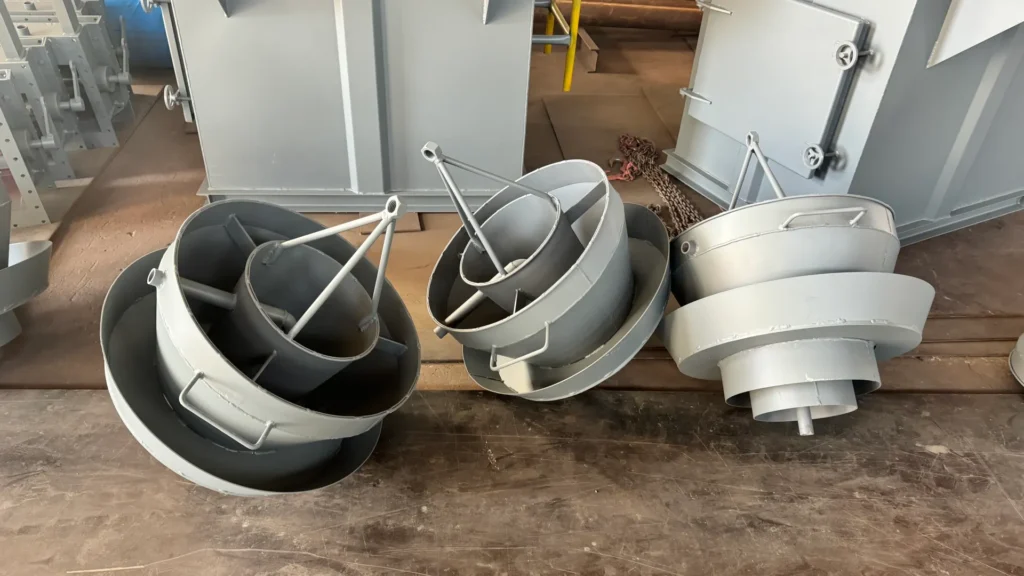
A loading spout may lower and retract normally while its internal cement passage is partially blocked.
Possible causes include:
√ Cement buildup on internal cones
√ A collapsed flexible sleeve
√ Misaligned telescopic sections
√ A small inlet transition
√ Deformed internal components
√ Restricted dust-return passages
√ An undersized effective material opening
The external diameter of the loading spout does not represent the actual cement flow area. Internal cones, cables, flexible sections, dust passages, and accumulated material may reduce the usable opening.
After the equipment has been safely isolated, inspect the complete internal passage in the extended position.
A loading spout for cement tanker loading should be selected according to loading capacity, cement bulk density, inlet size, travel distance, tanker opening, and dust extraction requirements.
4. Tanker Venting and Dust Extraction Problems
As cement enters a tanker, the displaced air must leave.
If this air cannot escape efficiently, internal pressure increases and resists the incoming cement flow.
When slow cement tanker loading starts with a normal flow and gradually becomes worse, tanker venting is one of the first areas to inspect.
√ Loading begins at a normal rate
√ Material flow gradually becomes slower
√ Dust pressure increases near the tanker inlet
√ Flow improves when the feeding rate is reduced
√ Different tankers have different loading times
√ One truck loads normally while another loads slowly
Possible causes include:
- Blocked tanker vent pipes
- Dirty internal vent filters
- Small air-release openings
- Cement buildup inside air passages
- Different tanker compartment arrangements
- Restricted dust-return connections
Comparing several tankers is one of the fastest diagnostic methods.
If the same loading system performs differently with different vehicles, inspect the tanker before changing the fixed equipment.
Dust Extraction Restriction
The dust extraction system also affects air evacuation during enclosed tanker loading.
Check:
√ Dust-return pipe diameter
√ Flexible hose condition
√ Filter differential pressure
√ Pulse-cleaning performance
√ Fan rotation and current
√ Damper position
√ Air leakage
√ Cement buildup inside the duct
Weak extraction may cause dust leakage and poor air removal. A blocked return-air pipe may also create tanker back pressure and reduce the cement loading rate.
The objective is balanced airflow. Maximum suction is not always better, because excessive negative pressure may disturb powder flow near the loading head. For broader engineering guidance on dust control during mineral processing and bulk-material handling, refer to the NIOSH Dust Control Handbook for Industrial Minerals Mining and Processing
Detailed dust leakage troubleshooting is covered separately in Loading Spout Dust Leakage: 7 Troubleshooting Methods.
5. Sensors and Interlocks Interrupt Material Flow
A slow cement tanker loading problem may also originate in the control system.
The equipment may have sufficient mechanical capacity, but the PLC, weighing system, level sensor, or interlock logic may repeatedly reduce or stop the cement flow.
Possible causes include:
√ Unstable weighing signals
√ Premature high-level alarms
√ Incorrect sensor position
√ Vibration affecting sensor signals
√ Frequent flow gate adjustment
√ Delayed conveyor restarts
√ Dust collector interlocks
√ Communication faults
√ Conservative control parameters
Several interruptions of only 10 or 20 seconds can significantly increase the loading time of every truck.
Review the operating history and record:
- Time and duration of each stop
- Flow gate opening position
- Conveyor running status
- Tanker level signal
- Weighing value
- Dust collector alarms
- Blower pressure
- Motor current
- Interlock status
Overfill protection is necessary, but unstable signals or incorrect delay settings may close the flow gate too early.
For detailed control and shut-off considerations, see the cement tanker overfill protection guide.
Use the Loading Pattern to Locate the Bottleneck
The operating pattern of slow cement tanker loading often reveals whether the restriction is located upstream, downstream, or inside the tanker.
| Observed loading pattern | Likely inspection area |
|---|---|
| Low flow from the beginning | Silo outlet, flow gate, conveyor |
| Good initial flow followed by gradual slowdown | Tanker venting, dust-return pipe, filter resistance |
| Flow repeatedly rises and falls | Silo aeration, lumps, sensor signals |
| Loading stops and restarts suddenly | Blockage, interlock, gate movement |
| Different tankers have different loading times | Tanker inlet, vent filters, internal air passages |
| Flow changes with silo level | Silo discharge pattern and aeration |
| Conveyor frequently runs underfed | Silo outlet and upstream flow control |
| Conveyor remains fully loaded but tanker flow is low | Loading spout, tanker venting, dust extraction |
This table provides an initial direction, but final decisions should be based on measured loading data.
A Practical Four-Step Diagnosis
A reliable diagnosis of slow cement tanker loading should be based on several loading cycles, not on observations from a single truck.
Step 1: Record Several Loading Cycles
Record at least five truck-loading cycles.
For each truck, collect:
- Tanker identification
- Net loaded weight
- Effective loading time
- Total truck cycle time
- Number of interruptions
- Silo level
- Valve opening
- Conveyor status
One truck is not enough to identify a repeatable system problem.
Step 2: Observe How the Flow Changes
The final average loading rate does not show the complete operating pattern.
For example, a 30-tonne tanker loaded in 18 minutes has an average rate of 100 t/h. However, the actual flow may be:
- Initial stage: 130 t/h
- Middle stage: 105 t/h
- Final stage: 55 t/h
A gradual reduction may indicate tanker back pressure or control-related flow reduction.
A consistently low rate from beginning to end is more likely to indicate an upstream capacity restriction.
Step 3: Compare Tankers and Silo Conditions
If only certain tankers load slowly, inspect their venting systems and inlet arrangements.
If every tanker loads slowly, inspect the fixed plant equipment.
Also compare loading performance when the silo is:
- Nearly full
- Half full
- Near low level
- Recently filled
- Left unused for several days
This comparison helps identify silo compaction, aeration, and discharge-pattern problems.
Step 4: Measure Equipment Conditions
Useful measurements include:
- Flow gate position
- Screw conveyor motor current
- Air slide chamber pressure
- Aeration blower pressure
- Dust collector differential pressure
- Fan current
- Actuator pressure
- Weighing signal stability
These values help distinguish low upstream cement supply from excessive downstream resistance.
Information Required Before Modifying the Loading System
Before proposing equipment modifications, collect:
√ Cement type and bulk density
√ Tanker capacity
√ Current loading time
√ Target loading capacity
√ Silo outlet dimensions
√ Silo aeration arrangement
√ Flow control gate size
√ Conveyor type and rated capacity
√ Loading spout dimensions
√ Tanker inlet diameter
√ Dust collector airflow
√ Tanker venting arrangement
√ Control sequence
√ Site photos
√ Process flow drawing
√ Records from several loading cycles
Increasing one machine size without identifying the real bottleneck may only move the restriction to another part of the system.
Frequently Asked Questions
Why does cement tanker loading start fast and then slow down?
There is no single cause in every plant. Common restrictions include unstable silo discharge, insufficient aeration, incomplete flow gate opening, low conveyor output, loading spout buildup, tanker venting resistance, and repeated control interruptions.
Can a larger cement bulk loader reduce loading time?
Only when the existing cement bulk loader is the confirmed bottleneck. If the silo outlet, conveyor, flow gate, loading spout, dust-return line, or tanker vent has a lower effective capacity, replacing the bulk loader may provide little improvement.
Why does tanker loading begin fast and then slow down?
This pattern often indicates increasing tanker back pressure, restricted venting, a blocked dust-return pipe, rising filter resistance, or a control system that reduces flow near the target weight.
Why do different cement tankers have different loading times?
Different tankers may have different inlet sizes, venting areas, internal filters, compartment layouts, and levels of cement buildup. If loading performance changes significantly between vehicles, inspect the tanker before modifying the fixed loading equipment.
How can operators locate the cause of slow cement tanker loading?
To locate the cause of slow cement tanker loading, observe whether the conveyor is underfed or remains fully supplied. If the conveyor runs underfed, inspect the silo outlet, aeration system, and flow control gate. If it remains fully supplied while the loading rate decreases, inspect the loading spout, tanker venting, dust-return piping, and control system.
Can poor dust collection reduce the cement loading rate?
Yes. A blocked or undersized dust-return line can prevent displaced air from leaving the tanker, creating back pressure that reduces the incoming cement flow.
Conclusion
Slow cement tanker loading should be treated as a complete system problem rather than an isolated bulk loader fault. A successful solution to slow cement tanker loading depends on identifying the lowest effective capacity in the complete material and airflow path.
The investigation should follow the actual cement and airflow path:
Silo discharge → Aeration → Flow control gate → Conveyor → Loading spout → Tanker venting → Dust extraction → Control system
Start with the actual loading rate and flow pattern. Then compare different tankers, silo levels, valve positions, conveyor loads, blower pressures, and control interruptions.
Once the narrowest effective section has been identified, the modification can be targeted accurately.
Need Help Diagnosing a Slow Cement Tanker Loading System?
Jiangsu Lvrui Machinery Co., Ltd. supplies cement bulk loader systems, loading spouts, flow control gate valves, air slide conveyors, lump breakers, and dust collection equipment for cement plants, grinding stations, fly ash terminals, and dry powder loading projects.
For a technical review, please provide:
- Current and target loading capacity
- Tanker size and inlet diameter
- Silo outlet dimensions
- Conveyor specifications
- Loading spout dimensions
- Dust collection information
- Process flow drawing
- Site photos or loading videos
WhatsApp / WeChat: +86-18261998937
Email: info@lvrui-conveyor.com