How load cells, feed cutoff, material in flight, vibration and unstable cement flow affect final bag weight
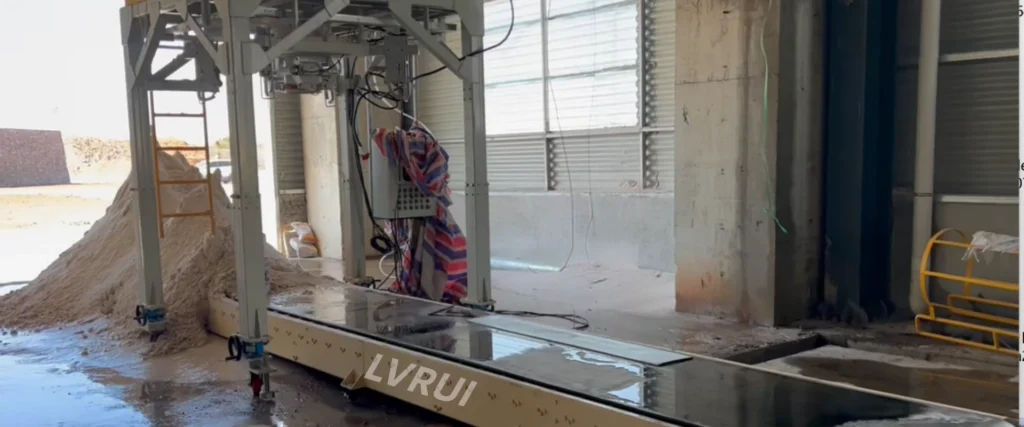
Why Does Bulk Bag Filling Accuracy Change?
Bulk bag filling accuracy becomes unstable when the weighing system and the material feeding system do not respond consistently to each other.
The most common causes are:
✓ Load cell zero or calibration drift
✓ External forces acting on the weighing frame
✓ Incorrect coarse-to-fine feed switching
✓ Material still falling after feed cutoff
✓ Unstable cement supply
✓ Vibration or bag movement
✓ Incorrect tare weight or operating sequence
A repeatable overweight or underweight error usually points to cutoff, compensation or tare settings. Random weight variation is more likely to involve unstable feeding, vibration, mechanical interference or load-cell signal problems.
First Distinguish a Stable Error from a Random Error
Stable bulk bag filling accuracy means the final net weight remains consistently close to the target over repeated filling cycles.
If almost every 1,000 kg FIBC finishes 6–8 kg overweight, the error is repeatable and usually points to cutoff or compensation. If the error changes from bag to bag, inspect feed stability, vibration, tare procedure and the weighing frame.
Before changing parameters, compare several bags rather than judging one filling cycle.
1. Load Cell Zero or Calibration Drift
If load-cell zero or calibration shifts, the controller may display a value that no longer matches the real load.
Check whether the empty frame returns to a stable zero, then verify the scale using the plant’s approved test-weight or calibration procedure. Loose mounts, damaged load cells or electrical problems can also affect the signal.
If static weighing is correct but completed bags still vary, investigate feeding and mechanical interference before recalibrating.
This distinction is important because scale accuracy and filling accuracy are not exactly the same problem. A weighing system can perform correctly under static conditions while the final filled weight still varies because of the material-feeding process.
2. Mechanical Forces Disturb the Weighing Frame
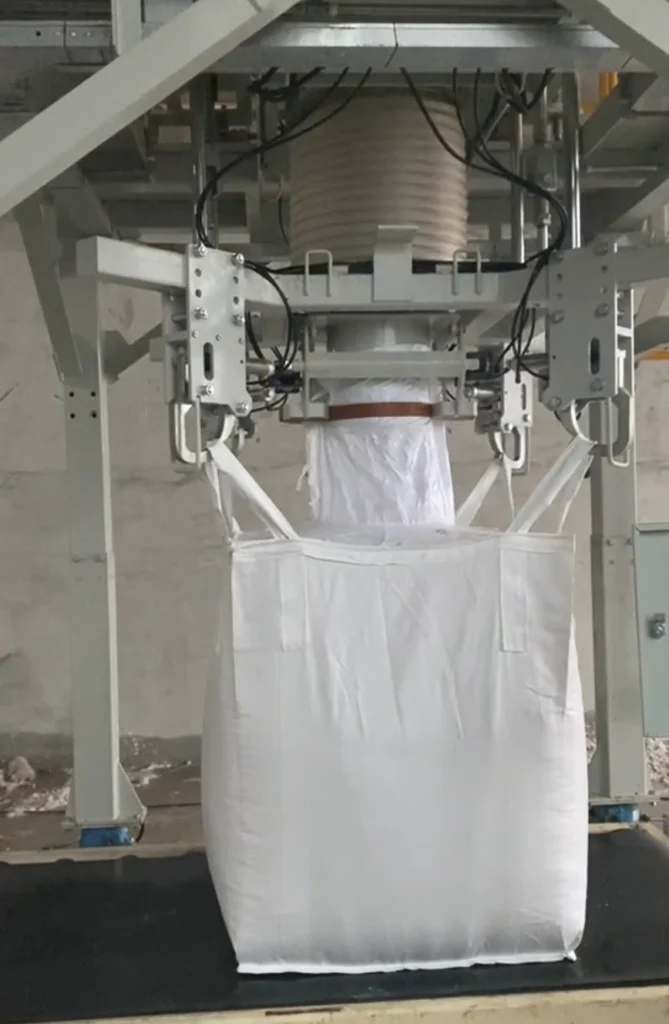
The weighing frame should respond mainly to the FIBC and the material entering it. Pipes, flexible connections, cables and nearby structures should not pull, push or support part of the load.
Typical problems include:
✓ Flexible connections stretched too tightly
✓ Rigid feed pipes touching the weighing frame
✓ Dust ducting pulling on the filling head
✓ Cables restricting movement
✓ Cement buildup creating an unintended contact point
If the displayed weight changes when a hose or nearby component moves without adding material, the weighing system is not mechanically isolated.
This can create weight errors even when the load cells are correctly calibrated.
For this reason, check the complete mechanical installation before assuming that an inaccurate bulk bag filler needs new load cells.
3. Coarse-to-Fine Feed Switching Is Too Late
Many FIBC filling machines use two feeding stages:
Coarse feed → Fine feed → Final cutoff
Coarse feed fills most of the bag quickly. Fine feed reduces the material rate near the target weight so the final cutoff can be controlled more accurately.
If coarse feed continues too close to the target, too much cement is already moving toward the FIBC when the system changes to fine feed.
Typical signs include:
✓ Repeated overweight bags
✓ Very short fine-feed time
✓ Large weight increase after the stop command
✓ Poor repeatability when upstream flow changes
The coarse-to-fine transition must leave enough remaining weight for fine feeding to stabilize the final fill.
There is no universal transition percentage. The correct setting depends on feeder capacity, cement flowability and response time.
For example, a 1,000 kg FIBC should not automatically change to fine feed at the same percentage in every project. A high-capacity screw feeder requires different control settings from a low-rate gravity or valve-fed system.
4. Material Continues Falling After Feed Cutoff
Stopping the feeder or closing the flow gate does not stop all material immediately.
Cement already inside the chute, filling tube or valve outlet continues falling into the FIBC. This is commonly called material in flight.
If the amount is repeatable, the controller can stop feeding before the displayed weight reaches the target.
The required compensation depends on:
✓ Feed rate
✓ Chute length
✓ Feeder type
✓ Material bulk density
✓ Valve or feeder response time
For example, suppose the system issues a stop command at 1,000 kg but another 5 kg of cement normally falls into the bag afterward. The final weight may repeatedly reach approximately 1,005 kg.
In that situation, recalibrating the load cells does not solve the real problem.
The cutoff point must account for material that is still moving between the feeding device and the FIBC.
Persistent overweight bags should therefore be checked for feed cutoff and material-in-flight compensation before load-cell recalibration.
5. Upstream Cement Flow Is Unstable
The weighing controller cannot compensate accurately for a material feed rate that changes unpredictably.
Cement may enter the FIBC filling machine from:
- A cement silo
- Screw conveyor
- Air slide conveyor
- Gravity chute
- Flow control gate
If the upstream supply surges or becomes intermittent, the same cutoff setting can produce different final weights.
Possible causes include silo compaction, poor aeration, cement lumps, blocked transitions or unstable feeder output.
Compare the weight trend over several filling cycles.
If the displayed weight rises smoothly in one bag but accelerates and slows during another, inspect the upstream material supply before changing weighing parameters.
A stable fine-feed rate is especially important near the target weight.
This is why bulk bag weighing accuracy depends on both the filling machine and the equipment feeding it.
6. Vibration or Bag Movement Affects the Weight Signal
Screw conveyors, blowers, vibrators or structural platforms can transmit vibration into the filling frame.
The FIBC can also swing if material enters off-centre.
These dynamic forces may make the displayed weight fluctuate near the target and cause premature or delayed cutoff.
Typical symptoms include:
✓ Weight reading moves while material flow is stable
✓ Final reading takes a long time to stabilize
✓ Weight changes when nearby machinery starts
✓ Repeatability improves when vibration stops
Check whether the signal stabilizes when nearby equipment stops.
If the filling machine uses a bag-settling or shaping device, the control sequence should also allow the weighing signal to stabilize before the final weight is confirmed.
7. Tare Weight or Bag Handling Is Inconsistent
Bulk bag filling accuracy is normally based on net weight:
Net weight = Gross filled weight − Tare weight
If tare is wrong, the final net weight will also be wrong.
Common causes include:
✓ Different empty FIBC weights
✓ Inconsistent pallet use
✓ Failure to re-zero after attaching the bag
✓ Residual cement on the weighing frame
✓ Different operator sequences
Use one repeatable sequence:
Empty-frame zero → Bag attachment → Tare confirmation → Filling → Final weight confirmation → Bag release
Operator-to-operator differences can otherwise create weight variation without any hardware fault.
If the weight error remains almost identical for every bag, tare settings should therefore be checked along with cutoff compensation.
Bulk Bag Filling Accuracy Troubleshooting Table
| Observed problem | Likely cause | First inspection point |
|---|---|---|
| Every bag is overweight by a similar amount | Late cutoff or excessive material in flight | Cutoff compensation |
| Every bag is underweight | Early cutoff or incorrect tare | Fine-feed setting and tare |
| Weight varies randomly | Unstable feed, vibration or mechanical interference | Feed rate and weighing frame |
| Display does not return to zero | Zero drift or material buildup | Empty frame and load cells |
| Weight changes when hoses move | External mechanical force | Flexible connections and ducting |
| Fine-feed time is very short | Coarse feed ends too late | Coarse-to-fine transition |
| Weight fluctuates near target | Vibration or bag swing | Frame stability and feeder output |
A Practical Four-Step Check
Improving bulk bag filling accuracy starts with separating weighing errors from material-feeding errors.
Step 1: Test Static Weighing First
Confirm that the empty frame returns to zero and that known test loads are measured consistently.
If static weighing is accurate but filled bags are not, focus on the filling process rather than recalibrating immediately.
Step 2: Record at Least Ten Filling Cycles
For each FIBC, record:
- Target weight
- Final weight
- Total filling time
- Coarse-feed cutoff
- Fine-feed duration
- Overweight or underweight amount
Ten consecutive cycles make it much easier to determine whether the problem is systematic or random.
Step 3: Observe the Final Filling Stage
Watch the final part of the cycle carefully.
Check whether fine feed remains stable and how much weight continues to increase after the stop command.
This is often where repeated overweight problems become visible.
Step 4: Change One Parameter at a Time
Do not adjust calibration, coarse-feed cutoff, fine-feed rate and compensation simultaneously.
Change one parameter, fill several bags, record the result and then decide on the next adjustment.
Otherwise, one correction may hide the real cause of the original weight error.
How to Improve Bulk Bag Weighing Accuracy
The most effective improvements combine stable weighing with stable material feeding.
Focus on:
✓ Correct load-cell installation and calibration
✓ Mechanical isolation of the weighing frame
✓ Stable silo or feeder output
✓ A repeatable tare procedure
✓ Correct coarse-to-fine transition
✓ A controllable fine-feed rate
✓ Compensation for material in flight
✓ A stable signal before final weight confirmation
The objective is not simply to slow the filling process.
An excessively low feeding rate may improve final control but unnecessarily increase filling time. A better system uses high-rate coarse filling for most of the cycle and controlled fine filling only near the target.
For applications where filling accuracy is acceptable but dust escapes around the bag inlet, see our guide to cement big bag filling dust control.
For commercial weighing applications, local metrology requirements should also be checked. In the United States, the NIST Handbook 44 weighing requirements provide technical requirements for weighing and measuring devices, including scales and automatic weighing systems.
Frequently Asked Questions About Bulk Bag Filling Accuracy
Why are my bulk bags always overweight?
A repeatable overweight condition usually means the feed stops too late or too much material continues falling after cutoff. Check coarse-to-fine switching, final feed rate and material-in-flight compensation before changing load-cell calibration.
Why do FIBC bag weights vary from one bag to another?
Random variation is commonly caused by unstable material flow, vibration, bag movement, mechanical interference with the weighing frame or an inconsistent tare procedure.
How does coarse and fine feeding improve bulk bag filling accuracy?
Coarse feed fills most of the FIBC quickly. Fine feed reduces the material rate near the target weight, giving the control system more time to stop the material flow with less overshoot.
Can correctly calibrated load cells still produce inaccurate final bag weights?
Yes. Static scale accuracy and filling accuracy are different. The load cells may measure correctly while unstable feeding, material in flight or external mechanical forces cause final weight variation.
What causes material-in-flight error during FIBC filling?
Material remains between the cutoff device and the FIBC after the stop command. Chute length, feed rate, feeder type, bulk density and response time determine how much additional material reaches the bag.
What information is needed to troubleshoot an inaccurate bulk bag filler?
Provide the target bag weight, actual weight variation, material type, required capacity, feeder type, coarse and fine feed settings, load-cell arrangement, filling-cycle data and site photos or videos.
Conclusion
Bulk bag filling accuracy should not be treated as a load-cell problem alone. Consistent bulk bag filling accuracy also depends on stable feeding, correct cutoff timing and predictable material-in-flight compensation.
Consistent FIBC weight depends on the complete filling sequence:
Stable material supply → Controlled coarse feed → Stable fine feed → Correct cutoff → Predictable material in flight → Reliable weighing
If every bag shows a similar error, investigate cutoff, compensation and tare settings first.
If the error changes randomly, inspect upstream material flow, vibration and mechanical interference.
A structured test using several consecutive filling cycles is more useful than repeatedly changing calibration or several parameters at once.
Need Help Improving Bulk Bag Filling Accuracy?
Jiangsu Lvrui Machinery Co., Ltd. supplies FIBC bag filling machines for cement, fly ash, mineral powder and other dry bulk powders.
To evaluate a filling application or weight-accuracy problem, please provide:
- Material name and bulk density
- Target bag weight
- Required filling capacity
- Current weight variation
- Feeding method
- Coarse and fine feed settings
- Available installation height
- Site photos, videos or process drawings
LVRUI can provide equipment drawings, installation drawings and remote technical guidance. On-site installation service is not included.
WhatsApp / WeChat: +86-18261998937
Email: info@lvrui-conveyor.com