How blade angle, pressure drop, duct resistance and fan interaction affect airflow regulation in industrial systems
Introduction
Louver damper airflow control in industrial duct systems depends on more than damper opening alone. The actual flow rate depends on fan performance, duct resistance, pressure conditions, and the effective flow area created by the damper blades. The actual flow rate depends on fan performance, duct resistance, pressure conditions, and the effective flow area created by the damper blades. A louver damper therefore works as part of the overall airflow-control system rather than as an isolated flow-regulating device.
This guide focuses on how louver dampers affect airflow, pressure drop, and flow distribution in industrial ventilation, exhaust, dust collection, and process-air duct systems. It covers blade-angle behavior, fan-system interaction, duct conditions, installation factors, and typical airflow-control applications.
For product construction, materials, actuation options, and project-specific configuration, see our Louver Damper Valve product page.
What Is a Louver Damper in an Industrial Duct System?
A louver damper is a multi-blade airflow-control device installed in industrial ductwork to vary the effective flow area and resistance of the system. As the blades rotate, the pressure loss across the damper changes, which influences the airflow delivered by the fan and its distribution through the duct network. Louver dampers are commonly used for air, exhaust gas, ventilation, and dust-laden airflow control; they are not intended to regulate the direct discharge of cement, fly ash, or other bulk powders.
How Blade Angle Affects Airflow and Pressure Drop
As the louver blades rotate from the open position toward the closed position, the effective flow area through the duct decreases and the resistance introduced by the damper increases. This causes a higher pressure drop across the damper and generally reduces the airflow through the system.
However, airflow does not change in a fixed linear relationship with blade angle. The actual response depends on the damper geometry, duct dimensions, air velocity, upstream and downstream conditions, and the operating point of the fan. At partially closed positions, local velocity and turbulence around the blades may also increase, making the pressure-loss characteristics more significant.
For stable airflow regulation, the blade position should therefore be evaluated together with the overall duct and fan system rather than treated as an isolated percentage opening.
Pressure Drop Across a Louver Damper
Pressure drop is one of the most important factors when evaluating a louver damper in an industrial duct system. Even when the blades are fully open, the blade profiles, shafts, frame, and other components introduce some resistance to the airflow. As the blades move toward the closed position, the effective flow area decreases and the pressure loss generally increases.
The actual pressure drop cannot be determined from blade angle alone. It is influenced by duct velocity, damper size, blade geometry, upstream airflow conditions, installation position, and the resistance of the surrounding duct system. Disturbed airflow immediately upstream of the damper can also affect its pressure-loss characteristics.
For this reason, a louver damper should not be selected or operated only according to a nominal opening percentage. The expected airflow rate and available system pressure should be considered together, especially in large ducts or systems where the fan has limited pressure margin.
For standardized laboratory methods used to evaluate damper pressure drop and other performance characteristics, refer to ANSI/AMCA Standard 500-D.
Louver Damper Airflow Control and Fan System Interaction
A louver damper does not determine airflow independently. The actual airflow in a duct system results from the interaction between fan performance and total system resistance. When the damper blades move toward the closed position, the additional resistance shifts the operating condition of the system, usually reducing airflow while increasing the pressure loss across the damper.
The same blade angle can therefore produce different airflow rates in different installations. A system with a higher available fan pressure may maintain more airflow at a partially closed damper position, while a system with greater duct resistance may experience a larger reduction in flow.
This interaction is especially important when a louver damper is used for process-air regulation, exhaust control, or branch balancing. Damper position should be evaluated together with fan capacity, duct resistance, and the required operating range rather than treated as a direct airflow percentage.
Parallel Blade Louver Dampers in Industrial Ducts
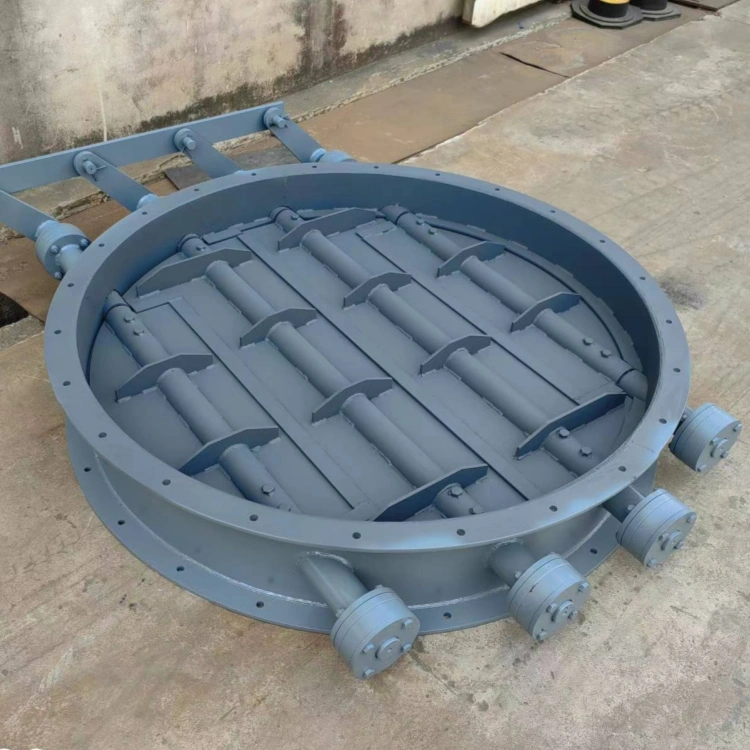
In a parallel-blade louver damper, all blades rotate in the same direction as the damper moves between open and closed positions. This arrangement changes the effective flow area across the duct and can be used to regulate airflow in large ventilation, process-air, exhaust, and dust-collection systems.
The resulting airflow pattern depends on more than blade arrangement alone. Blade geometry, duct dimensions, inlet velocity, upstream elbows or transitions, installation position, and the degree of opening can all influence local velocity distribution and pressure loss. For this reason, a parallel-blade damper should not be assumed to produce uniform airflow under every operating condition.
For industrial airflow-control applications, the damper should be evaluated as part of the complete duct system. Where required by a specific project, other blade arrangements can also be considered, but the appropriate design depends on the airflow objective and installation conditions.
Airflow Distribution in Large Industrial Ducts
Airflow through a large industrial duct is rarely perfectly uniform before it reaches a louver damper. Upstream elbows, reducers, branches, fans, and other duct components can create uneven velocity profiles or localized turbulence. These conditions affect how air passes through the damper and can influence both pressure loss and downstream flow distribution.
A louver damper can change the direction and resistance of the airflow as the blades move, but it should not be treated as an airflow-straightening device. The resulting flow pattern depends on blade position, inlet conditions, duct geometry, and the available straight duct length upstream and downstream of the damper.
Where stable downstream airflow distribution is important, the installation layout should be considered together with the damper itself. Avoiding highly disturbed inlet conditions and allowing sufficient space around the damper can improve the predictability of airflow-control performance.
Typical Airflow-Control Applications
Louver dampers are used where airflow or gas flow must be adjusted within an industrial duct system. Their function is typically related to system balancing, process-air regulation, exhaust control, or ventilation rather than direct handling of bulk solids.
Process Air Regulation
In process-air systems, a louver damper can be used to adjust the airflow supplied to different sections of equipment or ductwork. The required blade position depends on the available fan pressure, duct resistance, and the airflow demand of the downstream process.
Exhaust Gas Control
Louver dampers can regulate exhaust or process-gas flow in ducts connected to kilns, mills, dryers, coolers, or other industrial equipment. The damper should be selected and positioned according to the gas temperature, dust loading, pressure conditions, and required operating range.
For cement-specific kiln, preheater, mill, baghouse, and cooler applications, see our damper valve applications in cement plants guide.
Dust Collection Duct Balancing
In dust collection systems, dampers may be installed in branch ducts to balance airflow between different suction points. Adjusting the resistance of individual branches can help distribute the available fan capacity according to the requirements of the overall collection system.
Cooling and Combustion Air
Where cooling air or combustion-supporting air must be distributed between different sections, louver dampers can provide adjustable resistance within the duct network. Actual airflow should still be evaluated together with fan performance and total system resistance.
Industrial Ventilation
In large ventilation ducts, louver dampers can be used to regulate or restrict airflow between different zones or process areas. Installation layout and upstream airflow conditions can significantly affect the resulting pressure loss and downstream flow distribution.
Installation Factors That Affect Airflow Performance
The airflow performance of a louver damper is influenced not only by the damper itself but also by its position within the duct system. Upstream elbows, reducers, branch connections, fan outlets, and other fittings can create uneven velocity profiles before the air reaches the blades.
Installing a damper immediately downstream of a highly disturbed flow region may increase turbulence and make pressure-loss or airflow response less predictable. Where possible, the damper should be located in a section of duct with reasonably stable inlet conditions and sufficient access for inspection, linkage adjustment, and maintenance.
The downstream layout also matters. Sudden transitions, closely spaced elbows, or branch connections can interact with the flow leaving the damper and affect pressure distribution through the system. For large industrial ducts, the complete installation arrangement should therefore be reviewed together rather than treating the damper as an isolated component.
Duct Size and Velocity
Higher duct velocity generally increases the significance of pressure loss across airflow-control components. Damper size should therefore be considered together with the expected airflow rate and operating velocity rather than selected from duct dimensions alone.
Access for Inspection and Adjustment
The installation should allow access to the shaft, linkage, actuator connection, and blade area where practical. Restricted access can make inspection, alignment checks, and maintenance more difficult over the service life of the damper.
When a Louver Damper Is Used Instead of a Butterfly Damper
Louver and butterfly dampers use different blade arrangements, so their airflow characteristics and installation requirements are not identical. A louver damper is often considered for larger duct sections or applications where multi-blade airflow regulation is preferred, while a butterfly damper uses a single rotating blade and may be more suitable for other duct sizes, layouts, or operating conditions.
The appropriate choice depends on factors such as duct dimensions, required airflow range, pressure conditions, available installation space, leakage requirements, temperature, and actuation method. Neither design should be treated as universally superior.
For a detailed comparison of structure, airflow behavior, applications, and selection factors, see our Butterfly Damper vs Louver Damper guide.
Blade Positioning and Actuation
Stable airflow regulation depends on consistent blade positioning. If the blades, shafts, or linkage do not move together as intended, the actual flow area may differ from the commanded damper position, making airflow response less repeatable.
Manual, pneumatic, or electric actuation can all be used depending on the operating requirements of the system. For modulating airflow control, the actuator and linkage should provide sufficiently consistent positioning across the required operating range.
For details on electric actuators, linkage, position feedback, torque selection, fail position, and PLC/DCS integration, see our Electric Louver Damper guide.
Conclusion
Effective louver damper airflow control depends on more than blade position alone. Pressure drop, fan performance, duct resistance, airflow distribution, installation layout, and blade synchronization all influence how the damper performs within the complete duct system.
For industrial applications, the damper should therefore be evaluated as part of the overall airflow system rather than as an isolated component. Matching the blade arrangement, operating range, actuation, and installation conditions to the actual duct and fan characteristics helps achieve more predictable and stable airflow regulation.
FAQs About Louver Damper Airflow Control
Can a louver damper be retrofitted into an existing duct system?
Yes, provided the existing duct dimensions, available installation space, operating conditions, and structural arrangement are suitable. The retrofit should also allow sufficient access for the shaft, linkage, actuator connection, and future maintenance.
What can cause unstable airflow after a louver damper is adjusted?
Unstable airflow may result from disturbed inlet conditions, changing fan operation, excessive system resistance, blade or linkage movement, or changes elsewhere in the duct network. The damper position alone should not be assumed to be the cause.
How can dust buildup affect louver damper operation?
Dust accumulation around blades, shafts, or linkage components can increase operating resistance and may prevent the blades from reaching the intended position. In dust-laden applications, periodic inspection and cleaning should therefore be considered as part of routine maintenance.
Can a louver damper be used for complete airflow isolation?
A louver damper can substantially restrict airflow, but it should not automatically be considered airtight. Closed-position leakage depends on blade clearances, seals, frame design, shaft sealing, pressure conditions, temperature, and installation alignment.
What should be checked if the blades do not move evenly?
Check the blade shafts, linkage connections, bearings, actuator connection, alignment, and any material buildup that may restrict movement. Uneven blade movement can change the effective flow area and reduce the repeatability of airflow regulation.
What information is useful when evaluating an existing louver damper installation?
Useful information includes duct dimensions, airflow rate, operating temperature, system pressure, fan data, dust or gas conditions, damper location, nearby duct fittings, blade arrangement, and the current control method.
Need Help Evaluating Airflow Control in Your Duct System?
If you are evaluating a louver damper for industrial airflow regulation, please provide the main operating and duct-system data, including:
- Duct width and height or diameter
- Required airflow rate
- Operating temperature
- System pressure or available fan pressure
- Dust concentration or gas conditions
- Installation position and surrounding duct layout
- Required control method, if known
Based on these conditions, LVRUI can help review the damper arrangement, blade configuration, actuation requirements, and installation considerations for the intended airflow-control duty.
Email: info@lvrui-conveyor.com
WhatsApp / WeChat: +86-18261998937